Viewing archive of Friday, 7 November 2014
Select the desired archive item
Reports
Solar activity
Auroral activity
X1.6 solar flare from sunspot region 2205
Sunspot region 2205 has just produced an X1.6 (R3-strong) solar flare that peaked at 17:26 UTC. It already produced numerous M-class solar flares the past few days and now we saw it's first X-class solar flare! SDO imagery suggests this solar flare is eruptive and that it likely launched a coronal mass ejection (CME) despite it being a relatively impulsive solar flare. Type II and IV radio sweeps were reported which also indicate the launch of a CME.
Sunspot region 2205, SDO is back
Solar activity is at moderate levels since our last update with three R1-minor events, all from sunspot region 2205: M2.7 at 02:49 UTC, M2.0 at 04:25 UTC and at 10:22 UTC we saw an M1.0 solar flare. Numerous coronal mass ejections were observed over the past 48 hours including some from sunspot region 2205 but none of them were earth-directed. LASCO data is not fully available yet to analyse the three M-class from today but we do not expect that they launched any earth-directed coronal mass ejections. We are also happy to tell you that we are receiving up-to-date data again from the NASA Solar Dynamics Observatory and this means we can take a closer look at sunspot region 2205 and see what more we can expect from it.
Latest news

X1.5 solar flare

M2.7 solar flare, CME arrival possible
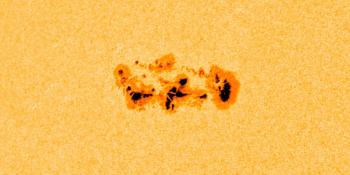
Complex sunspot region 4366
Latest forum messages
More topicsSupport SpaceWeatherLive.com!
A lot of people come to SpaceWeatherLive to follow the Solar activity or if there is a chance to see the aurora, but with more traffic comes higher costs to keep the servers online. If you like SpaceWeatherLive and want to support the project you can choose a subscription for an ad-free site or consider a donation. With your help we can keep SpaceWeatherLive online!



Space weather facts
| Last X-flare | 2026/03/30 | X1.5 |
| Last M-flare | 2026/04/09 | M1.0 |
| Last geomagnetic storm | 2026/04/03 | Kp7- (G3) |
| Spotless days | |
|---|---|
| Last 365 days | 3 days |
| 2026 | 3 days (3%) |
| Last spotless day | 2026/02/24 |
| Monthly mean Sunspot Number | |
|---|---|
| March 2026 | 85.9 +7.7 |
| April 2026 | 85.9 -0 |
| Last 30 days | 92.1 +30.2 |