Slow earth-bound coronal mass ejection
Monday, 18 July 2016 18:51 UTC
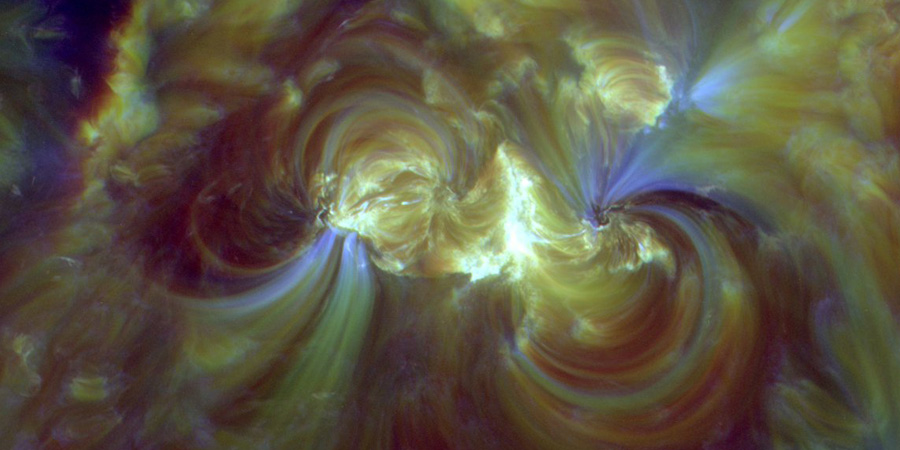
A long duration C1 solar flare from sunspot regions 2565/2567 peaked yesterday around 08:00 UTC. It was responsible for a faint coronal mass ejection that likely has an earth-directed component.
A clear shock arrival should not be expected due to the slow speed (about 300~350 km/s) of this coronal mass ejection. The plasma cloud travels at a similar speed as the background solar wind and this makes it harder to detect but an increase in the strength of the IMF should become noticable when the cloud passes our planet most likely on 22 July. It is hard to say what kind of geomagnetic activity we should expect as its crucial with these kind of events that the IMF (Bz) turns southward but for sky watchers at high latitudes it might pay off to stay alert in the days ahead.
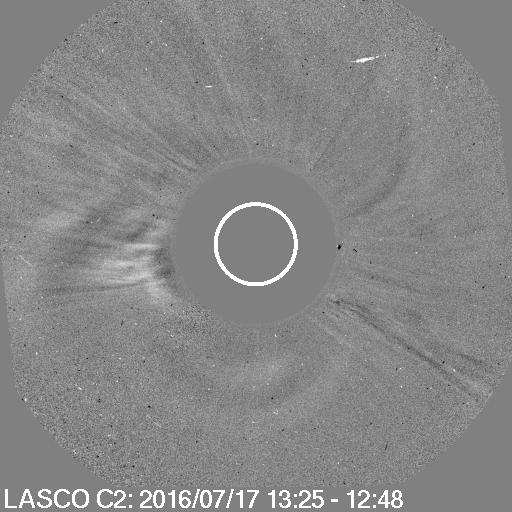
Image: It isn't easy to spot but sharp eyes can see the outline of a faint coronal mass ejection with an earth-directed component on this image from SOHO/LASCO.
A C4.4 solar flare that peaked today at 08:23 UTC was associated with a Type IV radio sweep but it does not look like it launched a coronal mass ejection.
Thank you for reading this article! Did you have any trouble with the technical terms used in this article? Our help section is the place to be where you can find in-depth articles, a FAQ and a list with common abbreviations. Still puzzled? Just post on our forum where we will help you the best we can!
Latest news
Coronal hole faces Earth

X1.5 solar flare

M2.7 solar flare, CME arrival possible
Latest forum messages
Support SpaceWeatherLive.com!
A lot of people come to SpaceWeatherLive to follow the Solar activity or if there is a chance to see the aurora, but with more traffic comes higher costs to keep the servers online. If you like SpaceWeatherLive and want to support the project you can choose a subscription for an ad-free site or consider a donation. With your help we can keep SpaceWeatherLive online!



Space weather facts
| Last X-flare | 2026/04/24 | X2.5 |
| Last M-flare | 2026/05/17 | M1.4 |
| Last geomagnetic storm | 2026/05/16 | Kp6- (G2) |
| Spotless days | |
|---|---|
| Last 365 days | 3 days |
| 2026 | 3 days (2%) |
| Last spotless day | 2026/02/24 |
| Monthly mean Sunspot Number | |
|---|---|
| April 2026 | 79.3 -6.6 |
| May 2026 | 90.4 +11.1 |
| Last 30 days | 100.4 +8.8 |