Quiet Sun, gusty solar wind
Tuesday, 14 October 2014 15:28 UTC

Solar activty has been very low now for a couple of days. There are only three numbered sunspot regions on the earth-facing solar disk and non of them are likely to produce a strong solar flare. That said, we do not need solar flares and coronal mass ejections for enhanced geomagnetic conditions at Earth. Coronal holes can do the same thing and the effects of such a coronal hole high speed stream is exactly what we are experiencing right now! Image: Aurora Borealis captured by Gibfoto from Tromsø, Norway.
The solar wind and IMF parameters indicate a distrubed solar wind enviroment near Earth likely thanks to coronal hole influences, perhaps from a northern hemisphere coronal hole with a small extention towards the equator, which was facing Earth on 10 October.
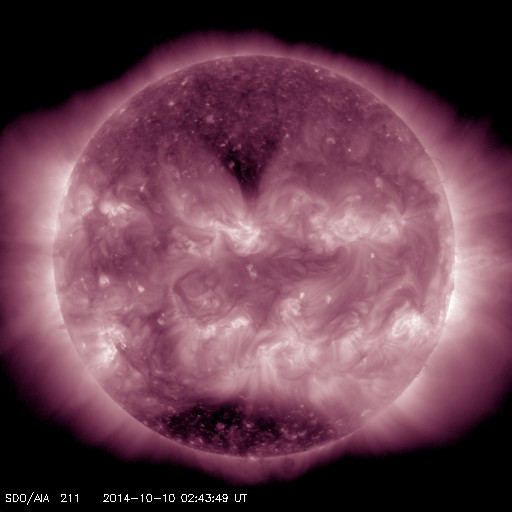
The IMF was directed mostly northward the past day but has now turned south following a solar sector boundary crossing at 12 UTC. The direction of the IMF is now holding steady near -8nT and the IMF Bt has increased to a moderate value close to 15nT. Solar wind speeds are reaching about 440km/sec and also the density of the solar wind is slightly above normal. This could be good news for sky watchers in Europe this coming evening as Kp-values of 4 (active geomagnetic conditions) are very well possible. Aurora might be seen later tonight from northern Scotland, Norway, large parts of Sweden and Finland.
Be sure to follow the activity live on our website as much can change in a short amount of time. For live alerts follow us on Twitter.
Not sure what coronal holes are? Read this help article!
Thank you for reading this article! Did you have any trouble with the technical terms used in this article? Our help section is the place to be where you can find in-depth articles, a FAQ and a list with common abbreviations. Still puzzled? Just post on our forum where we will help you the best we can!
Latest news
M8.1 solar flare with earth-directed CME
X1.9 solar flare, Coronal hole faces Earth
X4.0 solar flare
Latest forum messages
Support SpaceWeatherLive.com!
A lot of people come to SpaceWeatherLive to follow the Solar activity or if there is a chance to see the aurora, but with more traffic comes higher costs to keep the servers online. If you like SpaceWeatherLive and want to support the project you can choose a subscription for an ad-free site or consider a donation. With your help we can keep SpaceWeatherLive online!



Space weather facts
| Last X-flare | 2025/12/01 | X1.9 |
| Last M-flare | 2025/12/06 | M8.1 |
| Last geomagnetic storm | 2025/12/04 | Kp5 (G1) |
| Spotless days | |
|---|---|
| Last spotless day | 2022/06/08 |
| Monthly mean Sunspot Number | |
|---|---|
| November 2025 | 91.8 -22.8 |
| December 2025 | 167.7 +75.9 |
| Last 30 days | 107.1 +13.7 |