Affichage des archives de samedi, 4 avril 2026
Bulletin quotidien sur l'activité solaire et géomagnétique du SIDC
Publié: 2026 Apr 04 1240 UTC
Prévisions SIDC
Éruptions solaires
M-class flares expected (probability >=50%)
Géomagnétisme
Quiet (A<20 and K<4)
Moniteur de Flux de Proton
Warning condition (activity levels expected to increase, but no numeric forecast given)
| Flux de 10 cm | Ap | |
|---|---|---|
| 04 Apr 2026 | 134 | 017 |
| 05 Apr 2026 | 131 | 016 |
| 06 Apr 2026 | 128 | 010 |
Régions solaires actives et éruptions solaires
Solar flaring activity was moderate to high over the past 24 hours, with multiple M-class flares observed. The largest flare was an M7.5 flare (SIDC Flare 7328), peaking on 04 April at 01:17 UTC, originating from SIDC Sunspot Group 838 (NOAA Active Region 4409). Two additional M-class flares were recorded from the same region: an M1.7 flare (SIDC Flare 7334) peaking on 04 April at 07:58 UTC, and an M1.3 flare (SIDC Flare 7341) peaking on 03 April at 12:50 UTC. Several C-class flares were also observed. A total of seven numbered sunspot groups were present on the solar disk. SIDC Sunspot Group 838 (NOAA Active Region 4409), currently located near N02W05, exhibited a Beta-Gamma-Delta magnetic configuration and showed continued growth, remaining the most complex and active region on the disk. Solar flaring activity is expected to remained to moderate levels over the next 24 hours, with C-class flares expected and M-class flares likely, primarily from SIDC Sunspot Group 838 (NOAA Active Region 4409).
Éjection de masse coronale
A coronal mass ejections CME was observed on 02 April from SIDC Sunspot Group 835 (NOAA Active Region 4404, near N12W18), associated with an M3.5-class flare and a filament eruption occurring between approximately 16:00 and 21:00 UTC. This CME appeared narrow and was directed towards the northwest in SOHO/LASCO C2 imagery, and is not considered Earth-directed based on available observations. No additional Earth-directed coronal mass ejections were detected in available coronagraph imagery over the past 24 hours.
Trous coronaux
SIDC Coronal Hole 142 (high-latitude coronal hole with a negative polarity) first reached the central meridian on April 03 and is now positioned on the western side of the Sun.
Vent solaire
Solar wind parameters were strongly enhanced over the past 24 hours. A solar wind shock associated with the arrival of the interplanetary coronal mass ejection (SIDC CME 645) was observed on 03 April around 15:05 UTC. Solar wind speed increased abruptly from about 600 km/s to values up to approximately 850 km/s, and remained elevated thereafter, gradually decreasing to around 650-700 km/s. The interplanetary magnetic field (IMF) was enhanced, with the total field (Bt) reaching up to about 14 nT. The Bz component showed sustained variability with prolonged southward intervals reaching approximately -11 nT. These disturbed conditions occurred during the ongoing influence of a high-speed solar wind stream (HSS) originating from SIDC Coronal Hole 149 (an equatorial coronal hole with negative polarity that crossed the central meridian on 30 March). Solar wind conditions are expected to remain enhanced over the next 24 hours, with continued HSS influence and gradually declining ICME effects.
Géomagnétisme
Geomagnetic conditions ranged from active to strong storm levels over the past 24 hours. Following the shock arrival in the solar wind condition, the global NOAA Kp index reached up to 7 (strong storm levels), while the local K index (Belgium) reached up to K=6 (moderate storm levels). The geomagnetic activity was driven by the combined effects of the ICME impact (SIDC CME 645) and the ongoing high-speed solar wind stream from SIDC Coronal Hole 149, together with sustained southward IMF conditions. Geomagnetic activity gradually decreased after the main phase, returning to unsettled to active levels towards the end of the period. Geomagnetic conditions are expected to remain unsettled to active over the next 24 hours, with possible isolated minor storm intervals depending on the evolution of the IMF Bz component.
Niveaux de flux de protons
The greater than 10 MeV proton flux remained below the event threshold (10 pfu) over the past 24 hours, with values generally below 7 pfu and showing a gradual decrease towards the end of the period. No proton event was observed. Higher energy channels (greater than 100 MeV and greater than 500 MeV) remained at background levels. STEREO-A (currently located at approximately 54 degrees longitude) also shows elevated proton flux, supporting the interpretation of a weak and likely far-sided source. The greater than 10 MeV proton flux is expected to remain below the event threshold over the next 24 hours. Further minor variations cannot be excluded, particularly due to the enhanced flaring activity currently ongoing from the complex region SIDC Sunspot Group 838 (NOAA Active Region 4409).
Flux d'électrons sur l'orbite géostationnaire
The greater than 2 MeV electron flux showed an initial enhancement to moderate levels, followed by a decrease to low levels around 04 April 02:00-04:00 UTC, likely associated with the main phase of the geomagnetic storm and magnetospheric depletion. A gradual recovery was observed thereafter, with fluxes returning to moderate levels and approaching the high flux threshold towards the end of the period. The 24-hour fluence remained at moderate levels throughout. Electron fluxes are expected to continue increasing over the next 24-48 hours due to the ongoing influence of the high-speed solar wind stream associated with SIDC Coronal Hole 149. High flux levels may be reached, with a corresponding increase in the fluence.
Estimation du nombre international de taches solaires (ISN) pour aujourd'hui : 117, sur la base de 15 stations.Indices solaires pour 03 Apr 2026
| Nombre de Wolf, observé par Catania | /// |
| Flux solaire à 10 cm | 136 |
| AK Chambon La Forêt | 062 |
| AK Wingst | 041 |
| Ap estimé | 045 |
| Nombre international de taches solaires estimé | 131 - Basé sur 17 stations |
Résumé des événements marquants
| Jour | Commencer | Max | Fin | Loc | Force | OP | 10cm | Catania/NOAA | Types de sursaut radio |
|---|---|---|---|---|---|---|---|---|---|
| 03 | 1246 | 1250 | 1252 | ---- | M1.3 | --/---- | |||
| 04 | 0107 | 0117 | 0123 | ---- | M7.5 | 73/4409 | |||
| 04 | 0738 | 0758 | 0814 | N02W07 | M1.7 | SF | 73/4409 |
Données fournies par le Solar Influences Data analysis Center© - SIDC - Traité par SpaceWeatherLive
Toutes les heures sont indiquées en UTC
Dernières nouvelles
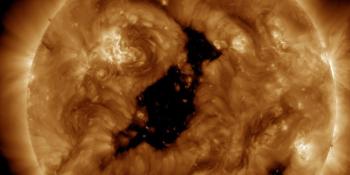
Coronal hole faces Earth

X1.5 solar flare

M2.7 solar flare, CME arrival possible
Aidez SpaceWeatherLive.com !
De nombreuses personnes consultent SpaceWeatherLive pour suivre l'activité solaire ou observer les aurores boréales, mais l'augmentation du trafic engendre des coûts plus élevés pour maintenir les serveurs en ligne. Si vous appréciez SpaceWeatherLive et souhaitez soutenir le projet, vous pouvez vous abonner pour un site sans publicité ou faire un don. Grâce à votre aide, SpaceWeatherLive restera accessible !



La Météo Spatiale en faits
| Dernière classe X | 24/04/2026 | X2.5 |
| Dernière classe M | 22/05/2026 | M2.3 |
| Dernier orage géomagnétique | 16/05/2026 | Kp6- (G2) |
| Jours sans taches solaires | |
|---|---|
| 365 derniers jours | 3 jours |
| 2026 | 3 jours (2%) |
| Dernier jour sans taches solaires | 24/02/2026 |
| Nombre mensuel moyen de taches solaires | |
|---|---|
| avril 2026 | 79.3 -6.6 |
| mai 2026 | 87.5 +8.2 |
| 30 derniers jours | 96 +3.9 |