Kosmoseilma ennustuse alane diskusioon
Välja antud: 2026 May 14 1230 UTC
Koostanud Ameerika Ühendriikide kaubandusosakond, NOAA, kosmoseilma prognoosikeskus (SWPC) ja töödeldud SpaceWeatherLive.com-i poolt
Päikese aktiivsus
24 h summaarne
Solar activity remained at low levels, with four active regions on disk and only C-class level activity. Region 4435 (N21W60, Csi/beta) was the only region that showed some growth during the period and was responsible for the most of the C-class flares of 14 May, including the largest event: a C5.5/Sf peaking at 14/0642 UTC. Region 4436 (N18E08, Cao/beta) was the source of three minor C-class flares that happened between 13/1630-1830 UTC. Region 4432 (N14 L=83), that is beyond the west limb, was likely the source of two C-class flares (C1.4 at 13/1948 UTC, and C1.6 at 14/0212 UTC) and a CME first seeing at LASCO/C2 coronagraph at 13/2300 UTC, with no Earth-directed component. No Earth-directed CMEs were observed in available coronagraph imagery.Ennustus
Solar activity is expected to remain predominately at low levels with a chance for M-class (R1-R2/Minor-Moderate) flares through 16 May.Energeetilised osakesed
24 h summaarne
The greater than 2 MeV electron flux was at normal to moderate levels. The greater than 10 MeV proton flux was at background levels.Ennustus
The greater than 2 MeV electron flux is expected to remain at moderate levels through 16 May. The greater than 10 MeV proton flux is expected to stay at background levels through 16 May.Päikese tuul
24 h summaarne
The solar wind parameters reflected the waning effects of a positive polarity CH HSS combined with a glancing blow of a CME that left the Sun on 10 May. The total magnetic field strength decreased from 13 nT to 5nT levels. The speeds also slowly dropped from about 500 km/s to 400 km/s levels by the end of the period. The north-south Bz component reduced the amplitude of its oscillation to +- 5 nT and the Phi angle remained predominantly positive.Ennustus
Solar wind parameters near Earth are expected to continue reflecting the waning influences of the + CH HSS through the end of the 14 May UTC-day. On 15-16 May, a CIR associated with a negative polarity CH HSS is anticipated impact Earth, likely resulting in more disturbed solar wind conditions.Georuum
24 h summaarne
The geomagnetic field was quiet to unsettled during the period.Ennustus
The geomagnetic field activity might reach active conditions on 14 May, if a sustained negative Bz period occurs. G2 (Moderate) storming conditions are likely on 15 May due to the anticipated impact of a CIR associated with a negative polarity CH HSS. Active to G1 (Minor) storm levels are likely to prevail on 16 May due to lingering CH HSS influences.Viimane uudis
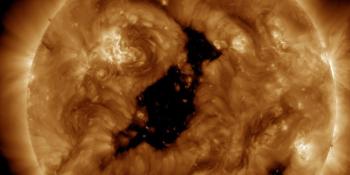
kolmapäev, 13 mai 2026
Coronal hole faces Earth

esmaspäev, 30 märts 2026
X1.5 solar flare

teisipäev, 17 märts 2026
M2.7 solar flare, CME arrival possible
Viimane foorumi postitus
AR4435 2Current Farside Activity 482AR4436 152Incoming & Unnumbered Active Regions 374Unspecified geomagnetic activity 248
Veel teemasidToeta SpaceWeatherLive.com-i!
Paljud inimesed tulevad SpaceWeatherLive veebilehele jälgima päikese aktiivsust või kui on võimalus näha virmalisi. Kuid suurema võrguliiklusega kaasnevad ka serverite suuremad võrgus hoidmise kulud. Kui teile meeldib SpaceWeatherLive ja soovite projekti toetada, saate valida reklaamivaba tellimuse või kaaluda annetamist. Teie abiga saame SpaceWeatherLive'i võrgus hoida!



Fakte kosmose ilmast
| Viimane X-loide | 24/04/2026 | X2.5 |
| Viimane M-loide | 10/05/2026 | M5.7 |
| Viimane geomagnetiline torm | 05/05/2026 | Kp5 (G1) |
| Plekivabasid päevi | |
|---|---|
| Viimased 365 päeva | 3 päeva |
| 2026 | 3 päeva (2%) |
| Viimane päikese plekivaba päev | 24/02/2026 |
| Kuu keskmine päikeseplekkide arv | |
|---|---|
| aprill 2026 | 79.3 -6.6 |
| mai 2026 | 99.5 +20.2 |
| Viimased 30 päeva | 94.9 +1.3 |
See päev ajaloos*
Virmalised sel päeval ajaloos
Selle päeva kohta ajaloos pole ühtegi vaatlust esitatud. Kui oled virmalisi vaadelnud ja sul on uhkeid fotosid sellest mida näidata, siis esita oma ülesvõtted kohe!
Esita oma virmaliste vaatlus