Affichage des archives de dimanche, 9 mars 2014
Bulletin quotidien sur l'activité solaire et géomagnétique du SIDC
Publié: 2014 Mar 09 1229 UTC
Prévisions SIDC
Éruptions solaires
Eruptive (C-class flares expected, probability >=50%)
Géomagnétisme
Active conditions expected (A>=20 or K=4)
Moniteur de Flux de Proton
Quiet
| Flux de 10 cm | Ap | |
|---|---|---|
| 09 Mar 2014 | 142 | 010 |
| 10 Mar 2014 | 140 | 009 |
| 11 Mar 2014 | 140 | 004 |
Bulletin
There are currently 7 sunspot groups visible. They are small and stable, except for NOAA 1996 and NOAA 2002 who gradually gained some sunspot area and developed a small delta in their middle portion. Most flaring activity came from NOAA 2002, with at least 7 C-class flares and one M1-flare peaking at 23:41UT, the strongest event of the period. Based on the currently available imagery, none of the observed CMEs has an Earth directed component. The CME first visible in LASCO/C2 at 18:24UT on 8 March seems to be related to a backside event (coronal dimming near an active region). Eruptive flaring conditions are expected, with a small chance for an M-class flare. Over the last 24 hours, solar wind speed has gradually decreased to values near 350km/s, with Bz varying between -3nT and +3nT. A small coronal hole on the southern hemisphere reached the central meridian (CM) and may have a geomagnetic influence on 12-13 March. Geomagnetic conditions have been quiet. The coronal hole solar wind stream (CM passage 5 March) has not arrived yet. A local active geomagnetic episode remains possible.
Estimation du nombre international de taches solaires (ISN) pour aujourd'hui : 083, sur la base de 16 stations.Indices solaires pour 08 Mar 2014
| Nombre de Wolf, observé par Catania | /// |
| Flux solaire à 10 cm | /// |
| AK Chambon La Forêt | /// |
| AK Wingst | 004 |
| Ap estimé | 003 |
| Nombre international de taches solaires estimé | 084 - Basé sur 22 stations |
Résumé des événements marquants
| Jour | Commencer | Max | Fin | Loc | Force | OP | 10cm | Catania/NOAA | Types de sursaut radio |
|---|---|---|---|---|---|---|---|---|---|
| 08 | 2326 | 2341 | 2350 | ---- | M1.4 | --/2002 |
Données fournies par le Solar Influences Data analysis Center© - SIDC - Traité par SpaceWeatherLive
Toutes les heures sont indiquées en UTC
Dernières nouvelles
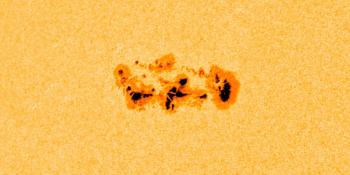
Complex sunspot region 4366

CME impact! S4 solar radiation storm

X1.9 solar flare with earth-directed CME
Forum
Aidez SpaceWeatherLive.com !
De nombreuses personnes consultent SpaceWeatherLive pour suivre l'activité solaire ou observer les aurores boréales, mais l'augmentation du trafic engendre des coûts plus élevés pour maintenir les serveurs en ligne. Si vous appréciez SpaceWeatherLive et souhaitez soutenir le projet, vous pouvez vous abonner pour un site sans publicité ou faire un don. Grâce à votre aide, SpaceWeatherLive restera accessible !



La Météo Spatiale en faits
| Dernière classe X | 04/02/2026 | X4.21 |
| Dernière classe M | 25/02/2026 | M2.4 |
| Dernier orage géomagnétique | 03/03/2026 | Kp5 (G1) |
| Jours sans taches solaires | |
|---|---|
| 365 derniers jours | 3 jours |
| 2026 | 3 jours (4%) |
| Dernier jour sans taches solaires | 24/02/2026 |
| Nombre mensuel moyen de taches solaires | |
|---|---|
| février 2026 | 78.2 -34.3 |
| mars 2026 | 78.5 +0.3 |
| 30 derniers jours | 54.3 -74.5 |