Affichage des archives de dimanche, 26 octobre 2014
Choisissez l'archive désirée
Rapports
Activité solaire
Activité aurorale
Evolution of sunspot region 2192
Solar activity is at high levels. We already saw an X2 solar flare today from sunspot region 2192 but this sunspot region continues to be active and is now firing M-class solar flares on a regular basis. The X2 solar flare from today unfortunately did not release a coronal mass ejection. In this article we take a look how sunspot region 2192 is developing. Our header image was taken by Sajad Sayadi on October 23, 2014 at Fasa/Fars/Iran. He captured this picture of our nearest star at sunset with a great view of sunspot region 2192. He captured this shot from the Observatory & Scietific Center of Fasa (OSCF) in south Iran with a 14 inch telescope. Stunning work!
X2.0 solar flare from sunspot region 2192
...and that is number five! Sunspot region 2192 again produced a major solar flare: X2.01 (R3-strong radio blackout) at 10:56 UTC. This was already it's fifth X-class solar flare and the 13th strongest solar flare of this solar cycle... however... just like all the other X-class solar flares that we have previously seen from this sunspot region... it again looks like it did not launch a coronal mass ejection.
Dernières nouvelles
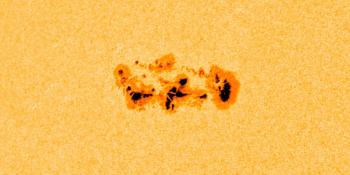
Complex sunspot region 4366

CME impact! S4 solar radiation storm

X1.9 solar flare with earth-directed CME
Forum
Aidez SpaceWeatherLive.com !
De nombreuses personnes consultent SpaceWeatherLive pour suivre l'activité solaire ou observer les aurores boréales, mais l'augmentation du trafic engendre des coûts plus élevés pour maintenir les serveurs en ligne. Si vous appréciez SpaceWeatherLive et souhaitez soutenir le projet, vous pouvez vous abonner pour un site sans publicité ou faire un don. Grâce à votre aide, SpaceWeatherLive restera accessible !



La Météo Spatiale en faits
| Dernière classe X | 04/02/2026 | X4.21 |
| Dernière classe M | 25/02/2026 | M2.4 |
| Dernier orage géomagnétique | 03/03/2026 | Kp5 (G1) |
| Jours sans taches solaires | |
|---|---|
| 365 derniers jours | 3 jours |
| 2026 | 3 jours (5%) |
| Dernier jour sans taches solaires | 24/02/2026 |
| Nombre mensuel moyen de taches solaires | |
|---|---|
| février 2026 | 78.2 -34.3 |
| mars 2026 | 75 -3.2 |
| 30 derniers jours | 57.2 -67.7 |