Bulletins prévisionnels de la Météo Spatiale
Publié: 2026 Jun 15 1230 UTC
Préparés par le Département américain du Commerce, la NOAA, le Centre de Prévision de la Météo spatiale et traités par SpaceWeatherLive.com
Activité solaire
Résumé des dernières 24 heures
Solar activity was at low levels. Only low-level C-class activity was observed. Region 4465 (N08W17, Dai/beta) exhibited minor growth, while the three remaining regions were either stable or in decay. No Earth-directed CMEs were observed in available coronagraph imagery.Prévisions
Solar activity is expected to remain at low levels over 15-17 Jun, with a slight chance for M-class (R1-R2/Minor-Moderate) flares.Particules énergétiques
Résumé des dernières 24 heures
The greater than 2 MeV electron flux reached high levels, with peak values observed at 1,581 pfu. The greater than 10 MeV proton flux remained at background levels.Prévisions
The greater than 2 MeV electron flux is likely to reach high levels on 15-17 Jun. The greater than 10 MeV proton flux is expected to continue at background levels through 17 Jun.Vent Solaire
Résumé des dernières 24 heures
Solar wind parameters reflected the waning influences of a negative polarity coronal hole. Total magnetic field strength averaged ~4 nT. No significant periods of southward Bz were observed. Solar wind speeds gradually declined from ~500 km/s to ~425 km/s over the past 24 hours. Phi angle was predominantly oriented in the negative solar sector.Prévisions
The solar wind environment is expected to be enhanced on 16-17 Jun due to the anticipated glancing-blow arrival of a CME that left the Sun on 12 Jun, followed by the onset of positive polarity CH HSS influences.Géospatial
Résumé des dernières 24 heures
The geomagnetic field was at quiet levels.Prévisions
The geomagnetic field is expected to continue at quiet levels on 15 Jun. Periods of active conditions are likely on 16 Jun due to the anticipated glancing-blow arrival of a CME that left the Sun on 12 Jun. Quiet to unsettled levels are expected on 17 Jun due to waning CME influences and the onset of positive polarity CH HSS influences.Dernières nouvelles
jeudi, 4 juin 2026
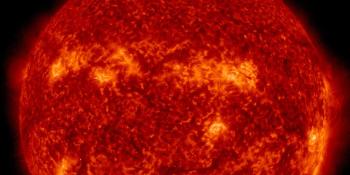
G3 geomagnetic storm watch for 4 and 5 June
mercredi, 13 mai 2026
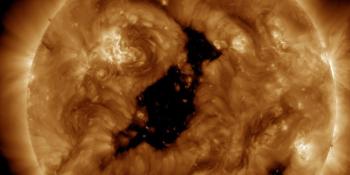
Coronal hole faces Earth

lundi, 30 mars 2026
X1.5 solar flare
Forum
Current Farside Activity 636Filaments and prominences 566Incoming & Unnumbered Active Regions 473AR4465 56Unspecified geomagnetic activity 312
Plus de messages du forumAidez SpaceWeatherLive.com !
De nombreuses personnes consultent SpaceWeatherLive pour suivre l'activité solaire ou observer les aurores boréales, mais l'augmentation du trafic engendre des coûts plus élevés pour maintenir les serveurs en ligne. Si vous appréciez SpaceWeatherLive et souhaitez soutenir le projet, vous pouvez vous abonner pour un site sans publicité ou faire un don. Grâce à votre aide, SpaceWeatherLive restera accessible !



La Météo Spatiale en faits
| Dernière classe X | 03/06/2026 | X1.0 |
| Dernière classe M | 06/06/2026 | M1.8 |
| Dernier orage géomagnétique | 11/06/2026 | Kp5 (G1) |
| Jours sans taches solaires | |
|---|---|
| 365 derniers jours | 3 jours |
| 2026 | 3 jours (2%) |
| Dernier jour sans taches solaires | 24/02/2026 |
| Nombre mensuel moyen de taches solaires | |
|---|---|
| mai 2026 | 101.4 +22.1 |
| juin 2026 | 116.7 +15.3 |
| 30 derniers jours | 110.6 +17.2 |
A ce jour dans l'histoire*
Aurora on this day in history
No observations submitted for this day in history. If you've observed the aurora and you have some amazing photos to show off, submit your observations now!
Submit your aurora observation