Affichage des archives de jeudi, 22 février 2024
Choisissez l'archive désirée
Rapports
Activité solaire
Activité aurorale
X6.3 solar flare
Sunspot region 3590 does it again! It's third X-class soalr flare and the strongest solar flare of the currently Solar Cycle thus far peaking at a respectable value of X6.3 (R3-strong).
Did space weather really knock out cell phone service in North America?
It's a hot topic today... North America woke up this morning with nationwide cell phone outage for AT&T. Is this caused by the two X-class solar flares from sunspot region 3590? A lot of people seem to think that is the case but this is completely false. Christian Harris from Space Weather Trackers made a great post explaining why space weather is not to blame for this outage. Correlation is not causation. Read his post below!
Two X-class solar flares only 7 hours apart
Sunspot region 3590 which is located at a fairly high latitude produced two impulsive X-class events. The first solar flare peaked yesterday at 23:07 UTC with a maximum X-ray flux of X1.9 and the second solar flare peaked today at 06:32 with a maximum observed X-ray flux of X1.7. Both events caused a brief strong R3 radio blackout at the day-side of our planet.
Dernières nouvelles

X1.5 solar flare

M2.7 solar flare, CME arrival possible
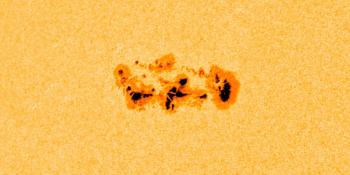
Complex sunspot region 4366
Forum
Aidez SpaceWeatherLive.com !
De nombreuses personnes consultent SpaceWeatherLive pour suivre l'activité solaire ou observer les aurores boréales, mais l'augmentation du trafic engendre des coûts plus élevés pour maintenir les serveurs en ligne. Si vous appréciez SpaceWeatherLive et souhaitez soutenir le projet, vous pouvez vous abonner pour un site sans publicité ou faire un don. Grâce à votre aide, SpaceWeatherLive restera accessible !



La Météo Spatiale en faits
| Dernière classe X | 30/03/2026 | X1.5 |
| Dernière classe M | 09/04/2026 | M1.0 |
| Dernier orage géomagnétique | 03/04/2026 | Kp7- (G3) |
| Jours sans taches solaires | |
|---|---|
| 365 derniers jours | 3 jours |
| 2026 | 3 jours (3%) |
| Dernier jour sans taches solaires | 24/02/2026 |
| Nombre mensuel moyen de taches solaires | |
|---|---|
| mars 2026 | 85.9 +7.7 |
| avril 2026 | 94.2 +8.3 |
| 30 derniers jours | 94.7 +35.4 |