Pogoda kosmiczna - Dyskusja
Odnotowany: 2026 May 19 1230 UTC
Przygotowane przez Departament do Spraw Komercjalizacji USA, NOAA, Centrum Prognozowania Pogody Kosmicznej (SWPC) i przetworzony przez SpaceWeatherLive.com
Aktywność słoneczna
Podsumowanie dobowe
Solar activity continued at low levels. The largest event of the period was a C2.1/sf flare at 19/0740 UTC from Region 4436 (N19W59, Hsx/alpha). This region was responsible for the vast majority of the otherwise occasional low-level B-class flaring observed throughout the period. There are currently four numbered regions on the visible disk, nearly all of which exhibited steady signs of decay and simplification. Region 4436 remained mostly stable, though it produced short-lived, transitory trailing pores. Region 4439 (N06E42, Dao/beta) underwent penumbral decay alongside flux submergence in its trailing spots. Region 4440 (N17E42, Hrx/alpha) showed a slight reduction in its overall penumbral extent. Region 4441 (N08W01, Dao/beta) was mostly stable in both area and magnetic complexity, despite some localized flux emergence. No Earth-directed CMEs were observed in available coronagraph imagery.Prognoza
Solar activity is expected to be at low levels through 21 May, with a chance for isolated M-class flares (R1-R2/Minor-Moderate). This flare potential is driven primarily by the complexity of Region 4441 and the recent eruptive trends of Region 4436.Cząsteczki energetyczne
Podsumowanie dobowe
The greater than 2 MeV electron flux at geosynchronous orbit remained at high levels, reaching a peak flux of 6,667 pfu observed at 18/1435 UTC. The greater than 10 MeV proton flux at geosynchronous orbit remained at background levels.Prognoza
The greater than 2 MeV electron flux is expected to drop to normal to moderate levels 19-20 May as high-speed stream influences continue to wane, likely returning to moderate to high levels on 21 May. The greater than 10 MeV proton flux is expected to remain at baseline background levels through 21 May.Wiatr słoneczny
Podsumowanie dobowe
Solar wind parameters reflected a very gradual decline back toward nominal conditions under the waning influence of a negative polarity coronal hole high-speed stream (-CH HSS), until shortly after 19/0600 UTC, when a weak shock occurred. Total field increased from 5 to 8 nT and Bz was +/- 8 nT. Phi remained mostly negative. Solar wind speeds increased from about 525 to 600 km/s.Prognoza
Solar wind parameters are expected to remain enhanced this period, with enhancements on 19 May due to glancing influences from a CME that left the Sun on 16 May event. Conditions are expected to become mildly enhanced again on 21 May from a solar sector boundary crossing ahead of an approaching positive polarity coronal hole high-speed stream (+CH HSS).Geoprzestrzeń
Podsumowanie dobowe
The geomagnetic field reached active levels late in the period after a weak shock enhancement.Prognoza
Isolated periods of up to G1 (Minor) geomagnetic storming are anticipated on 19 May due to glancing influences from the 16 May CME. The geomagnetic field is expected to return to quiet to unsettled levels on 20 and 21 May, due to lingering CME effects on 20 May and a projected solar sector boundary crossing on 21 May.Najnowsze wiadomości
środa, 13 maja 2026
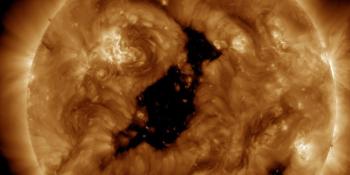
Coronal hole faces Earth

poniedziałek, 30 marca 2026
X1.5 solar flare

wtorek, 17 marca 2026
M2.7 solar flare, CME arrival possible
Najnowsze wiadomości z forum
Current Farside Activity 562Unspecified geomagnetic activity 250SWPC Display bug or other issues 40Coronal Hole 53 100AR4436 225
Więcej tematówWesprzyj SpaceWeatherLive.com!
Wiele ludzi odwiedza stronę SpaceWeatherLive, aby śledzić aktywność słońca lub czy jest szansa na zobaczenie zorzy, ale większy ruch powoduje większe koszty utrzymania serwerów. Jeżeli podoba ci się strona SpaceWeatherLive i chciałbyś/chciałabyś wesprzeć ten projekt to możesz kupić subskrypcje aby uzyskać dostęp do strony bez reklam lub kupić darowiznę. Dzięki waszej pomocy, pomagacie utrzymać serwery SpaceWeatherLive!



Fakty na temat pogody kosmicznej
| Ostatnie rozbłyski klasy X | 2026/04/24 | X2.5 |
| Ostatnie rozbłyski klasy M | 2026/05/17 | M1.4 |
| Ostatnia burza geomagnetyczna | 2026/05/16 | Kp6- (G2) |
| Dni bez plam słonecznych | |
|---|---|
| Ostatnie 365 dni | 3 Dni |
| 2026 | 3 Dni (2%) |
| Ostatni dzień bez plamy słonecznej | 2026/02/24 |
| Średnia miesięczna liczba plam słonecznych | |
|---|---|
| kwietnia 2026 | 79.3 -6.6 |
| maja 2026 | 91.4 +12.1 |
| Ostatnie 30 dni | 98.4 +8 |
Ten dzień w przeszłości*
Historia obserwacji zorzy polarnej dla wybranej daty
Jak dotąd nie nadesłano obserwacji zorzowych dla tej daty. Jeśli zaobserwowałeś zorzę polarną i masz niepowtarzalne zdjęcia, prześlij nam swoje obserwacje!
Prześlij własną obserwację zorzy polarnej