Viendo archivo del viernes, 24 octubre 2014
Seleccionar la opción de archivo deseado
Informes
Actividad solar
Actividad auroral
X3.1 solar flare from sunspot region 2192
Sunspot region 2192 (now the largest sunspot region in 24 years) produced a major X3.19 solar flare (R3-strong radio blackout) at 21:41 UTC. This was the third and also the strongest X-class solar flare from this sunspot region and the sixth strongest solar flare of the current solar cycle.
Sunspot region 2192, eruptive M4 solar flare
Another relatively quiet day when you consider the size of sunspot region 2192, the largest sunspot region that faced Earth in 24 years! Solar activity has been moderate today with only one M-class solar flare: M4.07 (R1-minor) at 07:48 UTC. This solar flare was rather impulsive but it was eruptive for a change and it did produce a coronal mass ejection! The bad news is that sunspot region 2192 miraculously managed to send the eruption south of the Sun-Earth line. No impact at Earth is thus expected from this event. In this article we take a closer look at the M4.0 solar flare and the evolution of sunspot region 2192.
Últimas noticias
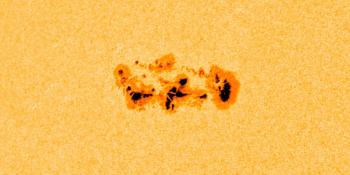
Complex sunspot region 4366

CME impact! S4 solar radiation storm

X1.9 solar flare with earth-directed CME
Últimos mensajes del foro
Apoye a SpaceWeatherLive.com!
A lot of people come to SpaceWeatherLive to follow the Solar activity or if there is a chance to see the aurora, but with more traffic comes higher costs to keep the servers online. If you like SpaceWeatherLive and want to support the project you can choose a subscription for an ad-free site or consider a donation. With your help we can keep SpaceWeatherLive online!



Hechos clima espacial
| Último evento clase X | 04/02/2026 | X4.21 |
| Último evento clase M | 13/03/2026 | M1.2 |
| Últimas tormentas geomagnéticas | 13/03/2026 | Kp6- (G2) |
| Días sin manchas | |
|---|---|
| Last 365 days | 3 días |
| 2026 | 3 días (4%) |
| Último día sin manchas | 24/02/2026 |
| Promedio de manchas solares mensuales | |
|---|---|
| febrero 2026 | 78.2 -34.3 |
| marzo 2026 | 81.7 +3.5 |
| Last 30 days | 56.5 -72 |