Space Weather Forecast - Debate
Emitido: 2026 Jun 13 0030 UTC
Preparado por el U.S. Dept. of Commerce, NOAA, Space Weather Prediction Center y procesado por SpaceWeatherLive.com
Actividad solar
Resumen 24 hr
Solar activity was at low levels. Region 4465 (N09E14, Cao/beta) produced the strongest flare of the period, a C5.2 at 12/0214 UTC. The region exhibited widespread decay over the past 24 hours. Region 4464 (S13W29, Dao/beta) saw growth in its trailer and intermediate spots. The remaining numbered spotted regions were either mostly stable or in gradual decay. Other activity included a small filament eruption that was observed near N02E40 beginning after 12/1600 UTC. Subsequent SOHO/LASCO C2 coronagraph imagery contained a CME signature towards the NE. Analysis and modeling of this event is ongoing.Predicción
Solar activity is expected to remain at low levels through 15 Jun, with a chance for M-class (R1-R2/Minor-Moderate) flares, primarily due to the potential of Regions 4464 and 4465.Partículas Energéticas
Resumen 24 hr
The greater than 2 MeV electron flux at geosynchronous orbit continued at low to moderate levels. The greater than 10 MeV proton flux remained at background levels.Predicción
The greater than 2 MeV electron flux is expected to increase to high levels over 13-14 Jun in response to high-speed stream influences. The greater than 10 MeV proton flux is expected to continue at background levels through 15 Jun.Viento Solar
Resumen 24 hr
Solar wind parameters reflected the transition from a CIR into a negative polarity CH HSS. Total magnetic field strength decreased from a peak of 15 nT at 12/0122 UTC to a steady ~5 nT by 12/0715 UTC. The Bz component briefly reached a maximum southward deflection of -10 nT during the CIR. Solar wind speeds increased from ~500 km/s during the CIR to a peak speed between 600-700 km/s over 12/0600-0900UTC. A gradual decline was observed through the remainder of the reporting period. Phi angle was predominantly oriented in the negative sector.Predicción
Solar wind enhancements, in response to -CH HSS influences, are expected to continue through 13 Jun. Further enhancements are anticipated to continue into 14 Jun, due to the anticipated arrival of combined effects from CMEs that departed the Sun on 09 and 11 Jun.Geoespacio
Resumen 24 hr
The geomagnetic field ranged from quiet to active due to the influence of a negative polarity CH HSS.Predicción
Geomagnetic field conditions are likely to reach G2 (Moderate) geomagnetic storm levels on 13 Jun due to the persistence of the high-speed stream combined with the anticipated arrival of CMEs that left the Sun over 09 Jun and 11 Jun. Conditions are expected to decrease to mostly active levels, with isolated G1 (Minor) storming periods, on 14 Jun as CME influences wane. Unsettled to active conditions are likely over 15 Jun.Últimas noticias
jueves, 4 junio 2026
G3 geomagnetic storm watch for 4 and 5 June
miércoles, 13 mayo 2026
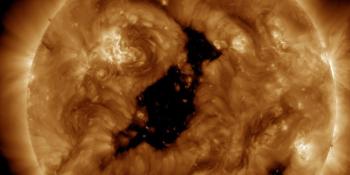
Coronal hole faces Earth

lunes, 30 marzo 2026
X1.5 solar flare
Últimos mensajes del foro
Coronal Hole 63 48Noctilucent clouds 47Unspecified geomagnetic activity 304Lack of reliability with data from SWPC 15Incoming & Unnumbered Active Regions 468
Más temasApoye a SpaceWeatherLive.com!
A lot of people come to SpaceWeatherLive to follow the Solar activity or if there is a chance to see the aurora, but with more traffic comes higher costs to keep the servers online. If you like SpaceWeatherLive and want to support the project you can choose a subscription for an ad-free site or consider a donation. With your help we can keep SpaceWeatherLive online!



Hechos clima espacial
| Último evento clase X | 03/06/2026 | X1.0 |
| Último evento clase M | 06/06/2026 | M1.8 |
| Últimas tormentas geomagnéticas | 11/06/2026 | Kp5 (G1) |
| Días sin manchas | |
|---|---|
| Last 365 days | 3 días |
| 2026 | 3 días (2%) |
| Último día sin manchas | 24/02/2026 |
| Promedio de manchas solares mensuales | |
|---|---|
| mayo 2026 | 101.4 +22.1 |
| junio 2026 | 127.7 +26.3 |
| Last 30 days | 110.7 +16.8 |
Efemérides*
Aurora on this day in history
No observations submitted for this day in history. If you've observed the aurora and you have some amazing photos to show off, submit your observations now!
Submit your aurora observation