Vaata kolmapäev, 5 veebruar 2014 arhiivi
SIDC igapäevane bülletään päikese ja geomagnetilise aktiivsuse kohta
Välja antud: 2014 Feb 05 1313 UTC
SIDC ennustus
Päikesepursked ehk loited
Active (M-class flares expected, probability >=50%)
Geomagnetism
Quiet (A<20 and K<4)
Päikese prootonid
Warning condition (activity levels expected to increase, but no numeric forecast given)
| 10 cm vool | Ap | |
|---|---|---|
| 05 Feb 2014 | 186 | 004 |
| 06 Feb 2014 | 184 | 004 |
| 07 Feb 2014 | 180 | 014 |
Bülletään
Catania sunspot group 28 (NOAA AR 1967) stopped growing, and produced only one M-class flare in the past 24 hours (M1.5 flare peaking at 16:02 UT yesterday). Catania sunspot group 27 (NOAA AR 1968) produced only C-class flares, but exhibited the emergence of new magnetic flux and new sunspots this morning. These two groups keep respectively beta-gamma-delta and beta-gamma configurations of the photospheric magnetic field. We expect further flaring activity on the C- and M-level in these two groups, with an X-class flare being possible but unlikely. Due to the position of both sunspot groups still close to the solar central meridian (around 20-30 degrees from it), a CME associated with a flare in these active regions may arrive at the Earth. A major CME in one of these sunspot groups may lead to a proton event due to their position in the western hemisphere, so we maintain the warning condition. A weak partial halo CME first appeared in the SOHO/LASCO C2 field of view at 16:36 UT yesterday. It had the angular width of around 240 degrees and the plane-of-the-sky projected speed around 500 km/s. It was associated with the above-mentioned M1.5 flare in the Catania sunspot group 28 (NOAA AR 1967), a post-eruption arcade in its western part, and weak coronal dimmings. We expect at most the arrival of the CME-driven shock wave at the Earth, on February 8, most probably without strong geomagnetic consequences (K = 4 at most). Another partial halo CME (first appearing in the LASCO C2 field of view at 19:48 UT, angular width around 130 degrees) is a far side event (with the source region around S20W170 as seen from the Earth). A narrow coronal hole extended in latitude from the equator to approximately N60 reached the solar central meridian late yesterday evening. We expect the fast flow from this coronal hole to arrive at the Earth late on February 7 (see below). The Earth is currently inside a slow (around 350 km/s) solar wind flow with anomalously high (around 10 nT) interplanetary magnetic field magnitude. The source of this high magnetic field is not clear at the moment. Due to the low solar wind speed, we expect quiet geomagnetic conditions. Late on February 7 we expect the arrival of the fast flow from the extended coronal hole (see above), resulting in active (K = 4) geomagnetic conditions.
Tänane hinnanguline rahvusvaheline päikeselaikude arv (ISN): 122, põhineb 15 jaamadel.Päikese indeksid 04 Feb 2014
| Catania Wolfi number | 183 |
| 10cm päikesevoog | 188 |
| AK Chambon La Forêt | 006 |
| AK Wingst | 004 |
| Hinnanguline Ap | 003 |
| Hinnanguline rahvusvaheline päikeselaikude arv | 108 - Põhineb 20 jaamal |
Märkimisväärsete sündmuste kokkuvõte
| Päev | Algus | Maks | Lõpp | Lokatsioon | Tugevus | OP | 10cm | Catania/NOAA | Raadiosignaalipursete tüübid |
|---|---|---|---|---|---|---|---|---|---|
| 04 | 1525 | 1602 | 1649 | S12W12 | M1.5 | 1N | 28/1967 |
Andmed on esitanud Päikeseinfektide Andmeanalüüsi Keskus (Solar Influences Data Analysis Center)© - SIDC - Töötleb SpaceWeatherLive
Kõik ajad UTC-s
<< Mine igapäevase ülevaate lehele
Viimane uudis
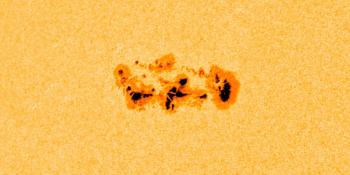
Complex sunspot region 4366

CME impact! S4 solar radiation storm

X1.9 solar flare with earth-directed CME
Viimane foorumi postitus
Veel teemasidToeta SpaceWeatherLive.com-i!
Paljud inimesed tulevad SpaceWeatherLive veebilehele jälgima päikese aktiivsust või kui on võimalus näha virmalisi. Kuid suurema võrguliiklusega kaasnevad ka serverite suuremad võrgus hoidmise kulud. Kui teile meeldib SpaceWeatherLive ja soovite projekti toetada, saate valida reklaamivaba tellimuse või kaaluda annetamist. Teie abiga saame SpaceWeatherLive'i võrgus hoida!



Fakte kosmose ilmast
| Viimane X-loide | 04/02/2026 | X4.3 |
| Viimane M-loide | 05/02/2026 | M1.1 |
| Viimane geomagnetiline torm | 05/02/2026 | Kp5+ (G1) |
| Plekivabasid päevi | |
|---|---|
| Viimane päikese plekivaba päev | 08/06/2022 |
| Kuu keskmine päikeseplekkide arv | |
|---|---|
| jaanuar 2026 | 112.6 -11.4 |
| veebruar 2026 | 140.8 +28.2 |
| Viimased 30 päeva | 124.6 +17.7 |