Vaata pühapäev, 15 veebruar 2015 arhiivi
SIDC igapäevane bülletään päikese ja geomagnetilise aktiivsuse kohta
Välja antud: 2015 Feb 15 1302 UTC
SIDC ennustus
Päikesepursked ehk loited
Quiet conditions (<50% probability of C-class flares)
Geomagnetism
Quiet (A<20 and K<4)
Päikese prootonid
Quiet
| 10 cm vool | Ap | |
|---|---|---|
| 15 Feb 2015 | 118 | 006 |
| 16 Feb 2015 | 117 | 007 |
| 17 Feb 2015 | 118 | 003 |
Bülletään
Over the past 24 hours there were several B class flares. Most activity occurred in (Active Region) AR 2282 currently located close to the center of the solar disk (N10W10). AR 2283 produced the largest flare, a B9.0 class flare on 2015-Feb-15 peaking at 00:51 UTC. NOAA AR 2281 has moved on to the Western hemisphere limb. NOAA ARs 2282, 2283 and 2284 all appear stable, with small amounts of flux emergence. AR 2283, which emerged near disk center on 2015-Feb-12, has remained small and appears stable, but did produce the largest flare. There is a large filament located between S40W30 and S10W90, however this has remained, and appears, stable. A second less well-defined filament is centered on S20E20, but this also appears stable. Flaring is expected to continue at the B-class level with a possibility of C-class flares. There was a sharp spike in proton numbers at 22:30 UTC on 2015-Feb-14. There were no Earth directed CMEs, but LASCO recorded two CMEs off of the Eastern hemisphere, the first at 22:00 UTC on 2015-Feb-14 and a second at 03:12 UTC on 2015-Feb-15. Both events were small and believed to be back sided. As the source AR rotates into view we may experience more geo-effective activity. The solar wind speed has remained stable over the past 24 hours around 320 km /s, with a small increase over the past 3 hours to around 350 km /s. The total magnetic field has shown a gentle increase over the past 24 hours, increasing from 6 nT to 10 nT. The field showed a sharp drop at around 21:00 UTC on 2015-Feb-14, and then increased again at 01:00 UTC on 2015-Feb-15. The source is believed to be the coronal hole in the Western hemisphere. The Bz has ranged between +6 and -6 nT over the past 24 hours, and also experienced the same drop in field strength as the total field. Geomagnetic conditions were quiet to moderate over the past 24 hours (NOAA Kp 0-2, local K Dourbes 0-3). A large transient coronal hole is currently centered at W55. Solar wind conditions have been quiet, which is expected to persist. Geomagnetic conditions are expected to be quiet to unsettled with an isolated active period possible.
Tänane hinnanguline rahvusvaheline päikeselaikude arv (ISN): 047, põhineb 13 jaamadel.Päikese indeksid 14 Feb 2015
| Catania Wolfi number | /// |
| 10cm päikesevoog | 120 |
| AK Chambon La Forêt | 006 |
| AK Wingst | 002 |
| Hinnanguline Ap | 002 |
| Hinnanguline rahvusvaheline päikeselaikude arv | 038 - Põhineb 13 jaamal |
Märkimisväärsete sündmuste kokkuvõte
| Päev | Algus | Maks | Lõpp | Lokatsioon | Tugevus | OP | 10cm | Catania/NOAA | Raadiosignaalipursete tüübid | |
|---|---|---|---|---|---|---|---|---|---|---|
| Puuduvad | ||||||||||
Andmed on esitanud Päikeseinfektide Andmeanalüüsi Keskus (Solar Influences Data Analysis Center)© - SIDC - Töötleb SpaceWeatherLive
Kõik ajad UTC-s
<< Mine igapäevase ülevaate lehele
Viimane uudis

X1.5 solar flare

M2.7 solar flare, CME arrival possible
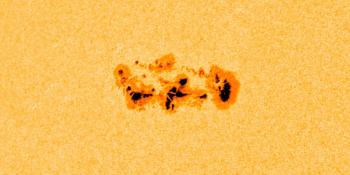
Complex sunspot region 4366
Viimane foorumi postitus
Toeta SpaceWeatherLive.com-i!
Paljud inimesed tulevad SpaceWeatherLive veebilehele jälgima päikese aktiivsust või kui on võimalus näha virmalisi. Kuid suurema võrguliiklusega kaasnevad ka serverite suuremad võrgus hoidmise kulud. Kui teile meeldib SpaceWeatherLive ja soovite projekti toetada, saate valida reklaamivaba tellimuse või kaaluda annetamist. Teie abiga saame SpaceWeatherLive'i võrgus hoida!



Fakte kosmose ilmast
| Viimane X-loide | 30/03/2026 | X1.5 |
| Viimane M-loide | 09/04/2026 | M1.0 |
| Viimane geomagnetiline torm | 03/04/2026 | Kp7- (G3) |
| Plekivabasid päevi | |
|---|---|
| Viimased 365 päeva | 3 päeva |
| 2026 | 3 päeva (3%) |
| Viimane päikese plekivaba päev | 24/02/2026 |
| Kuu keskmine päikeseplekkide arv | |
|---|---|
| märts 2026 | 85.9 +7.7 |
| aprill 2026 | 94.2 +8.3 |
| Viimased 30 päeva | 94.7 +35.4 |