Vaata kolmapäev, 31 august 2022 arhiivi
SIDC igapäevane bülletään päikese ja geomagnetilise aktiivsuse kohta
Välja antud: 2022 Aug 31 1232 UTC
SIDC ennustus
Päikesepursked ehk loited
C-class flares expected, (probability >=50%)
Geomagnetism
Quiet (A<20 and K<4)
Päikese prootonid
Quiet
| 10 cm vool | Ap | |
|---|---|---|
| 31 Aug 2022 | 126 | 013 |
| 01 Sep 2022 | 124 | 007 |
| 02 Sep 2022 | 122 | 007 |
Bülletään
NOAA AR 3088 (behind the west limb) produced an M2.1 flare, peaking at 19:29 UT on 30 August. NOAA AR 3089 has now a beta-gamma magnetic field configuration and has produced only C-class flares. M-class flares remain possible, but less likely.
No earth directed CMEs were detected in the past 24 hours. A full halo CME was observed starting at 18:12 UT on 30 August (LASCO/C2), originating from NOAA AR 3088, associated with the M2.1 flare. This CME is backsided and will not arrive to the Earth. A filament eruption close to the south pole of the Sun created a slow CME at 15:24 UT on 30 August, directed mostly to the south and not expected to affect the Earth.
The greater than 10 MeV proton flux is below the 10 pfu mark, and is expected to remain so. The greater than 2MeV electron flux was below the 1000 pfu threshold over the past 24 hours. It is expected to remain below threshold over the next 24 hours. The 24h electron fluence was at nominal levels over the past 24 hours. It is expected to remain at nominal levels over the next 24 hours.
The Earth is still inside the high speed solar wind from the low latitudinal extension of the southern polar coronal hole, with speeds close to 600 km/s. A shock-like structure was seen in the solar wind (DSCOVR) at 18:50 UT on 30 August, clearly seen in a jump of the interplanetary magnetic field from 11 to 15 nT, but less clear in the plasma data (a jump in solar wind speed from 550 to ~600 km/s can be seen, but the data is marked as suspect by DSCOVR, and the jump is not clear in ACE). This transient is most probably driven by the CME from 28 August (the ICME itself missed the Earth, as it passed to the west of it). The solar wind speed is currently close to 530 km/s, with interplanetary magnetic field magnitudes around 7 nT. The solar wind is expected to gradually return to a slow solar wind regime in the next 24 hours.
Unsettled geomagnetic conditions were recorded over the past 24 hours (NOAA Kp and K_Dourbes up to 3). Over the next 24 hours, similar conditions can be expected.
Tänane hinnanguline rahvusvaheline päikeselaikude arv (ISN): 047, põhineb 22 jaamadel.Päikese indeksid 30 Aug 2022
| Catania Wolfi number | 058 |
| 10cm päikesevoog | 126 |
| AK Chambon La Forêt | 021 |
| AK Wingst | 017 |
| Hinnanguline Ap | 016 |
| Hinnanguline rahvusvaheline päikeselaikude arv | 053 - Põhineb 25 jaamal |
Märkimisväärsete sündmuste kokkuvõte
| Päev | Algus | Maks | Lõpp | Lokatsioon | Tugevus | OP | 10cm | Catania/NOAA | Raadiosignaalipursete tüübid |
|---|---|---|---|---|---|---|---|---|---|
| 30 | 1804 | 1929 | 2123 | ---- | M2.1 | --/3088 |
Andmed on esitanud Päikeseinfektide Andmeanalüüsi Keskus (Solar Influences Data Analysis Center)© - SIDC - Töötleb SpaceWeatherLive
Kõik ajad UTC-s
<< Mine igapäevase ülevaate lehele
Viimane uudis

X1.5 solar flare

M2.7 solar flare, CME arrival possible
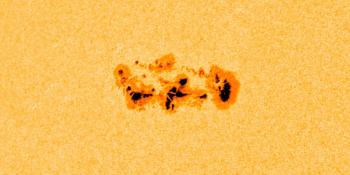
Complex sunspot region 4366
Viimane foorumi postitus
Toeta SpaceWeatherLive.com-i!
Paljud inimesed tulevad SpaceWeatherLive veebilehele jälgima päikese aktiivsust või kui on võimalus näha virmalisi. Kuid suurema võrguliiklusega kaasnevad ka serverite suuremad võrgus hoidmise kulud. Kui teile meeldib SpaceWeatherLive ja soovite projekti toetada, saate valida reklaamivaba tellimuse või kaaluda annetamist. Teie abiga saame SpaceWeatherLive'i võrgus hoida!



Fakte kosmose ilmast
| Viimane X-loide | 30/03/2026 | X1.5 |
| Viimane M-loide | 04/04/2026 | M1.0 |
| Viimane geomagnetiline torm | 03/04/2026 | Kp7- (G3) |
| Plekivabasid päevi | |
|---|---|
| Viimased 365 päeva | 3 päeva |
| 2026 | 3 päeva (3%) |
| Viimane päikese plekivaba päev | 24/02/2026 |
| Kuu keskmine päikeseplekkide arv | |
|---|---|
| märts 2026 | 85.9 +7.7 |
| aprill 2026 | 128.3 +42.3 |
| Viimased 30 päeva | 97.5 +35.7 |