Vaata reede, 9 jaanuar 2026 arhiivi
SIDC igapäevane bülletään päikese ja geomagnetilise aktiivsuse kohta
Välja antud: 2026 Jan 09 1231 UTC
SIDC ennustus
Päikesepursked ehk loited
C-class flares expected, (probability >=50%)
Geomagnetism
Active conditions expected (A>=20 or K=4)
Päikese prootonid
Quiet
| 10 cm vool | Ap | |
|---|---|---|
| 09 Jan 2026 | 131 | 022 |
| 10 Jan 2026 | 132 | 026 |
| 11 Jan 2026 | 130 | 040 |
Päikese aktiivsed piirkonnad ja pursked
Solar flaring activity was low over the past 24 hours, with several C-class flares recorded. The largest flare was a C5.6 flare (SIDC Flare 6614), peaking at 17:30 UTC on January 8, associated with SIDC Sunspot Group 722 (NOAA Active Region 4334; magnetic type beta), which was the main driver of the flaring activity observed over the past 24 hours. There are currently four numbered active regions on the visible solar disk. SIDC Sunspot Group 754 (NOAA Active Region 4336; magnetic type beta-gamma-delta) remains the most complex active region on the disk but produced only low-level C-class flare. Solar flaring activity is expected to remain low over the next 24 hours, with C-class flares very likely and a small chance for M-class flares.
Krooniaine massiline väljavool
A partial halo coronal mass ejection (SIDC CME 622) was observed in LASCO/C2 coronagraph data starting at 17:00 UTC on January 8. The CME is directed primarily toward the southeast from Earth's perspective and is likely associated with a filament eruption in the southeast from SIDC Sunspot Group 722 (NOAA Active Region 4334) and a C5.6 flare (SIDC Flare 6614), peaking at 17:30 UTC on January 8, produced by SIDC Sunspot Group 722. The CME may have an Earth-directed component, with a predicted arrival time late on January 10 - early on January 11. Further analysis of the faint coronal mass ejection (SIDC CME 620), observed in SOHO/LASCO-C2 at around 06:24 UTC on January 8 and directed toward the southeast from Earth’s perspective, indicates that the bulk of the ejecta is expected to miss Earth, but a glancing blow cannot be excluded late on January 10. No other Earth-directed CMEs were detected in the available coronagraph imagery over the past 24 hours.
Päikesetuul
Over the past 24 hours, solar wind parameters (ACE and DSCOVR) were indicative of a probable mixture of an ICME arrival, associated with the CME that lifted off the solar surface at around 02:00 UTC on January 6 (SIDC CME 619), and the arrival of a high-speed stream (HSS) from negative polarity coronal holes (SIDC Coronal Hole 144 and SIDC Coronal Hole 145). The interplanetary magnetic field increased to values up to 14 nT, and its southward component reached a minimum of about -10 nT. The solar wind speed increased from values about 380 km/s to 560 km/s. Solar wind conditions are expected to remain elevated over the next days, with a chance of a weak enhancement on January 10-11 due to possible ICME arrivals associated with the CMEs that lifted off the solar surface at around 06:24 UTC on January 8 (SIDC CME 620) and around 17:00 UTC on January 8 (SIDC CME 622).
Geomagnetism
Geomagnetic conditions reached active levels globally (NOAA Kp = 4-) between 00:00 and 03:00 UTC on January 9. Locally over Belgium, quiet to unsettled conditions were observed (K-Bel = 1 to 3). Mostly unsettled to active geomagnetic conditions are expected over the next days, with a chance of isolated minor to moderate storm periods, due to the ongoing influence of a high-speed stream, probably mixed with an ICME arrival associated with the CME that lifted off the solar surface at around 02:00 UTC on January 6 (SIDC CME 619). From late on January 10 - early January 11, minor to moderate geomagnetic storm levels are possible in the event of additional ICME arrivals associated with the CMEs that lifted off the solar surface at around 06:24 UTC on January 8 (SIDC CME 620) and around 17:00 UTC on January 8 (SIDC CME 622).
Prootoni voo tasemed
The greater than 10 MeV proton flux, as measured by the GOES-19 satellite, was at background levels over the past 24 hours and is likely to remain so over the next 24 hours.
Elektronivoog geostatsionaarsel orbiidil
The greater than 2 MeV electron flux, as measured by the GOES-18 and GOES-19 satellites, remained below the 1000 pfu threshold over the past 24 hours. The greater than 2 MeV electron flux is expected to remain below the 1000 pfu threshold over the next 24 hours. The electron fluence was at normal levels and is expected to be at normal levels over the next 24 hours.
Tänane hinnanguline rahvusvaheline päikeselaikude arv (ISN): 055, põhineb 05 jaamadel.Päikese indeksid 08 Jan 2026
| Catania Wolfi number | 074 |
| 10cm päikesevoog | 140 |
| AK Chambon La Forêt | 021 |
| AK Wingst | 017 |
| Hinnanguline Ap | 016 |
| Hinnanguline rahvusvaheline päikeselaikude arv | 079 - Põhineb 10 jaamal |
Märkimisväärsete sündmuste kokkuvõte
| Päev | Algus | Maks | Lõpp | Lokatsioon | Tugevus | OP | 10cm | Catania/NOAA | Raadiosignaalipursete tüübid | |
|---|---|---|---|---|---|---|---|---|---|---|
| Puuduvad | ||||||||||
Andmed on esitanud Päikeseinfektide Andmeanalüüsi Keskus (Solar Influences Data Analysis Center)© - SIDC - Töötleb SpaceWeatherLive
Kõik ajad UTC-s
<< Mine igapäevase ülevaate lehele
Viimane uudis
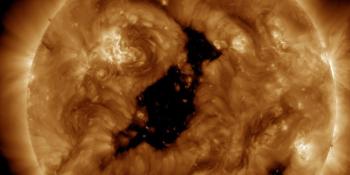
Coronal hole faces Earth

X1.5 solar flare

M2.7 solar flare, CME arrival possible
Viimane foorumi postitus
Toeta SpaceWeatherLive.com-i!
Paljud inimesed tulevad SpaceWeatherLive veebilehele jälgima päikese aktiivsust või kui on võimalus näha virmalisi. Kuid suurema võrguliiklusega kaasnevad ka serverite suuremad võrgus hoidmise kulud. Kui teile meeldib SpaceWeatherLive ja soovite projekti toetada, saate valida reklaamivaba tellimuse või kaaluda annetamist. Teie abiga saame SpaceWeatherLive'i võrgus hoida!



Fakte kosmose ilmast
| Viimane X-loide | 24/04/2026 | X2.5 |
| Viimane M-loide | 29/05/2026 | M1.1 |
| Viimane geomagnetiline torm | 16/05/2026 | Kp6- (G2) |
| Plekivabasid päevi | |
|---|---|
| Viimased 365 päeva | 3 päeva |
| 2026 | 3 päeva (2%) |
| Viimane päikese plekivaba päev | 24/02/2026 |
| Kuu keskmine päikeseplekkide arv | |
|---|---|
| aprill 2026 | 79.3 -6.6 |
| mai 2026 | 96.6 +17.3 |
| Viimased 30 päeva | 96.6 +3.7 |