Affichage des archives de mardi, 3 avril 2001
Rapport d'activité solaire
Chaque éruption solaire mentionnée dans ce rapport a été ajustée selon un facteur d'échelle fourni par le Space Weather Prediction Center (SWPC). Ce facteur a conduit à une sous-estimation de 42% des éruptions solaires par rapport aux données de qualité scientifique. Nous avons supprimé ce facteur d'échelle de nos données archivées pour refléter les véritables unités physiques.
Rapport d'activité solaire et géophysique 2001 Apr 03 2200 UTCFait par le NOAA © SWPC et adapté par SpaceWeatherLive.com
Rapport de l'USAF/NOAA sur l'activité solaire et géophysique
SDF numéro 093 publié à 2200Z le 03 Apr 2001IA. Analyse des régions solaires actives et activité du 02-2100Z au 03-2100Z Solar activity has been high. Region 9393 (N18W82)
produced a spectacular flare beginning at 02/2132Z, reaching maximum
at 02/2151Z and ending at 02/2203Z: the peak of the event saturated
the GOES-XRS sensors, but was estimated to be X20, the largest
observed so far this solar cycle. A fast coronal mass ejection (CME)
was observed in association with this event. The CME appeared to be
primarily headed off the west limb, but there was a deflection of
material near the north polar region, suggesting that the event
trajectory might have some earthward component. In the LASCO-C3
coronagraph images, this CME was overtaking the previous CME
associated with yesterday's X-class event from the same region.
Region 9393 also produced an M2/2f flare at 1234Z. The leading spots
of 9393 are currently rotating off the solar disk. Newly assigned
region 9415 (S22E72) produced an X1/1n flare at 0357Z. The event was
also associated with a CME which has the signature of a partial halo
event, although the bulk of the material appears to be flowing in a
southeasterly direction. So far Region 9415 is showing three large
penumbral clusters with an area of about 470 millionths. Solar
observers report that additional spots are rotating into view behind
this leading section of the region. Two new regions emerged on the
disk today: Region 9416 (N17W18) and Region 9417 (S10E43). Region
9408 (S08W46) showed some growth during the past 24 hours but was
relatively stable.
IB. Prévisions d'activité solaire
Solar activity is expected to be high.
Region 9393 will continue to be a threat for major flares and proton
events during the next three days, although the probabilities will
decrease as it rotates around the solar limb. Region 9415 has also
clearly shown major flare potential and is expected to be a source
of M-class flares and probably additional isolated X-class flares.
IIA. Résumé de l'activité géophysique du 02-2100Z au 03-2100Z
The geomagnetic field ranged from quiet to active levels. Quiet to
unsettled levels prevailed for most of the day, but there was an
active period from 02/2100-2400Z. An energetic proton event resulted
from the X20 flare. Greater than 10 MeV particles exceeded event
threshold at 02/2340Z, and reached a maximum of 1,110 PFU at 0745Z.
The 10 MeV particle event continues in progress with 308 PFU at
forecast issue time. Greater than 100 MeV particles also exceeded
thresholds, beginning at 03/0120Z, reaching maximum of 5.4 PFU at
03/0740Z, The greater than 100 MeV particles dipped below threshold
around 03/1900Z and appeared to be staying below threshold as of
03/2050Z.
IIB. Prévision de l'activité géophysique
The geomagnetic field is
expected to increase to minor to major storm levels during the next
24 hours. The two recent CMEs from region 9393 are likely to have
combined by now, and the size and possible partial earthward
component of the 2nd CME create the expectation of some interaction
at Earth. The response is less certain than in the case of a
full-halo CME and probably less dramatic than the result of a
direct, head-on hit. The forecast is for minor storm levels at the
mid-latitudes, with major storm levels at the higher latitudes.
Minor storm conditions are expected to persist through the second
day. Additional activity, most likely reaching active levels, is
possible on the third day due to a glancing blow from the CME from
region 9415. The greater than 10 MeV proton event is expected to
persist through most of tomorrow.
III. Probabilité d'éruption solaire du 04 Apr au 06 Apr
| Classe M | 85% | 80% | 70% |
| Classe X | 35% | 30% | 20% |
| Proton | 99% | 30% | 15% |
| PCAF | in progress | ||
IV. Flux Penticton 10.7 cm
  Observé       03 Apr 223
  Prévisionnel   04 Apr-06 Apr  215/205/195
  Moyenne des 90 derniers jours        03 Apr 166
V. Indice géomagnetique A
  Observé Afr/Ap 02 Apr  012/020
  Estimé     Afr/Ap 03 Apr  010/012
  Prévisionnel    Afr/Ap 04 Apr-06 Apr  035/060-035/040-020/020
VI. Probabilités d'activité géomagnétique du 04 Apr au 06 Apr
| A. Latitudes moyennes | |||
|---|---|---|---|
| Actif | 35% | 35% | 35% |
| Tempête mineure | 30% | 30% | 15% |
| Tempête majeure/sévère | 25% | 15% | 10% |
| B. Hautes latitudes | |||
|---|---|---|---|
| Actif | 25% | 25% | 25% |
| Tempête mineure | 35% | 35% | 20% |
| Tempête majeure/sévère | 35% | 30% | 15% |
Toutes les heures sont indiquées en UTC
Dernières nouvelles

lundi, 30 mars 2026
X1.5 solar flare

mardi, 17 mars 2026
M2.7 solar flare, CME arrival possible
dimanche, 1 février 2026
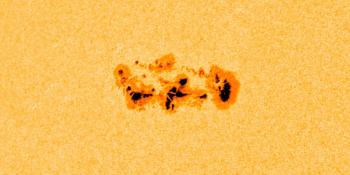
Complex sunspot region 4366
Aidez SpaceWeatherLive.com !
De nombreuses personnes consultent SpaceWeatherLive pour suivre l'activité solaire ou observer les aurores boréales, mais l'augmentation du trafic engendre des coûts plus élevés pour maintenir les serveurs en ligne. Si vous appréciez SpaceWeatherLive et souhaitez soutenir le projet, vous pouvez vous abonner pour un site sans publicité ou faire un don. Grâce à votre aide, SpaceWeatherLive restera accessible !



La Météo Spatiale en faits
| Dernière classe X | 30/03/2026 | X1.5 |
| Dernière classe M | 09/04/2026 | M1.0 |
| Dernier orage géomagnétique | 03/04/2026 | Kp7- (G3) |
| Jours sans taches solaires | |
|---|---|
| 365 derniers jours | 3 jours |
| 2026 | 3 jours (3%) |
| Dernier jour sans taches solaires | 24/02/2026 |
| Nombre mensuel moyen de taches solaires | |
|---|---|
| mars 2026 | 85.9 +7.7 |
| avril 2026 | 97.2 +11.3 |
| 30 derniers jours | 95.9 +36.7 |
A ce jour dans l'histoire*
Aurora on this day in history
No observations submitted for this day in history. If you've observed the aurora and you have some amazing photos to show off, submit your observations now!
Submit your aurora observation