Affichage des archives de dimanche, 20 mai 2001
Rapport d'activité solaire
Chaque éruption solaire mentionnée dans ce rapport a été ajustée selon un facteur d'échelle fourni par le Space Weather Prediction Center (SWPC). Ce facteur a conduit à une sous-estimation de 42% des éruptions solaires par rapport aux données de qualité scientifique. Nous avons supprimé ce facteur d'échelle de nos données archivées pour refléter les véritables unités physiques.
Rapport d'activité solaire et géophysique 2001 May 20 2200 UTCFait par le NOAA © SWPC et adapté par SpaceWeatherLive.com
Rapport de l'USAF/NOAA sur l'activité solaire et géophysique
SDF numéro 140 publié à 2200Z le 20 May 2001IA. Analyse des régions solaires actives et activité du 19-2100Z au 20-2100Z Solar activity was high. Two highly impulsive M-class
flares occurred during the period. Both were optically uncorrelated.
The first was an M6 flare at 20/0603 UTC, with an accompanying Type
II radio sweep (1200 km/s) and a 360 sfu 10 cm radio burst. EIT
imagery shows that this event originated over the southwestern limb
and was probably from Region 9455 (S17W90+). An impressive coronal
mass ejection (CME) in conjunction with the flare can be seen on
images from the LASCO/SOHO spacecraft. The CME appears to be non
earth-directed. An M1 flare with an accompanying Type II radio sweep
(1088 km/s) was detected at 20/0920 UTC. This event was most likely
a backside event from the same region as the previously described M6
event. Region 9463 (N09E46) nearly doubled in size and spot count
overnight and also developed into a more complex sunspot group
classification (14 spot, Eko-Beta). Region 9465 (S08E63) was
numbered as it rotated onto the disk, already showing a 4 spot
Dao-Beta sunspot classification.
IB. Prévisions d'activité solaire
Solar activity is expected to be low
to moderate. Regions 9461 (N22E10) and 9463 are both capable of
producing isolated M-class events.
IIA. Résumé de l'activité géophysique du 19-2100Z au 20-2100Z
The geomagnetic field was at quiet to unsettled levels. The greater than 10 MeV proton flux at geosynchronous orbit became enhanced following today's M6 flare, but did not reach event criteria. The greater than 2 MeV electron flux at geosynchronous
orbit reached moderate levels during the period.
IIB. Prévision de l'activité géophysique
The geomagnetic field is
expected to be mostly quiet to unsettled for the first two days of
the forecast period. Isolated active conditions may occur on the
third day due to a potentially favorably positioned coronal hole and
the subsequent high speed stream impacting earth. The greater than 2
MeV electron flux and greater than 10 MeV proton flux at
geosynchronous orbit should continue to be at elevated levels for
the first half of the period and then can expected to return to near
background levels.
III. Probabilité d'éruption solaire du 21 May au 23 May
| Classe M | 30% | 30% | 30% |
| Classe X | 01% | 01% | 01% |
| Proton | 01% | 01% | 01% |
| PCAF | green | ||
IV. Flux Penticton 10.7 cm
  Observé       20 May 142
  Prévisionnel   21 May-23 May  140/140/140
  Moyenne des 90 derniers jours        20 May 168
V. Indice géomagnetique A
  Observé Afr/Ap 19 May  010/012
  Estimé     Afr/Ap 20 May  008/012
  Prévisionnel    Afr/Ap 21 May-23 May  008/012-008/012-015/015
VI. Probabilités d'activité géomagnétique du 21 May au 23 May
| A. Latitudes moyennes | |||
|---|---|---|---|
| Actif | 20% | 20% | 25% |
| Tempête mineure | 05% | 05% | 10% |
| Tempête majeure/sévère | 01% | 01% | 01% |
| B. Hautes latitudes | |||
|---|---|---|---|
| Actif | 25% | 25% | 35% |
| Tempête mineure | 10% | 10% | 15% |
| Tempête majeure/sévère | 01% | 01% | 01% |
Toutes les heures sont indiquées en UTC
Dernières nouvelles
dimanche, 1 février 2026
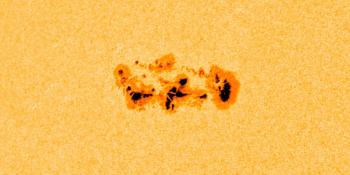
Complex sunspot region 4366

lundi, 19 janvier 2026
CME impact! S4 solar radiation storm

dimanche, 18 janvier 2026
X1.9 solar flare with earth-directed CME
Forum
AR4366 1025Filaments and prominences 487Do the high-resolution sunspot counts point to more complex sunspots? 62AR 4373 4Yes, we really went to the moon before. 1
Plus de messages du forumAidez SpaceWeatherLive.com !
De nombreuses personnes consultent SpaceWeatherLive pour suivre l'activité solaire ou observer les aurores boréales, mais l'augmentation du trafic engendre des coûts plus élevés pour maintenir les serveurs en ligne. Si vous appréciez SpaceWeatherLive et souhaitez soutenir le projet, vous pouvez vous abonner pour un site sans publicité ou faire un don. Grâce à votre aide, SpaceWeatherLive restera accessible !



La Météo Spatiale en faits
| Dernière classe X | 04/02/2026 | X4.3 |
| Dernière classe M | 11/02/2026 | M1.4 |
| Dernier orage géomagnétique | 05/02/2026 | Kp5+ (G1) |
| Jours sans taches solaires | |
|---|---|
| Dernier jour sans taches solaires | 08/06/2022 |
| Nombre mensuel moyen de taches solaires | |
|---|---|
| janvier 2026 | 112.6 -11.4 |
| février 2026 | 129.4 +16.8 |
| 30 derniers jours | 129.3 +29.3 |