Affichage des archives de dimanche, 19 octobre 2003
Rapport d'activité solaire
Chaque éruption solaire mentionnée dans ce rapport a été ajustée selon un facteur d'échelle fourni par le Space Weather Prediction Center (SWPC). Ce facteur a conduit à une sous-estimation de 42% des éruptions solaires par rapport aux données de qualité scientifique. Nous avons supprimé ce facteur d'échelle de nos données archivées pour refléter les véritables unités physiques.
Rapport d'activité solaire et géophysique 2003 Oct 19 2200 UTCFait par le NOAA © SWPC et adapté par SpaceWeatherLive.com
Rapport de l'USAF/NOAA sur l'activité solaire et géophysique
SDF numéro 292 publié à 2200Z le 19 Oct 2003IA. Analyse des régions solaires actives et activité du 18-2100Z au 19-2100Z Solar activity was high. Region 484 (N06E54) produced
an X1/1n flare starting at 1629 UTC, with maximum at 1650 UTC and
ending at 1704 UTC. The flare was accompanied by strong radio
bursts, a type II radio sweep, and was associated with a coronal
mass ejection. The CME was observed in LASCO-C2 off the northeast
limb beginning at 1708 UTC with a plane-of-sky speed of about 500
km/s. Region 484 also produced two M1 flares: one at 0626 UTC, the
other at 1926 UTC. The region also produced a C6/1f at 18/2218 UTC
that was associated with a CME off the southeast limb around 18/2230
UTC. Neither of these CMEs appear to have any earthward directed
component. Region 484 grew dramatically during the past 24 hours
from 240 millionths at the start of the day to just over 1000
millionths by forecast issue time. This remarkable emergence of new
flux led to the formation of a strong delta configuration across a
northeast-to-southwest polarity inversion line which was also the
location of the most intense emission from the X1 flare event.
IB. Prévisions d'activité solaire
Solar activity is expected to be
predominantly moderate for the next three days, with Region 484 as
the dominant source of activity. There is a chance for more major
flare activity from Region 484, especially if it continues to grow.
IIA. Résumé de l'activité géophysique du 18-2100Z au 19-2100Z
The geomagnetic field ranged from unsettled to minor storm levels
during the past 24 hours. A jump in solar wind velocity from 540
km/s to 600 km/s was observed around 2200 UTC. However, the solar
wind signatures continue to be consistent with a high-speed coronal
driven wind stream. The Bz component of the interplanetary magnetic
field continues to oscillate around an average value of about -5 nT.
The greater than 2 MeV electron fluxes continue to be at high
levels.
IIB. Prévision de l'activité géophysique
The geomagnetic field is
expected to be unsettled to active for the next 24 hours, increasing
to mostly active with minor storm periods on the second day, and
returning back to unsettled to active for the third day. The
increase on day two is expected as a response to the particular
morphology of a coronal hole rotating across the western part of the
solar disk. A glancing blow from the partial-halo CME of 18/1554 UTC
may also contribute to activity on day two.
III. Probabilité d'éruption solaire du 20 Oct au 22 Oct
| Classe M | 70% | 70% | 70% |
| Classe X | 15% | 15% | 15% |
| Proton | 10% | 10% | 10% |
| PCAF | green | ||
IV. Flux Penticton 10.7 cm
  Observé       19 Oct 120
  Prévisionnel   20 Oct-22 Oct  125/130/130
  Moyenne des 90 derniers jours        19 Oct 115
V. Indice géomagnetique A
  Observé Afr/Ap 18 Oct  015/027
  Estimé     Afr/Ap 19 Oct  015/025
  Prévisionnel    Afr/Ap 20 Oct-22 Oct  012/020-020/030-015/025
VI. Probabilités d'activité géomagnétique du 20 Oct au 22 Oct
| A. Latitudes moyennes | |||
|---|---|---|---|
| Actif | 30% | 35% | 35% |
| Tempête mineure | 25% | 30% | 30% |
| Tempête majeure/sévère | 10% | 20% | 10% |
| B. Hautes latitudes | |||
|---|---|---|---|
| Actif | 35% | 25% | 35% |
| Tempête mineure | 30% | 40% | 35% |
| Tempête majeure/sévère | 15% | 25% | 15% |
Toutes les heures sont indiquées en UTC
Dernières nouvelles

lundi, 30 mars 2026
X1.5 solar flare

mardi, 17 mars 2026
M2.7 solar flare, CME arrival possible
dimanche, 1 février 2026
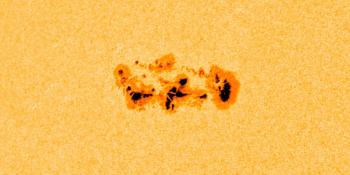
Complex sunspot region 4366
Forum
Filaments and prominences 543AR4416 11Space Weather Memes 821AR4415 6Solar cycle 25, solar maximum, is it over? 64
Plus de messages du forumAidez SpaceWeatherLive.com !
De nombreuses personnes consultent SpaceWeatherLive pour suivre l'activité solaire ou observer les aurores boréales, mais l'augmentation du trafic engendre des coûts plus élevés pour maintenir les serveurs en ligne. Si vous appréciez SpaceWeatherLive et souhaitez soutenir le projet, vous pouvez vous abonner pour un site sans publicité ou faire un don. Grâce à votre aide, SpaceWeatherLive restera accessible !



La Météo Spatiale en faits
| Dernière classe X | 30/03/2026 | X1.5 |
| Dernière classe M | 09/04/2026 | M1.0 |
| Dernier orage géomagnétique | 03/04/2026 | Kp7- (G3) |
| Jours sans taches solaires | |
|---|---|
| 365 derniers jours | 3 jours |
| 2026 | 3 jours (3%) |
| Dernier jour sans taches solaires | 24/02/2026 |
| Nombre mensuel moyen de taches solaires | |
|---|---|
| mars 2026 | 85.9 +7.7 |
| avril 2026 | 107.7 +21.8 |
| 30 derniers jours | 99.4 +43 |
A ce jour dans l'histoire*
Aurora on this day in history
No observations submitted for this day in history. If you've observed the aurora and you have some amazing photos to show off, submit your observations now!
Submit your aurora observation