Affichage des archives de jeudi, 30 octobre 2003
Rapport d'activité solaire
Chaque éruption solaire mentionnée dans ce rapport a été ajustée selon un facteur d'échelle fourni par le Space Weather Prediction Center (SWPC). Ce facteur a conduit à une sous-estimation de 42% des éruptions solaires par rapport aux données de qualité scientifique. Nous avons supprimé ce facteur d'échelle de nos données archivées pour refléter les véritables unités physiques.
Rapport d'activité solaire et géophysique 2003 Oct 30 2200 UTCFait par le NOAA © SWPC et adapté par SpaceWeatherLive.com
Rapport de l'USAF/NOAA sur l'activité solaire et géophysique
SDF numéro 303 publié à 2200Z le 30 Oct 2003IA. Analyse des régions solaires actives et activité du 29-2100Z au 30-2100Z Solar activity was at high levels. Region 486 (S18W23)
produced an X10/2b flare that peaked at the end of the last period
(29/2049Z). Once again, intense radio emissions accompanied this
flare, including a 360,000 sfu burst at 245 MHz, a 2500 sfu
Tenflare, and strong Type II/IV radio sweeps. An extremely fast
(over 1900 km/s) earth-directed full halo CME was observed on LASCO
imagery. A new injection of high energy protons accompanied this
flare. Region 486 maintains its tremendous size and magnetic
complexity. Strong delta configurations exist in this spot group
containing over 2500 millionths of white light areal coverage.
Region 488 (N08W28) continues to develop in size and complexity and
now nears 1800 millionths of areal overage. Despite its impressive
size, this region's activity levels have so far been limited to high
C-class and low M-class flares. New Regions 494 (S23E08) and 495
(S22E20) were numbered today. Region 495 is a very fast growing
D-type spot group.
IB. Prévisions d'activité solaire
Solar activity is expected to continue
at high levels. Region 486 has been one of the most active regions
of solar cycle 23 and maintains strong potential for further major
proton flares. Large Region 488 also contains potential for a major
flare.
IIA. Résumé de l'activité géophysique du 29-2100Z au 30-2100Z
The geomagnetic field was at predominantly minor to severe storm
levels. The intense geomagnetic storm that began at 29/0611Z
continued through the first half of this period. Severe (K8-9)
levels were observed from 29/2100 - 30/0300Z. A short-lived "lull"
(K5-6) in activity preceded the onset of another severe geomagnetic
storm. The very fast CME from the X10 flare that peaked at 29/2049Z
impacted the magnetic field at around 30/1600Z - a remarkably fast
19-hour transit from Sun to Earth. GOES-10,11, and 12 geosynchronous
satellites have experienced magnetopause crossings and in fact have
been outside the magnetopause for much of the time since the onset
of this severe storm. Sustained southward IMF Bz in the -15 to -30
Nt range is assuring a severe response. A Forbush decrease at
around 20% remains in progress. A new surge of high energy protons
followed the X-10 flare, enhancing the existing greater than 10 MeV
and greater than 100 MeV proton events from the X17 flare on the
28th. This enhancement reached 110 pfu (29/2310Z) in the greater
than 100 MeV level, and 3300 pfu (30/1935Z) in the greater than 10
MeV level. A polar cap absorption continues and the proton event
remains in progress.
IIB. Prévision de l'activité géophysique
The geomagnetic field is
expected to continue at major to severe storm levels through the
first half of day one. The current severe geomagnetic storm is
expected to gradually subside by the end of day one. Unsettled to
occasional minor storm periods are possible on day two. Mostly
unsettled levels are expected by day three. The greater than 100 MeV
proton event is expected to end by day one. The greater than 10 MeV
proton event will likely persist through day two.
III. Probabilité d'éruption solaire du 31 Oct au 02 Nov
| Classe M | 90% | 90% | 90% |
| Classe X | 50% | 50% | 50% |
| Proton | 99% | 99% | 75% |
| PCAF | in progress | ||
IV. Flux Penticton 10.7 cm
  Observé       30 Oct 271
  Prévisionnel   31 Oct-02 Nov  265/260/255
  Moyenne des 90 derniers jours        30 Oct 128
V. Indice géomagnetique A
  Observé Afr/Ap 29 Oct  199/189
  Estimé     Afr/Ap 30 Oct  115/130
  Prévisionnel    Afr/Ap 31 Oct-02 Nov  080/100-020/030-010/015
VI. Probabilités d'activité géomagnétique du 31 Oct au 02 Nov
| A. Latitudes moyennes | |||
|---|---|---|---|
| Actif | 10% | 40% | 20% |
| Tempête mineure | 20% | 15% | 05% |
| Tempête majeure/sévère | 70% | 10% | 01% |
| B. Hautes latitudes | |||
|---|---|---|---|
| Actif | 10% | 50% | 25% |
| Tempête mineure | 10% | 30% | 10% |
| Tempête majeure/sévère | 80% | 10% | 05% |
Toutes les heures sont indiquées en UTC
Dernières nouvelles
dimanche, 1 février 2026
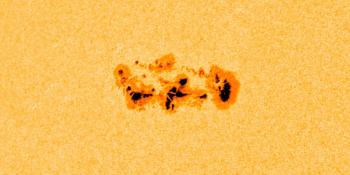
Complex sunspot region 4366

lundi, 19 janvier 2026
CME impact! S4 solar radiation storm

dimanche, 18 janvier 2026
X1.9 solar flare with earth-directed CME
Forum
The hypothetical role of metal ions in Sporadic E skip 2Unspecified geomagnetic activity 81Well… here it goes again.. 9Filaments and prominences 490Comet C/2026 A1 (MAPS) for the southern hemisphere 4
Plus de messages du forumAidez SpaceWeatherLive.com !
De nombreuses personnes consultent SpaceWeatherLive pour suivre l'activité solaire ou observer les aurores boréales, mais l'augmentation du trafic engendre des coûts plus élevés pour maintenir les serveurs en ligne. Si vous appréciez SpaceWeatherLive et souhaitez soutenir le projet, vous pouvez vous abonner pour un site sans publicité ou faire un don. Grâce à votre aide, SpaceWeatherLive restera accessible !



La Météo Spatiale en faits
| Dernière classe X | 04/02/2026 | X4.21 |
| Dernière classe M | 16/02/2026 | M2.4 |
| Dernier orage géomagnétique | 16/02/2026 | Kp6 (G2) |
| Jours sans taches solaires | |
|---|---|
| Dernier jour sans taches solaires | 08/06/2022 |
| Nombre mensuel moyen de taches solaires | |
|---|---|
| janvier 2026 | 112.6 -11.4 |
| février 2026 | 90.2 -22.4 |
| 30 derniers jours | 102.4 -15.3 |