Affichage des archives de samedi, 15 janvier 2005
Rapport d'activité solaire
Chaque éruption solaire mentionnée dans ce rapport a été ajustée selon un facteur d'échelle fourni par le Space Weather Prediction Center (SWPC). Ce facteur a conduit à une sous-estimation de 42% des éruptions solaires par rapport aux données de qualité scientifique. Nous avons supprimé ce facteur d'échelle de nos données archivées pour refléter les véritables unités physiques.
Rapport d'activité solaire et géophysique 2005 Jan 15 2200 UTCFait par le NOAA © SWPC et adapté par SpaceWeatherLive.com
Rapport de l'USAF/NOAA sur l'activité solaire et géophysique
SDF numéro 015 publié à 2200Z le 15 Jan 2005IA. Analyse des régions solaires actives et activité du 14-2100Z au 15-2100Z Solar activity was at high levels. Large Region 720
(N13W03) produced three major flares this period, beginning with an
X1/1b flare at 15/0043Z. There was no CME associated with this
X-class flare. An impulsive M8 flare was observed at 15/0431Z, and
at 15/0638Z, the region produced the most significant event of the
period, a long duration M8 flare. This event had associated intense
radio emission including a 160,000 sfu burst on 410 MHz and moderate
to strong centimetric bursts including a 3000 sfu Tenflare. Type II
(1300 km/s) and Type IV radio sweeps were also observed, and the
energetic protons (>10 MeV) began to rise soon after the flare
maximum. SOHO/LASCO imagery revealed a fast full halo coronal mass
ejection. Region 720 is a large and magnetically complex sunspot
group with white light area coverage exceeding 1600 millionths.
Strong shear along an extended east-west inversion line in this
region was the focal point for the major flare activity. Region 718
(S07W21) produced an M3 flare at 15/1423Z with an associated 420 sfu
Tenflare and CME off the southwest limb.
IB. Prévisions d'activité solaire
Solar activity is expected to continue
at moderate to high levels. Region 720 has potential for M and
X-class flares. An isolated M-class flare is also possible from
Region 718.
IIA. Résumé de l'activité géophysique du 14-2100Z au 15-2100Z
The geomagnetic field ranged from unsettled to minor storm periods
with isolated major storm levels at high latitudes. A gradual rise
in the solar wind speed began early in the period, rising to a peak
speed near 700 km/s, before gradually declining to near 550 km/s.
The IMF Bz was predominantly southward during the first half of the
period, which accounted for the most disturbed conditions. A greater
than 10 MeV proton enhancement began soon after today's long
duration M8 flare. The protons did not exceed the 10 pfu threshold,
and remain elevated. The greater than 2 MeV electron flux at
geosynchronous orbit was at high levels.
IIB. Prévision de l'activité géophysique
The geomagnetic field is
expected to range from quiet to severe storm levels. Solar wind
remains elevated at near 500 Km/s which may produce isolated active
periods early on 16 January. A CME associated with today's long
duration M8 flare is expected to impact the geomagnetic field late
on 16 January into 17 January. Major to severe storm periods are
possible during this disturbance. Barring another Earth-directed
CME, the geomagnetic field will likely return to unsettled levels
with isolated active periods on 18 January.
III. Probabilité d'éruption solaire du 16 Jan au 18 Jan
| Classe M | 85% | 85% | 85% |
| Classe X | 25% | 25% | 25% |
| Proton | 25% | 25% | 25% |
| PCAF | yellow | ||
IV. Flux Penticton 10.7 cm
  Observé       15 Jan 145
  Prévisionnel   16 Jan-18 Jan  145/150/150
  Moyenne des 90 derniers jours        15 Jan 106
V. Indice géomagnetique A
  Observé Afr/Ap 14 Jan  011/012
  Estimé     Afr/Ap 15 Jan  015/022
  Prévisionnel    Afr/Ap 16 Jan-18 Jan  035/040-050/060-010/015
VI. Probabilités d'activité géomagnétique du 16 Jan au 18 Jan
| A. Latitudes moyennes | |||
|---|---|---|---|
| Actif | 40% | 50% | 30% |
| Tempête mineure | 25% | 30% | 10% |
| Tempête majeure/sévère | 15% | 20% | 05% |
| B. Hautes latitudes | |||
|---|---|---|---|
| Actif | 50% | 40% | 40% |
| Tempête mineure | 30% | 35% | 20% |
| Tempête majeure/sévère | 20% | 25% | 10% |
Toutes les heures sont indiquées en UTC
Dernières nouvelles

lundi, 30 mars 2026
X1.5 solar flare

mardi, 17 mars 2026
M2.7 solar flare, CME arrival possible
dimanche, 1 février 2026
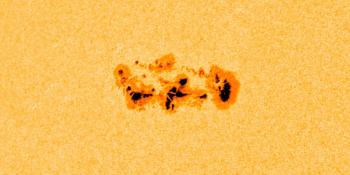
Complex sunspot region 4366
Forum
X1.5 CME (2026-03-30) 104AR4405 73Comet C/2026 A1 (MAPS) for the southern hemisphere 26Photographing auroras 239Unspecified geomagnetic activity 136
Plus de messages du forumAidez SpaceWeatherLive.com !
De nombreuses personnes consultent SpaceWeatherLive pour suivre l'activité solaire ou observer les aurores boréales, mais l'augmentation du trafic engendre des coûts plus élevés pour maintenir les serveurs en ligne. Si vous appréciez SpaceWeatherLive et souhaitez soutenir le projet, vous pouvez vous abonner pour un site sans publicité ou faire un don. Grâce à votre aide, SpaceWeatherLive restera accessible !



La Météo Spatiale en faits
| Dernière classe X | 30/03/2026 | X1.4 |
| Dernière classe M | 28/03/2026 | M1.3 |
| Dernier orage géomagnétique | 25/03/2026 | Kp5+ (G1) |
| Jours sans taches solaires | |
|---|---|
| 365 derniers jours | 3 jours |
| 2026 | 3 jours (3%) |
| Dernier jour sans taches solaires | 24/02/2026 |
| Nombre mensuel moyen de taches solaires | |
|---|---|
| février 2026 | 78.2 -34.3 |
| mars 2026 | 86.6 +8.4 |
| 30 derniers jours | 86.6 +11.2 |
A ce jour dans l'histoire*
Aurora on this day in history
No observations submitted for this day in history. If you've observed the aurora and you have some amazing photos to show off, submit your observations now!
Submit your aurora observation