Affichage des archives de mercredi, 24 août 2005
Rapport d'activité solaire
Chaque éruption solaire mentionnée dans ce rapport a été ajustée selon un facteur d'échelle fourni par le Space Weather Prediction Center (SWPC). Ce facteur a conduit à une sous-estimation de 42% des éruptions solaires par rapport aux données de qualité scientifique. Nous avons supprimé ce facteur d'échelle de nos données archivées pour refléter les véritables unités physiques.
Rapport d'activité solaire et géophysique 2005 Aug 24 2203 UTCFait par le NOAA © SWPC et adapté par SpaceWeatherLive.com
Rapport de l'USAF/NOAA sur l'activité solaire et géophysique
SDF numéro 236 publié à 2200Z le 24 Aug 2005IA. Analyse des régions solaires actives et activité du 23-2100Z au 24-2100Z Solar activity was low during the past 24 hours.
Today's activity consisted of a few C-class events. The largest was
a C4 at 0706 UTC from Region 798 (S11W90) which is rotating off the
visible disk. Region 800 (N17W21) and newly numbered Region 803
(N12E78) also contributed to the activity. New Region 802 (S12E14)
emerged on the disk today as a small, simple H-type group.
IB. Prévisions d'activité solaire
Solar activity is expected to be
mostly low, but there is a fair chance for an isolated M-class event
from Region 798 during the next 24 hours (25 August). Probabilities
will decline for 26-27 August but there will still be a slight
chance for an isolated M-class event from Region 800 or Region 803.
IIA. Résumé de l'activité géophysique du 23-2100Z au 24-2100Z
The geomagnetic field ranged from quiet to severe storm levels. An
initially quiet to unsettled field became disturbed after a series of
two shocks and transient flow. The first shock was seen at ACE at
0539 UTC and was followed by a sudden impulse at 0612 UTC and minor
storm level activity. The second shock was observed at 0828 UTC and
was followed by about 6 hours of major to severe storm level
activity, which was driven by high velocity and very strongly
negative interplanetary magnetic field component Bz (which reached
about -56 nT). Activity declined to minor storm levels after 1500
UTC and remained there through the end of the period. The solar wind
remains elevated but is slowly declining; Bz turned mostly
northwards and substantially weakened although the total solar wind
magnetic field remains high (about 20 nT). The solar wind signatures
are most consistent with the successive arrivals of CMEs associated
with the M2 of 22/0133 UTC and the M5 of 22/1727 UTC. The greater
than 10 MeV proton event that began at 22/2040 UTC and reached a
maximum of 330 PFU at 23/1045 UTC continues in progress with flux of
about 19 PFU at the end of the period.
IIB. Prévision de l'activité géophysique
The geomagnetic field is
expected to be at active to minor storm levels with a chance for
isolated major storm intervals for the next 24 hours (25 August) as
the current disturbance is likely to persist. In addition, a
favorably positioned coronal hole is likely to keep the solar wind
velocity elevated in this flow behind the CMEs. There is also a
chance for a glancing blow contribution to activity from the M2/CME
of 23/1444 UTC. Conditions should subside to unsettled to active for
26 August and should be mostly unsettled by 27 August. The greater
than 10 MeV proton event will probably end sometime on 25 August.
III. Probabilité d'éruption solaire du 25 Aug au 27 Aug
| Classe M | 50% | 30% | 20% |
| Classe X | 05% | 01% | 01% |
| Proton | 90% | 20% | 05% |
| PCAF | in progress | ||
IV. Flux Penticton 10.7 cm
  Observé       24 Aug 099
  Prévisionnel   25 Aug-27 Aug  100/095/095
  Moyenne des 90 derniers jours        24 Aug 094
V. Indice géomagnetique A
  Observé Afr/Ap 23 Aug  007/009
  Estimé     Afr/Ap 24 Aug  050/125
  Prévisionnel    Afr/Ap 25 Aug-27 Aug  025/040-015/020-010/008
VI. Probabilités d'activité géomagnétique du 25 Aug au 27 Aug
| A. Latitudes moyennes | |||
|---|---|---|---|
| Actif | 35% | 25% | 20% |
| Tempête mineure | 35% | 20% | 10% |
| Tempête majeure/sévère | 15% | 10% | 05% |
| B. Hautes latitudes | |||
|---|---|---|---|
| Actif | 35% | 30% | 15% |
| Tempête mineure | 25% | 15% | 10% |
| Tempête majeure/sévère | 20% | 10% | 05% |
Toutes les heures sont indiquées en UTC
Dernières nouvelles
dimanche, 1 février 2026
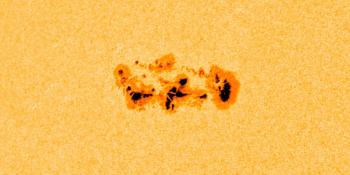
Complex sunspot region 4366

lundi, 19 janvier 2026
CME impact! S4 solar radiation storm

dimanche, 18 janvier 2026
X1.9 solar flare with earth-directed CME
Forum
AR4366 1019Yes, we really went to the moon before. 1Filaments and prominences 485Unexplained proton activity 111Feb 8-9 CMEs 26
Plus de messages du forumAidez SpaceWeatherLive.com !
De nombreuses personnes consultent SpaceWeatherLive pour suivre l'activité solaire ou observer les aurores boréales, mais l'augmentation du trafic engendre des coûts plus élevés pour maintenir les serveurs en ligne. Si vous appréciez SpaceWeatherLive et souhaitez soutenir le projet, vous pouvez vous abonner pour un site sans publicité ou faire un don. Grâce à votre aide, SpaceWeatherLive restera accessible !



La Météo Spatiale en faits
| Dernière classe X | 04/02/2026 | X4.3 |
| Dernière classe M | 11/02/2026 | M1.3 |
| Dernier orage géomagnétique | 05/02/2026 | Kp5+ (G1) |
| Jours sans taches solaires | |
|---|---|
| Dernier jour sans taches solaires | 08/06/2022 |
| Nombre mensuel moyen de taches solaires | |
|---|---|
| janvier 2026 | 112.6 -11.4 |
| février 2026 | 132.1 +19.5 |
| 30 derniers jours | 130.2 +30.2 |