Affichage des archives de dimanche, 5 juin 2011
Rapport d'activité solaire
Chaque éruption solaire mentionnée dans ce rapport a été ajustée selon un facteur d'échelle fourni par le Space Weather Prediction Center (SWPC). Ce facteur a conduit à une sous-estimation de 42% des éruptions solaires par rapport aux données de qualité scientifique. Nous avons supprimé ce facteur d'échelle de nos données archivées pour refléter les véritables unités physiques.
Rapport d'activité solaire et géophysique 2011 Jun 05 2200 UTCFait par le NOAA © SWPC et adapté par SpaceWeatherLive.com
Rapport de l'USAF/NOAA sur l'activité solaire et géophysique
SDF numéro 156 publié à 2200Z le 05 Jun 2011IA. Analyse des régions solaires actives et activité du 04-2100Z au 05-2100Z Solar activity was at very low levels with only a
single B3 x-ray event recorded at 05/0214Z from Region 1226
(S21W38). New Region 1233 (S18W29) was numbered as a unipolar spot
group. No significant changes were observed with the remaining
regions on the disk. During the period, LASCO C3 and STEREO-B COR2
imagery observed three separate CMEs. The first two CMEs were
back-sided, and appeared to originate from the vicinity of old
Region 1222 (N17, L=160) which rotated off the visible disk on 31
May. CME number one was first observed in STEREO Ahead EUVI 195
imagery at 04/0645Z and later in LASCO C3 imagery at 04/2212Z as a
partial-halo CME lifting of the east limb. The plane-of-sky speed
was estimated at about 1380 km/s. CME number two was first observed
in STEREO Ahead EUVI 195 imagery at 04/2145Z and later in LASCO C3
imagery at 05/0733ZZ as an asymmetric full-halo CME lifting off the
east limb. The plane-of-sky speed for this CME was estimated at
about 2160 km/s. A third CME originated from an eruptive, 16 degree
filament centered near N34E37. The filament was first observed
lifting off in SDO/AIA 193 imagery at 05/0341Z, with the
partial-halo CME first visible in STEREO Behind COR2 imagery at
05/0733Z. The plane-of-sky speed for the third CME was estimated at
490 km/s.
IB. Prévisions d'activité solaire
Solar activity is expected to be low
with a slight chance for an M-class event all three days (06 - 08
June).
IIA. Résumé de l'activité géophysique du 04-2100Z au 05-2100Z
The geomagnetic field was at quiet to major storm levels. The
increase in activity was in response to the arrival of the 02 June
CME, coupled with a recurrent coronal hole high speed wind stream.
After the ACE spacecraft detected the initial interplanetary shock
at 04/1958Z, wind velocities rose steadily for the next four hours
and reached a peak during the period of 560 km/s at 05/0020Z. Bt
reached a maximum of 28 nT at 05/0053Z while the Bz component of the
interplanetary magnetic field (IMF) reached a maximum southward
value of -19 nT at 04/2157Z. The Bz component remained strongly
southward through about 05/0000Z where it turned strongly northward
to about +18 nT through 05/0700Z. Thereafter, and through the
balance of the period, the Bz component of the IMF did not vary much
beyond +/- 7 nT. Associated with the first two CMEs, observed off
the east limb, was a greater than 10 MeV proton enhancement that
reached a maximum of 3.9 pfu at 05/0050Z. Proton flux values decayed
to below 1 pfu after 05/0205Z and remained below through the
remainder of the period. The greater than 2 MeV electron flux at
geosynchronous orbit reached high levels during the period.
IIB. Prévision de l'activité géophysique
The geomagnetic field is
expected to be quiet to unsettled, with isolated high latitude
active periods, on day one (06 June) due to lingering effects from
the CME and recurrent coronal hole high speed stream. On days two
and three (07 - 08 June), mostly quiet conditions are expected as
the activity subsides. Other than the brief proton ehnhancement
observed early on 05 June, no other effects are expected from the
three CMEs observed on 04 and 05 June.
III. Probabilité d'éruption solaire du 06 Jun au 08 Jun
| Classe M | 10% | 10% | 10% |
| Classe X | 01% | 01% | 01% |
| Proton | 01% | 01% | 01% |
| PCAF | green | ||
IV. Flux Penticton 10.7 cm
  Observé       05 Jun 103
  Prévisionnel   06 Jun-08 Jun  100/098/096
  Moyenne des 90 derniers jours        05 Jun 106
V. Indice géomagnetique A
  Observé Afr/Ap 04 Jun  011/015
  Estimé     Afr/Ap 05 Jun  020/020
  Prévisionnel    Afr/Ap 06 Jun-08 Jun  008/010-005/005-005/005
VI. Probabilités d'activité géomagnétique du 06 Jun au 08 Jun
| A. Latitudes moyennes | |||
|---|---|---|---|
| Actif | 15% | 05% | 05% |
| Tempête mineure | 05% | 01% | 01% |
| Tempête majeure/sévère | 01% | 01% | 01% |
| B. Hautes latitudes | |||
|---|---|---|---|
| Actif | 20% | 05% | 05% |
| Tempête mineure | 10% | 01% | 01% |
| Tempête majeure/sévère | 01% | 01% | 01% |
Toutes les heures sont indiquées en UTC
Dernières nouvelles

lundi, 30 mars 2026
X1.5 solar flare

mardi, 17 mars 2026
M2.7 solar flare, CME arrival possible
dimanche, 1 février 2026
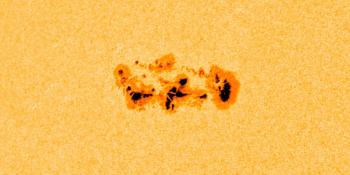
Complex sunspot region 4366
Forum
Incoming & Unnumbered Active Regions 266Unspecified geomagnetic activity 151AR4416 12Filaments and prominences 543Space Weather Memes 821
Plus de messages du forumAidez SpaceWeatherLive.com !
De nombreuses personnes consultent SpaceWeatherLive pour suivre l'activité solaire ou observer les aurores boréales, mais l'augmentation du trafic engendre des coûts plus élevés pour maintenir les serveurs en ligne. Si vous appréciez SpaceWeatherLive et souhaitez soutenir le projet, vous pouvez vous abonner pour un site sans publicité ou faire un don. Grâce à votre aide, SpaceWeatherLive restera accessible !



La Météo Spatiale en faits
| Dernière classe X | 30/03/2026 | X1.5 |
| Dernière classe M | 09/04/2026 | M1.0 |
| Dernier orage géomagnétique | 03/04/2026 | Kp7- (G3) |
| Jours sans taches solaires | |
|---|---|
| 365 derniers jours | 3 jours |
| 2026 | 3 jours (3%) |
| Dernier jour sans taches solaires | 24/02/2026 |
| Nombre mensuel moyen de taches solaires | |
|---|---|
| mars 2026 | 85.9 +7.7 |
| avril 2026 | 101.7 +15.8 |
| 30 derniers jours | 97.5 +41.1 |
A ce jour dans l'histoire*
Aurora on this day in history
No observations submitted for this day in history. If you've observed the aurora and you have some amazing photos to show off, submit your observations now!
Submit your aurora observation