Affichage des archives de jeudi, 20 février 2014
Bulletin quotidien sur l'activité solaire et géomagnétique du SIDC
Publié: 2014 Feb 20 1315 UTC
Prévisions SIDC
Éruptions solaires
Active (M-class flares expected, probability >=50%)
Géomagnétisme
Major magstorm expected (A>=50 or K>=6)
Moniteur de Flux de Proton
Proton event in progress (>10 MeV)
| Flux de 10 cm | Ap | |
|---|---|---|
| 20 Feb 2014 | 158 | 057 |
| 21 Feb 2014 | 155 | 008 |
| 22 Feb 2014 | 154 | 031 |
Bulletin
Solar activity has been dominated by NOAA ARs 1982 and 1976. The latter, even though it decayed in past 24h, produced an M3.0 flare peaking at 07:56 UT, it is now rotating over the west limb. NOAA AR 1982, with beta-gamma configuration, has grown and developed, M-class flares are possible. The M3.0 flare was associated with radio bursts, and a proton storm that increased the 10 MeV fluxes over the threshold of 10 protons/cm2-s-sr (at 09:00 UT) and reached a peak of 20 protons/cm2-s-sr 30 minutes later (at present is around 10 protons/cm2-s-sr). The fluxes of 50 and 100 MeV protons were also affected and peaked around 3 and 0.7 protons/cm2-s-sr respectively. Three halo CMEs occurred in past 24h. The first one, a full halo at 16:00 UT (LASCO-C2) on February 19, related to a filament eruption close to central meridian. The bulk of the material is heading south, but a glancing blow at the Earth can be expected on February 23 around 15:00 UT (using the measured speed of 430 km/s). The second one was related to a C3.3 flare from NOAA AR 1982 (peaking at 03:25 UT), first seen by LASCO-C2 at 03:12 UT . This CME will most likely arrive to the Earth. Arrival time expected for February 22 around 16:00 UT, using the measured speed of 830 km/s. The third one occurred in relation with the M3.0 flare from NOAA AR 1976, due to the location of the source (W75), the bulk of the CME is travelling towards the west. Most likely only a shock will reach the Earth. The measured speed is 959 km/s and thus the expected arrival time is February 22 at 09:00 UT. Due to the speeds, all three CMEs will most likely interact on its way to the Earth. A shock arrived to ACE at 02:58 UT, probably related to an early arrival of the halo CME from February 18. Kp has reached 6 from 03:00 to 12:00 UT due to a southward Bz of -10nT and solar wind speeds in the order of 700 km/s during several hours. More geomagnetic storm periods are expected as Bz is around -7 nT with speeds over 600 km/s.
Estimation du nombre international de taches solaires (ISN) pour aujourd'hui : 090, sur la base de 09 stations.Indices solaires pour 19 Feb 2014
| Nombre de Wolf, observé par Catania | /// |
| Flux solaire à 10 cm | 158 |
| AK Chambon La Forêt | 048 |
| AK Wingst | 041 |
| Ap estimé | 046 |
| Nombre international de taches solaires estimé | 088 - Basé sur 13 stations |
Résumé des événements marquants
| Jour | Commencer | Max | Fin | Loc | Force | OP | 10cm | Catania/NOAA | Types de sursaut radio |
|---|---|---|---|---|---|---|---|---|---|
| 20 | 0726 | 0756 | 0825 | S15W73 | M3.0 | SN | 420 | 42/1976 | V/1III/2II/2 |
Données fournies par le Solar Influences Data analysis Center© - SIDC - Traité par SpaceWeatherLive
Toutes les heures sont indiquées en UTC
Dernières nouvelles

M2.7 solar flare, CME arrival possible
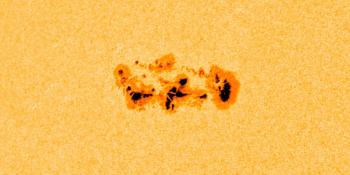
Complex sunspot region 4366

CME impact! S4 solar radiation storm
Aidez SpaceWeatherLive.com !
De nombreuses personnes consultent SpaceWeatherLive pour suivre l'activité solaire ou observer les aurores boréales, mais l'augmentation du trafic engendre des coûts plus élevés pour maintenir les serveurs en ligne. Si vous appréciez SpaceWeatherLive et souhaitez soutenir le projet, vous pouvez vous abonner pour un site sans publicité ou faire un don. Grâce à votre aide, SpaceWeatherLive restera accessible !



La Météo Spatiale en faits
| Dernière classe X | 04/02/2026 | X4.21 |
| Dernière classe M | 28/03/2026 | M1.3 |
| Dernier orage géomagnétique | 25/03/2026 | Kp5+ (G1) |
| Jours sans taches solaires | |
|---|---|
| 365 derniers jours | 3 jours |
| 2026 | 3 jours (3%) |
| Dernier jour sans taches solaires | 24/02/2026 |
| Nombre mensuel moyen de taches solaires | |
|---|---|
| février 2026 | 78.2 -34.3 |
| mars 2026 | 85.2 +7 |
| 30 derniers jours | 85.2 +8.6 |