Affichage des archives de mercredi, 2 avril 2014
Bulletin quotidien sur l'activité solaire et géomagnétique du SIDC
Publié: 2014 Apr 02 1244 UTC
Prévisions SIDC
Éruptions solaires
Eruptive (C-class flares expected, probability >=50%)
Géomagnétisme
Active conditions expected (A>=20 or K=4)
Moniteur de Flux de Proton
Quiet
| Flux de 10 cm | Ap | |
|---|---|---|
| 02 Apr 2014 | 153 | 022 |
| 03 Apr 2014 | 154 | 011 |
| 04 Apr 2014 | 154 | 007 |
Bulletin
Solar flaring activity was limited to about a dozen of low level C class flares. Most of them originated from NOAA AR 2026, with the strongest one peaking at 06:08 UT, April 2, at C3.5 level. Others originated from NOAA AR 2022, 2027, and 2029. The eruption of a filament located to the south-east of NOAA AR 2021, triggered a faint halo CME which was visible in LASCO COR 2 images from April 1, 16:48 UT onwards. The bulk of the CME was expelled in eastern direction and directed slightly south. CACTus software only detected multiple fragments of the event. The projected speed as estimated from Stereo B COR2 is about 300 km/s. Hence, the arrival of the perturbation can be expected around late April 4 and early April 6, probably only causing merely unsettled to active geomagnetic conditions. This halo CME was immediately followed by a faster partial halo CME, first visible in LASCO C2 images at 19:00 UT, April 1. In STEREO B COR2 the event is first visible at 19:25 UT. CACTus underestimated its angular width, which from manual detection is estimated to be around 160 degrees, with the main component directed in west southwest direction. It does not seem to be related to any front side activity and we therefore do not expect the CME to be geoeffective. However, since the event could neither be clearly related to any activity on the back side, the source of the CME remains yet undetermined. The solar wind speed is steady between 400 and 450 km/s with total field still around 5 nT. There are yet no signs of the expected arrival of the CMEs of March 28, 29, and 30. Unsettled conditions to minor storm levels can still be expected over the next days when/if these CMEs arrive.
Estimation du nombre international de taches solaires (ISN) pour aujourd'hui : 083, sur la base de 16 stations.Indices solaires pour 01 Apr 2014
| Nombre de Wolf, observé par Catania | 109 |
| Flux solaire à 10 cm | 153 |
| AK Chambon La Forêt | 014 |
| AK Wingst | 005 |
| Ap estimé | 006 |
| Nombre international de taches solaires estimé | 074 - Basé sur 25 stations |
Résumé des événements marquants
| Jour | Commencer | Max | Fin | Loc | Force | OP | 10cm | Catania/NOAA | Types de sursaut radio | |
|---|---|---|---|---|---|---|---|---|---|---|
| Aucun | ||||||||||
Données fournies par le Solar Influences Data analysis Center© - SIDC - Traité par SpaceWeatherLive
Toutes les heures sont indiquées en UTC
Dernières nouvelles

X1.5 solar flare

M2.7 solar flare, CME arrival possible
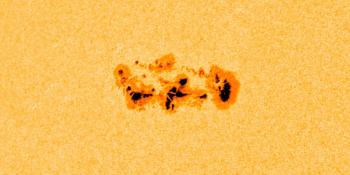
Complex sunspot region 4366
Forum
Aidez SpaceWeatherLive.com !
De nombreuses personnes consultent SpaceWeatherLive pour suivre l'activité solaire ou observer les aurores boréales, mais l'augmentation du trafic engendre des coûts plus élevés pour maintenir les serveurs en ligne. Si vous appréciez SpaceWeatherLive et souhaitez soutenir le projet, vous pouvez vous abonner pour un site sans publicité ou faire un don. Grâce à votre aide, SpaceWeatherLive restera accessible !



La Météo Spatiale en faits
| Dernière classe X | 30/03/2026 | X1.5 |
| Dernière classe M | 09/04/2026 | M1.0 |
| Dernier orage géomagnétique | 03/04/2026 | Kp7- (G3) |
| Jours sans taches solaires | |
|---|---|
| 365 derniers jours | 3 jours |
| 2026 | 3 jours (3%) |
| Dernier jour sans taches solaires | 24/02/2026 |
| Nombre mensuel moyen de taches solaires | |
|---|---|
| mars 2026 | 85.9 +7.7 |
| avril 2026 | 94.2 +8.3 |
| 30 derniers jours | 94.7 +35.4 |