Affichage des archives de jeudi, 11 septembre 2014
Bulletin quotidien sur l'activité solaire et géomagnétique du SIDC
Publié: 2014 Sep 11 1236 UTC
Prévisions SIDC
Éruptions solaires
Active (M-class flares expected, probability >=50%)
Géomagnétisme
Active conditions expected (A>=20 or K=4)
Moniteur de Flux de Proton
Proton event in progress (>10 MeV)
| Flux de 10 cm | Ap | |
|---|---|---|
| 11 Sep 2014 | 164 | 018 |
| 12 Sep 2014 | 168 | 026 |
| 13 Sep 2014 | 170 | 059 |
Bulletin
On 10 September, NOAA 2158 produced an X1.6 flare peaking at 17:45UT. It was accompanied by an EIT wave, coronal dimming, and post-flare coronal loops. Around 21:00UT, the proton flux gradually started to increase, and a minor proton event started around 03:00UT. Associated to this strong flare was a full halo CME, first observed by SOHO/LASCO at 18:00UT. It had a plane-of-the-sky speed of at least 800 km/s and is directed to Earth. Estimated arrival time is 21 September at 21:00UT (+/- 12 hours). There are currently 9 sunspot groups visible. NOAA 2158 has no delta structure, but the main spot remains close to opposite polarity flux to the south and east. NOAA 2157 retained its delta structure in its main trailing spot. An active region that is about to round the northeast limb was responsible for a C4 flare peaking at 03:49UT. This was the strongest of 3 low-level C-class flares that were observed during the last 24 hours. M-class flares are expected, with a chance on another X-class event. Solar wind speed was mostly between 350 and 400 km/s, with Bz varying between +6 and -7 nT. A sector boundary crossing was observed around 21:30UT, with IMF turning away from the Sun. Brief periods of active geomagnetic conditions were observed over the last 12 hours, otherwise the geomagnetic field was unsettled. Unsettled to active geomagnetic conditions are expected for 11 and most of 12 September in response to the possible impact of the halo CME related to the M4.5 flare from 9 September. This will then be followed by the arrival of the halo CME related to the X1.6 flare late on 12 or early on 13 September. Pending the orientation of the CME's magnetic field, this may result in a major geomagnetic storm, with locally severe geomagnetic storming possible.
Estimation du nombre international de taches solaires (ISN) pour aujourd'hui : 114, sur la base de 13 stations.Indices solaires pour 10 Sep 2014
| Nombre de Wolf, observé par Catania | 184 |
| Flux solaire à 10 cm | 160 |
| AK Chambon La Forêt | 018 |
| AK Wingst | 010 |
| Ap estimé | 011 |
| Nombre international de taches solaires estimé | 113 - Basé sur 21 stations |
Résumé des événements marquants
| Jour | Commencer | Max | Fin | Loc | Force | OP | 10cm | Catania/NOAA | Types de sursaut radio |
|---|---|---|---|---|---|---|---|---|---|
| 10 | 1721 | 1745 | 1820 | N14E02 | X1.6 | 2B | 1300 | 48/2158 | IV/2 |
Données fournies par le Solar Influences Data analysis Center© - SIDC - Traité par SpaceWeatherLive
Toutes les heures sont indiquées en UTC
Dernières nouvelles

M2.7 solar flare, CME arrival possible
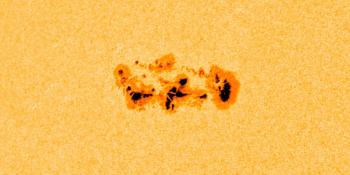
Complex sunspot region 4366

CME impact! S4 solar radiation storm
Forum
Aidez SpaceWeatherLive.com !
De nombreuses personnes consultent SpaceWeatherLive pour suivre l'activité solaire ou observer les aurores boréales, mais l'augmentation du trafic engendre des coûts plus élevés pour maintenir les serveurs en ligne. Si vous appréciez SpaceWeatherLive et souhaitez soutenir le projet, vous pouvez vous abonner pour un site sans publicité ou faire un don. Grâce à votre aide, SpaceWeatherLive restera accessible !



La Météo Spatiale en faits
| Dernière classe X | 04/02/2026 | X4.21 |
| Dernière classe M | 18/03/2026 | M2.7 |
| Dernier orage géomagnétique | 22/03/2026 | Kp7- (G3) |
| Jours sans taches solaires | |
|---|---|
| 365 derniers jours | 3 jours |
| 2026 | 3 jours (4%) |
| Dernier jour sans taches solaires | 24/02/2026 |
| Nombre mensuel moyen de taches solaires | |
|---|---|
| février 2026 | 78.2 -34.3 |
| mars 2026 | 77 -1.2 |
| 30 derniers jours | 71.5 -16.6 |