Affichage des archives de lundi, 13 avril 2015
Bulletin quotidien sur l'activité solaire et géomagnétique du SIDC
Publié: 2015 Apr 13 1232 UTC
Prévisions SIDC
Éruptions solaires
Eruptive (C-class flares expected, probability >=50%)
Géomagnétisme
Active conditions expected (A>=20 or K=4)
Moniteur de Flux de Proton
Warning condition (activity levels expected to increase, but no numeric forecast given)
| Flux de 10 cm | Ap | |
|---|---|---|
| 13 Apr 2015 | 138 | 011 |
| 14 Apr 2015 | 145 | 014 |
| 15 Apr 2015 | 148 | 017 |
Bulletin
The strongest flare reported during the last 24 hours was the C9.0 flare which peaked at 18:07 UT on April 12. The flare originated from the NOAA AR 2321, situated at that moment close to the east solar limb. No clear signatures of the CME possibly associated with this flare are visible in the currently available data. The NOAA AR 2321 presently has beta-gamma- delta configuration of its photospheric magnetic field and therefore also potential to be the source of C-class and M-class flares in the course of coming hours. The partial halo CME, first seen in the SOHO LASCO C2 field of view at about 23:36 UT on April 12 was associated with the flare and the filament eruption triggered by the flare (from the close to the west solar limb region). The associated type II radio burst, signature of the shock wave, was reported by Culgoora Observatory. The radio burst gives indication that the speed of the associated shock was about 1100 km/s. The CME had the angular width of about 150 degrees and the projected plane of the sky speed of about 630 km/s. The expected CME arrival at the Earth is in late evening of the April 15 or early morning of April 16. The Earth is still inside a slow solar wind with the speed of 350 km/s, and the interplanetary magnetic field is currently rather low with the magnitude of about 2nT. The geomagnetic conditions are currently quiet, and we expect quiet to unsettled geomagnetic conditions in the coming hours. The arrival of the fast flow, from the southern polar coronal hole which has strong extend towards the solar equator, is expected in the afternoon of April 14 and morning of April 15 with possible active geomagnetic conditions.
Estimation du nombre international de taches solaires (ISN) pour aujourd'hui : 077, sur la base de 18 stations.Indices solaires pour 12 Apr 2015
| Nombre de Wolf, observé par Catania | /// |
| Flux solaire à 10 cm | 134 |
| AK Chambon La Forêt | 010 |
| AK Wingst | 005 |
| Ap estimé | 004 |
| Nombre international de taches solaires estimé | 064 - Basé sur 26 stations |
Résumé des événements marquants
| Jour | Commencer | Max | Fin | Loc | Force | OP | 10cm | Catania/NOAA | Types de sursaut radio | |
|---|---|---|---|---|---|---|---|---|---|---|
| Aucun | ||||||||||
Données fournies par le Solar Influences Data analysis Center© - SIDC - Traité par SpaceWeatherLive
Toutes les heures sont indiquées en UTC
Dernières nouvelles

X1.5 solar flare

M2.7 solar flare, CME arrival possible
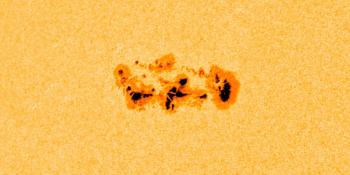
Complex sunspot region 4366
Forum
Aidez SpaceWeatherLive.com !
De nombreuses personnes consultent SpaceWeatherLive pour suivre l'activité solaire ou observer les aurores boréales, mais l'augmentation du trafic engendre des coûts plus élevés pour maintenir les serveurs en ligne. Si vous appréciez SpaceWeatherLive et souhaitez soutenir le projet, vous pouvez vous abonner pour un site sans publicité ou faire un don. Grâce à votre aide, SpaceWeatherLive restera accessible !



La Météo Spatiale en faits
| Dernière classe X | 30/03/2026 | X1.4 |
| Dernière classe M | 28/03/2026 | M1.3 |
| Dernier orage géomagnétique | 25/03/2026 | Kp5+ (G1) |
| Jours sans taches solaires | |
|---|---|
| 365 derniers jours | 3 jours |
| 2026 | 3 jours (3%) |
| Dernier jour sans taches solaires | 24/02/2026 |
| Nombre mensuel moyen de taches solaires | |
|---|---|
| février 2026 | 78.2 -34.3 |
| mars 2026 | 86.6 +8.4 |
| 30 derniers jours | 86.6 +11.2 |