Affichage des archives de samedi, 23 juillet 2016
Bulletin quotidien sur l'activité solaire et géomagnétique du SIDC
Publié: 2016 Jul 23 1230 UTC
Prévisions SIDC
Éruptions solaires
M-class flares expected (probability >=50%)
Géomagnétisme
Quiet (A<20 and K<4)
Moniteur de Flux de Proton
Warning condition (activity levels expected to increase, but no numeric forecast given)
| Flux de 10 cm | Ap | |
|---|---|---|
| 23 Jul 2016 | 093 | 008 |
| 24 Jul 2016 | 090 | 006 |
| 25 Jul 2016 | 087 | 016 |
Bulletin
NOAA 2567 started another active flaring episode shortly after midnight producing 3 M-class flares. The intensities and peak timings of the events were resp. M5.0 (02:11UT), M7.6 (05:16UT), and M5.5 (05:31UT). In particular the last event was accompanied by an impressive ejection of material. San Vito reported a type II radio burst with related shock speed of the disturbance of 729 km/s. The greater than 10 MeV proton flux is somewhat enhanced (0.77 pfu at 07:25UT), but has remained so far well below the event threshold (10 pfu). The currently available coronagraphic images show that the bulk of the associated coronal mass ejections (CMEs) is directed away from the Earth. However, a glancing blow from the CME of the double-peaked M-class event cannot be excluded. No other earth-directed CMEs were observed.
An accurate assessment of the magnetic configuration of the NOAA 2565 / 2567 sunspot cluster is difficult due to its close proximity near the west limb. Nonetheless, further M-class flaring is possible, with a small chance on an X-class flare. A warning for a potential proton event has been put into effect.
The interplanetary magnetic field was directed towards the Sun (negative), except during the 17:00-02:00UT interval when it was steadily positive (away from the Sun). This interval corresponded to somewhat elevated solar wind speeds between about 440 and 500 km/s and Bz near 0 nT. At the end of the reporting period, solar wind parameters were back at nominal values with wind speed near 390 km/s, and Bz varying between -8 and +7 nT. A small positive coronal hole (CH; latitude +20 degrees) is near the central meridian. Quiet to unsettled geomagnetic conditions were observed.
Mostly quiet to unsettled geomagnetic conditions are expected. An active episode is not excluded, in particular on 25 July when a glancing blow from the 23 July CME is possible.
Estimation du nombre international de taches solaires (ISN) pour aujourd'hui : 030, sur la base de 22 stations.Indices solaires pour 22 Jul 2016
| Nombre de Wolf, observé par Catania | 057 |
| Flux solaire à 10 cm | 090 |
| AK Chambon La Forêt | 018 |
| AK Wingst | 012 |
| Ap estimé | 011 |
| Nombre international de taches solaires estimé | 044 - Basé sur 30 stations |
Résumé des événements marquants
| Jour | Commencer | Max | Fin | Loc | Force | OP | 10cm | Catania/NOAA | Types de sursaut radio |
|---|---|---|---|---|---|---|---|---|---|
| 23 | 0146 | 0211 | 0223 | ---- | M5.0 | 09/2567 | VI/2III/2 | ||
| 23 | 0500 | 0516 | 0524 | N02W74 | M7.6 | 3B | 310 | 09/2567 | III/2 |
| 23 | 0527 | 0531 | 0533 | ---- | M5.5 | 900 | 09/2567 | V/3IV/2II/1 |
Données fournies par le Solar Influences Data analysis Center© - SIDC - Traité par SpaceWeatherLive
Toutes les heures sont indiquées en UTC
Dernières nouvelles

X1.5 solar flare

M2.7 solar flare, CME arrival possible
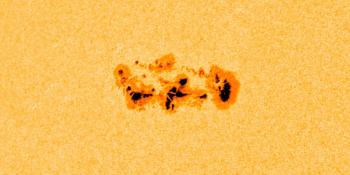
Complex sunspot region 4366
Forum
Aidez SpaceWeatherLive.com !
De nombreuses personnes consultent SpaceWeatherLive pour suivre l'activité solaire ou observer les aurores boréales, mais l'augmentation du trafic engendre des coûts plus élevés pour maintenir les serveurs en ligne. Si vous appréciez SpaceWeatherLive et souhaitez soutenir le projet, vous pouvez vous abonner pour un site sans publicité ou faire un don. Grâce à votre aide, SpaceWeatherLive restera accessible !



La Météo Spatiale en faits
| Dernière classe X | 30/03/2026 | X1.5 |
| Dernière classe M | 09/04/2026 | M1.0 |
| Dernier orage géomagnétique | 03/04/2026 | Kp7- (G3) |
| Jours sans taches solaires | |
|---|---|
| 365 derniers jours | 3 jours |
| 2026 | 3 jours (3%) |
| Dernier jour sans taches solaires | 24/02/2026 |
| Nombre mensuel moyen de taches solaires | |
|---|---|
| mars 2026 | 85.9 +7.7 |
| avril 2026 | 114.3 +28.4 |
| 30 derniers jours | 101.8 +46.6 |
