Affichage des archives de mardi, 30 août 2016
Bulletin quotidien sur l'activité solaire et géomagnétique du SIDC
Publié: 2016 Aug 30 1230 UTC
Prévisions SIDC
Éruptions solaires
C-class flares expected, (probability >=50%)
Géomagnétisme
Active conditions expected (A>=20 or K=4)
Moniteur de Flux de Proton
Quiet
| Flux de 10 cm | Ap | |
|---|---|---|
| 30 Aug 2016 | 086 | 008 |
| 31 Aug 2016 | 088 | 022 |
| 01 Sep 2016 | 091 | 011 |
Bulletin
Over the past 24 hours solar activity has been low. The largest flare was a C1.1 class flare. Active Region (AR) 2583 (Macintosh class:Dao; Mag. type:Beta) has been most active, producing the C1.1 class flare, which peaked at 17:36 UT yesterday. All other ARs have shown low levels of activity. AR 2583 still shows evidence of flux emergence and cancellation in HMI magnetogram observations which may increase flaring activity, however, the region is approaching the West solar limb. A filament channel located between N30W15 and N15W60 was observed to lift off around 19:00 UT yesterday in SDO/AIA 304 observations. The eruption did not produce a clear Coronal Mass Ejection (CME) signature in coronagraph observations, but there were significant data gaps in imagery. There is some evidence of a small CME moving off to West, which will have a small impact on the Earth system. Solar protons have remained at background levels over the past 24 hours. Solar activity is expected to remain low over the next 24 hours with a chance of C-class flares and a low probability of M-class flares.
The solar wind speed has increased from around 330 to 425 km/s over the past 24 hours. The total magnetic field strength has increased from around 5 nT to 10 nT. The Bz component has oscillated between positive and negative, fluctuating between -8 and +10 nT. Geomagnetic conditions ranged between Kp index 2-3 (NOAA) and local K index 1-3 (Dourbes) over the past 24 hours. A small trans-equatorial coronal hole located at central latitudes, N01W60, created enhanced solar wind speeds at Earth due to its associated high-speed stream (HSS), which are expected to persist throughout the day and may enhance geomagnetic activity. A large positive polarity Northern polar coronal hole located near central longitudes extending toward low latitudes is expected to enhance solar wind speeds in the coming days. As a consequence the geomagnetic activity is expected to be slightly enhanced today and again later in the week. The small filament eruption discussed above is expected to move to the West and avoid the Earth system.
Estimation du nombre international de taches solaires (ISN) pour aujourd'hui : 078, sur la base de 20 stations.Indices solaires pour 29 Aug 2016
| Nombre de Wolf, observé par Catania | /// |
| Flux solaire à 10 cm | /// |
| AK Chambon La Forêt | /// |
| AK Wingst | 012 |
| Ap estimé | 010 |
| Nombre international de taches solaires estimé | 068 - Basé sur 24 stations |
Résumé des événements marquants
| Jour | Commencer | Max | Fin | Loc | Force | OP | 10cm | Catania/NOAA | Types de sursaut radio | |
|---|---|---|---|---|---|---|---|---|---|---|
| Aucun | ||||||||||
Données fournies par le Solar Influences Data analysis Center© - SIDC - Traité par SpaceWeatherLive
Toutes les heures sont indiquées en UTC
Dernières nouvelles

X1.5 solar flare

M2.7 solar flare, CME arrival possible
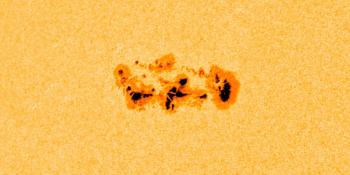
Complex sunspot region 4366
Forum
Aidez SpaceWeatherLive.com !
De nombreuses personnes consultent SpaceWeatherLive pour suivre l'activité solaire ou observer les aurores boréales, mais l'augmentation du trafic engendre des coûts plus élevés pour maintenir les serveurs en ligne. Si vous appréciez SpaceWeatherLive et souhaitez soutenir le projet, vous pouvez vous abonner pour un site sans publicité ou faire un don. Grâce à votre aide, SpaceWeatherLive restera accessible !



La Météo Spatiale en faits
| Dernière classe X | 30/03/2026 | X1.5 |
| Dernière classe M | 09/04/2026 | M1.0 |
| Dernier orage géomagnétique | 19/04/2026 | Kp6- (G2) |
| Jours sans taches solaires | |
|---|---|
| 365 derniers jours | 3 jours |
| 2026 | 3 jours (3%) |
| Dernier jour sans taches solaires | 24/02/2026 |
| Nombre mensuel moyen de taches solaires | |
|---|---|
| mars 2026 | 85.9 +7.7 |
| avril 2026 | 81 -4.9 |
| 30 derniers jours | 94 +31.1 |