Affichage des archives de lundi, 20 août 2018
Bulletin quotidien sur l'activité solaire et géomagnétique du SIDC
Publié: 2018 Aug 20 1245 UTC
Prévisions SIDC
Éruptions solaires
Quiet conditions (<50% probability of C-class flares)
Géomagnétisme
Active conditions expected (A>=20 or K=4)
Moniteur de Flux de Proton
Quiet
| Flux de 10 cm | Ap | |
|---|---|---|
| 20 Aug 2018 | 067 | 023 |
| 21 Aug 2018 | 067 | 029 |
| 22 Aug 2018 | 067 | 017 |
Bulletin
Solar activity was very quiet with X-ray flux remaining below B level. NOAA active region 2718 has decayed while the newly developing small bipolar region in the East was numbered NOAA 2719. X-ray flux is expected to remain below C level.
Around 5:00UT August 19, a minor but long duration A-flare from region 2718 was associated with an on disk dimming (5:40UT august 19), evidencing an eruptive phenomenon. In SoHO/LASCO C2 coronagraph images a very narrow (only around 10 degrees angular width) CME is visible from August 19 7:36UT onwards, directed towards the South-West. It is also visible from Stereo A COR2, also narrow and directed to the South-West from this viewpoint. From the Stereo COR2 images a radial speed of around 1000 km/s may be estimated. Given the narrow angular extent and the direction of the ejecta (no halo character from Earth perspective), the bulk of this CME is expected to go South of the Earth.
Proton flux levels were at background values and are expected to remain so.
Solar wind conditions were indicative of the arrival of the expected high speed stream from the transequatorial negative polarity coronal hole. Solar wind speed reached a minimum of close to 400 km/s near the start of the period and then started a steady increase to current values of over 650 km/s. Between 17UT and 8UT total magnetic field was enhanced reaching values of close to 14nT, but the Bz component was mainly positive. Meanwhile, total magnetic field has restored to below 5nT. Solar wind speed is still expected to increase and is expected to remain elevated for several days given the extent of the coronal hole. For the CME of August 19 the bulk of the CME is expected to go South of the Earth but there remains a possibility that a shock arrives at Earth. If this occurs this is expected around midnight August 21/22 but its effect will be small within the already elevated background solar wind conditions. Geomagnetic conditions were mainly quiet to unsettled (K Dourbes and NOAA Kp 1-3) with an isolated active period for Kp around midnight. Geomagnetic conditions may reach active levels under the influence of the high speed stream over the next days.
Estimation du nombre international de taches solaires (ISN) pour aujourd'hui : 016, sur la base de 15 stations.Indices solaires pour 19 Aug 2018
| Nombre de Wolf, observé par Catania | /// |
| Flux solaire à 10 cm | 067 |
| AK Chambon La Forêt | 018 |
| AK Wingst | 011 |
| Ap estimé | 010 |
| Nombre international de taches solaires estimé | 018 - Basé sur 27 stations |
Résumé des événements marquants
| Jour | Commencer | Max | Fin | Loc | Force | OP | 10cm | Catania/NOAA | Types de sursaut radio | |
|---|---|---|---|---|---|---|---|---|---|---|
| Aucun | ||||||||||
Données fournies par le Solar Influences Data analysis Center© - SIDC - Traité par SpaceWeatherLive
Toutes les heures sont indiquées en UTC
Dernières nouvelles
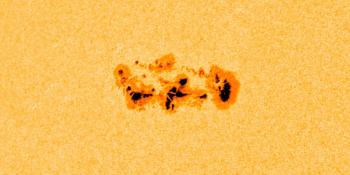
Complex sunspot region 4366

CME impact! S4 solar radiation storm

X1.9 solar flare with earth-directed CME
Forum
Aidez SpaceWeatherLive.com !
De nombreuses personnes consultent SpaceWeatherLive pour suivre l'activité solaire ou observer les aurores boréales, mais l'augmentation du trafic engendre des coûts plus élevés pour maintenir les serveurs en ligne. Si vous appréciez SpaceWeatherLive et souhaitez soutenir le projet, vous pouvez vous abonner pour un site sans publicité ou faire un don. Grâce à votre aide, SpaceWeatherLive restera accessible !



La Météo Spatiale en faits
| Dernière classe X | 04/02/2026 | X4.21 |
| Dernière classe M | 16/02/2026 | M2.4 |
| Dernier orage géomagnétique | 16/02/2026 | Kp6 (G2) |
| Jours sans taches solaires | |
|---|---|
| Dernier jour sans taches solaires | 08/06/2022 |
| Nombre mensuel moyen de taches solaires | |
|---|---|
| janvier 2026 | 112.6 -11.4 |
| février 2026 | 94.2 -18.4 |
| 30 derniers jours | 108.9 -4.7 |