Affichage des archives de jeudi, 25 août 2022
Bulletin quotidien sur l'activité solaire et géomagnétique du SIDC
Publié: 2022 Aug 25 1233 UTC
Prévisions SIDC
Éruptions solaires
C-class flares expected, (probability >=50%)
Géomagnétisme
Quiet (A<20 and K<4)
Moniteur de Flux de Proton
Quiet
| Flux de 10 cm | Ap | |
|---|---|---|
| 25 Aug 2022 | 108 | 003 |
| 26 Aug 2022 | 100 | 010 |
| 27 Aug 2022 | 118 | 010 |
Bulletin
Solar flaring activity was at low levels over the past 24 hours. Newly rotated NOAA AR 3089 appears to have been the location of the flare of the largest output, a C3.6-class flare, peak time 25 August 10:01 UTC. NOAA AR 3088 developed and was numbered over the past 24 hours. NOAA AR 3085 was fairly stable while NOAA AR 3086 exhibited small level of growth. Flaring activity is expected to be at low levels over the next 24 hours, while M class flares are possible.
A filament eruption was observed around NOAA AR 3088 at 24 August 21:18 UTC. However, there has been no clear indication of an associated Coronal Mass Ejection (CME). No Earth directed CMEs were confirmed in the available coronagraphic imagery over the past 24 hours.
The greater than 10 MeV proton flux was at nominal levels in the past 24 hours. The proton flux is expected to remain at nominal levels for the next 24 hours. The greater than 2MeV electron flux was above the 1000 pfu threshold over the past 24 hours. It is expected to be about threshold over the next 24 hours. The 24h electron fluence was at moderate levels over the past 24 hours. It is expected to be at moderate levels over the next 24 hours.
The solar wind parameters continued to reflect a return to background levels over the past 24 hours. The solar wind magnetic field values fluctuated between 4 and 7 nT, while Bz had values between -5 and 5 nT. The solar wind speed decreased further, down to 320 km/s. The interplanetary magnetic field phi angle was on the negative sector (towards the Sun). The equatorial coronal hole reported yesterday has dissipated. A negative polarity southern coronal hole, that almost encircles NOAA AR 3086 appeared will cross central meridian on 26 August. The associated high speed stream can be expected around 29-30 August. Over the next 24 hours, we are expecting this general trend to continue.
Quiet conditions were recorded over the past 24 hours (NOAA Kp and K Dourbes 0-2). Over next the 24 hours, quiet to unsettled conditions are expected.
Estimation du nombre international de taches solaires (ISN) pour aujourd'hui : 098, sur la base de 23 stations.Indices solaires pour 24 Aug 2022
| Nombre de Wolf, observé par Catania | 059 |
| Flux solaire à 10 cm | 108 |
| AK Chambon La Forêt | 006 |
| AK Wingst | 003 |
| Ap estimé | 002 |
| Nombre international de taches solaires estimé | 064 - Basé sur 31 stations |
Résumé des événements marquants
| Jour | Commencer | Max | Fin | Loc | Force | OP | 10cm | Catania/NOAA | Types de sursaut radio | |
|---|---|---|---|---|---|---|---|---|---|---|
| Aucun | ||||||||||
Données fournies par le Solar Influences Data analysis Center© - SIDC - Traité par SpaceWeatherLive
Toutes les heures sont indiquées en UTC
Dernières nouvelles

Happy New Year! Celebrate with an M7.1 solar flare!

M8.1 solar flare with earth-directed CME
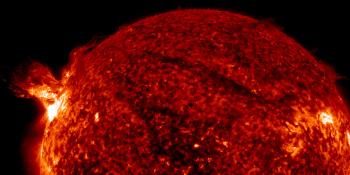
X1.9 solar flare, Coronal hole faces Earth
Aidez SpaceWeatherLive.com !
A lot of people come to SpaceWeatherLive to follow the Solar activity or if there is a chance to see the aurora, but with more traffic comes higher costs to keep the servers online. If you like SpaceWeatherLive and want to support the project you can choose a subscription for an ad-free site or consider a donation. With your help we can keep SpaceWeatherLive online!



La Météo Spatiale en faits
| Dernière classe X | 08/12/2025 | X1.1 |
| Dernière classe M | 14/01/2026 | M1.6 |
| Dernier orage géomagnétique | 16/01/2026 | Kp5 (G1) |
| Jours sans taches solaires | |
|---|---|
| Dernier jour sans taches solaires | 08/06/2022 |
| Nombre mensuel moyen de taches solaires | |
|---|---|
| décembre 2025 | 124 +32.2 |
| janvier 2026 | 96.7 -27.3 |
| 30 derniers jours | 101.3 -5.7 |