Affichage des archives de lundi, 12 septembre 2022
Bulletin quotidien sur l'activité solaire et géomagnétique du SIDC
Publié: 2022 Sep 12 1257 UTC
Prévisions SIDC
Éruptions solaires
C-class flares expected, (probability >=50%)
Géomagnétisme
Quiet (A<20 and K<4)
Moniteur de Flux de Proton
Warning condition (activity levels expected to increase, but no numeric forecast given)
| Flux de 10 cm | Ap | |
|---|---|---|
| 12 Sep 2022 | 151 | 007 |
| 13 Sep 2022 | 150 | 004 |
| 14 Sep 2022 | 150 | 007 |
Bulletin
Solar flaring activity over the past 24 hours was at low levels with twenty C-class flares. There are seven active regions on the visible solar disk, the most prominent being NOAA AR 3098 (beta-gamma), which has developed to be the largest and most complex active region and was responsible for the majority of the C-class flaring, including an impulsive C6.1-class with peak time 22:28 UTC on Sept 11th. The remaining low C-class flaring activity was produced by NOAA 3101 (beta), which underwent minor development over the past 24 hours. The remaining active regions are magnetically simple and remained either stable or exhibited gradual decay, expect for NOAA 3100 (beta), which underwent minor development, but showed no significant activity. The flaring activity is expected to remain at low levels with more C-class flares and some chances for isolated M-class flaring in the next 24 hours.
No Earth-directed coronal mass ejections (CMEs) were detected in the available coronagraph imagery over the past 24 hours.
Following the flaring activity the greater than 10 MeV proton flux was enhanced in the past 24 hours and might reach minor storm levels over the next 24 hours. The greater than 2 MeV electron flux has crossed the 1000 pfu threshold and is expected to cross the threshold again in the next 24 hours. The 24h electron fluence was at moderate levels in the past 24 hours and is expected to remain so in the next 24 hours.
Over the past 24 hours the solar wind parameters (ACE and DSCOVR) continued their decline towards background slow solar wind regime. The solar wind velocity smoothly varied in the range of 489 km/s to almost 378 km/s. The interplanetary magnetic field was weak with a maximum value of 6 nT with a minimum Bz component reaching -4.7 nT. The B field was predominantly in the positive sector (directed away from the Sun). The solar wind parameters are expected to be at slow solar wind conditions over the next 24 hours.
The geomagnetic conditions over the past 24 hours were quiet to unsettled. Mostly quiet to unsettled geomagnetic conditions are expected for the next 24 hours.
Estimation du nombre international de taches solaires (ISN) pour aujourd'hui : 140, sur la base de 21 stations.Indices solaires pour 11 Sep 2022
| Nombre de Wolf, observé par Catania | /// |
| Flux solaire à 10 cm | 152 |
| AK Chambon La Forêt | 017 |
| AK Wingst | 012 |
| Ap estimé | 010 |
| Nombre international de taches solaires estimé | 127 - Basé sur 24 stations |
Résumé des événements marquants
| Jour | Commencer | Max | Fin | Loc | Force | OP | 10cm | Catania/NOAA | Types de sursaut radio | |
|---|---|---|---|---|---|---|---|---|---|---|
| Aucun | ||||||||||
Données fournies par le Solar Influences Data analysis Center© - SIDC - Traité par SpaceWeatherLive
Toutes les heures sont indiquées en UTC
Dernières nouvelles

X1.5 solar flare

M2.7 solar flare, CME arrival possible
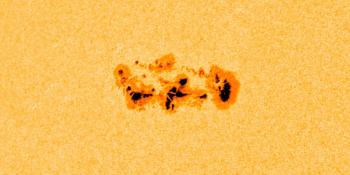
Complex sunspot region 4366
Aidez SpaceWeatherLive.com !
De nombreuses personnes consultent SpaceWeatherLive pour suivre l'activité solaire ou observer les aurores boréales, mais l'augmentation du trafic engendre des coûts plus élevés pour maintenir les serveurs en ligne. Si vous appréciez SpaceWeatherLive et souhaitez soutenir le projet, vous pouvez vous abonner pour un site sans publicité ou faire un don. Grâce à votre aide, SpaceWeatherLive restera accessible !



La Météo Spatiale en faits
| Dernière classe X | 30/03/2026 | X1.5 |
| Dernière classe M | 28/03/2026 | M1.3 |
| Dernier orage géomagnétique | 25/03/2026 | Kp5+ (G1) |
| Jours sans taches solaires | |
|---|---|
| 365 derniers jours | 3 jours |
| 2026 | 3 jours (3%) |
| Dernier jour sans taches solaires | 24/02/2026 |
| Nombre mensuel moyen de taches solaires | |
|---|---|
| février 2026 | 78.2 -34.3 |
| avril 2026 | 130 +51.8 |
| 30 derniers jours | 91.6 +20.3 |