Affichage des archives de dimanche, 7 décembre 2025
Bulletin quotidien sur l'activité solaire et géomagnétique du SIDC
Publié: 2025 Dec 07 1252 UTC
Prévisions SIDC
Éruptions solaires
M-class flares expected (probability >=50%)
Géomagnétisme
Active conditions expected (A>=20 or K=4)
Moniteur de Flux de Proton
Warning condition (activity levels expected to increase, but no numeric forecast given)
| Flux de 10 cm | Ap | |
|---|---|---|
| 07 Dec 2025 | 198 | 013 |
| 08 Dec 2025 | 196 | 012 |
| 09 Dec 2025 | 194 | 055 |
Régions solaires actives et éruptions solaires
Solar flaring activity over the past 24 hours was at moderate levels with background C-class flaring and 2 M-class flares detected. A total of 8 sunspot groups were identified on the visible solar disk. The strongest activity was a M8.1 flare (SIDC Flare 6318) with peak time 20:39 UTC on Dec 06, produced by SIDC Sunspot Group 687 (NOAA Active Regions 4274, 4299), which has evolved into magnetic type beta- gamma-delta. The region was also responsible for an M1.1 flare (SIDC Flare 6319) with peak time at 19:21 UTC on Dec 06. SIDC Sunspot Group 709 (NOAA Active Region 4294) and SIDC Sunspot Group 712 (NOAA Active Region 4296) remain the largest regions on disc, classified respectively as magnetic type beta-gamma-delta and beta-delta. These regions have produced only low levels of flaring activity. A new region, SIDC Sunspot Group 717, classified as magnetic type beta, has emerged in the south-easter quadrant and is currently growing. The solar flaring activity is expected to be at moderate levels over the next 24 hours with background C-class flaring, likely M-class flares and chances of isolated X-class flaring.
Éjection de masse coronale
A halo coronal mass ejection (SIDC CME 605) was first detected in the LASCO/C2 imagery starting at 19:24 UTC on Dec 06 and visible to the north-east in STEREO at 20:38 UTC. The CME is associated to the M-flaring from SIDC Sunspot Group 687 (NOAA Active Regions 4274, 4299). Related type II and type IV radio emissions were registered at 20:40 UTC and 20:57 UTC on Dec 06, respectively, and a large coronal dimming with post-eruptive arcade was detected as well. The CME has an estimated velocity of 850 km/s and is directed predominantly to the north-east. Preliminary analysis suggests a possible arrival at Earth late UTC on Dec 08 to early Dec 09. No other Earth-directed CMEs have been identified in the available coronagraph imagery over the past 24 hours.
Vent solaire
Over the past 24 hours the solar wind parameters (as measured by ACE at L1) continued to register the waning influence of a high-speed stream. The solar wind speed was on the decreasing trend, varying between 730 km/s and 490 km/s. The magnitude of the interplanetary magnetic field, B, is currently getting mildly elevated, reaching values of 8 nT. The Bz component has remained weak with a minimum value of -5.2 nT. The B field phi angle was predominantly in the negative sector (directed towards the Sun) reflecting the polarity of the geo-effective coronal hole. The solar wind conditions are expected to remain elevated over the next day under the waning influence of the ongoing high-speed stream with chances for minor enhancements Dec 07 related to any possible glancing blow influence from the modelled CMEs, which launched from the Sun on Dec 03 and Dec 04. Stronger enhancements are expected late on Dec 08 or early Dec 09 with an anticipated arrival of the halo CME from Dec 06.
Géomagnétisme
The geomagnetic conditions over the past 24 hours were predominantly quiet to unsettled with an isolated active period registered between 03-06 UTC on Dec 03. Locally over Belgium only quiet to unsettled conditioned were observed. Quiet to active conditions are expected for Dec 07 with chances for isolated minor storm levels in case of any possible glancing blow arrivals. Moderate to major geomagnetic storms might be expected starting early UTC on Dec 09 with chances of reaching severe geomagnetic conditions due to an anticipated arrival of the halo CME from Dec 06.
Niveaux de flux de protons
Over the past 24 hours the greater than 10 MeV GOES proton flux has exhibited some enhancements related to the M8.1-flaring and consequent CME eruption, but remained below any radiation storm thresholds. The 10 MeV GOES proton flux is expected to remain so over the next days with chances for further enhancements.
Flux d'électrons sur l'orbite géostationnaire
The greater than 2 MeV electron flux (as measured by GOES 18 and GOES 19) has exceeded the 1000 pfu threshold over the last 24 hours and is expected to exceed the 1000 pfu threshold again in the next 24 hours. The 24-hour electron fluence was at moderate levels and is expected to remain so over the next 24 hours.
Estimation du nombre international de taches solaires (ISN) pour aujourd'hui : 161, sur la base de 02 stations.Indices solaires pour 06 Dec 2025
| Nombre de Wolf, observé par Catania | /// |
| Flux solaire à 10 cm | 200 |
| AK Chambon La Forêt | 018 |
| AK Wingst | 014 |
| Ap estimé | 016 |
| Nombre international de taches solaires estimé | 158 - Basé sur 07 stations |
Résumé des événements marquants
| Jour | Commencer | Max | Fin | Loc | Force | OP | 10cm | Catania/NOAA | Types de sursaut radio |
|---|---|---|---|---|---|---|---|---|---|
| 06 | 1858 | 1921 | 1936 | N23E08 | M1.1 | 1F | 24/4299 | VI/1 | |
| 06 | 2029 | 2039 | 2049 | N21E04 | M8.1 | 2 | 24/4299 | V/3II/3 |
Données fournies par le Solar Influences Data analysis Center© - SIDC - Traité par SpaceWeatherLive
Toutes les heures sont indiquées en UTC
Dernières nouvelles
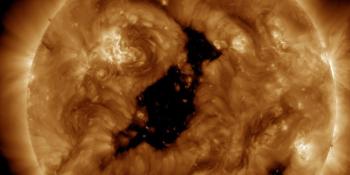
Coronal hole faces Earth

X1.5 solar flare

M2.7 solar flare, CME arrival possible
Aidez SpaceWeatherLive.com !
De nombreuses personnes consultent SpaceWeatherLive pour suivre l'activité solaire ou observer les aurores boréales, mais l'augmentation du trafic engendre des coûts plus élevés pour maintenir les serveurs en ligne. Si vous appréciez SpaceWeatherLive et souhaitez soutenir le projet, vous pouvez vous abonner pour un site sans publicité ou faire un don. Grâce à votre aide, SpaceWeatherLive restera accessible !



La Météo Spatiale en faits
| Dernière classe X | 03/06/2026 | X1.0 |
| Dernière classe M | 03/06/2026 | M7.9 |
| Dernier orage géomagnétique | 16/05/2026 | Kp6- (G2) |
| Jours sans taches solaires | |
|---|---|
| 365 derniers jours | 3 jours |
| 2026 | 3 jours (2%) |
| Dernier jour sans taches solaires | 24/02/2026 |
| Nombre mensuel moyen de taches solaires | |
|---|---|
| avril 2026 | 79.3 -6.6 |
| juin 2026 | 140 +60.7 |
| 30 derniers jours | 97.7 +4.1 |