Previsioni Meteorologiche Spaziali - Discussione
Emesso: 2026 May 15 0030 UTC
Preparati dal Dipartimento di Commercio degli Stati Uniti, NOAA, Centro di Previsione Meteorologica Spaziale e elaborati da SpaceWeatherLive.com
Attività solare
Sommario di 24 ore
Solar activity remained at low levels, with four active regions on disk and only C-class level activity. Region 4435 (N22W66, Dri/beta-gamma) was responsible for the most of the C-class flares, including the largest event: a C5.5/Sf peaking at 14/0642 UTC. Region 4436 (N18E02, Cao/beta) was stable this period and produced a C5.1 flare at 14/1840 UTC. Regions 4435 and 4438 (N20W44, Dao/beta) showed significant growth in the later half of the reporting period. An active filament was observed near N40W45 at approximately 14/1330 UTC. However, no discernable ejecta has been observed in coronagraph imagery at the time of this summary.Previsione
Solar activity is expected to remain predominately at low levels with a chance for M-class (R1-R2/Minor-Moderate) flares through 16 May, decreasing to a slight chance on 17 May.Particelle energetiche
Sommario di 24 ore
The greater than 2 MeV electron flux was at normal to moderate levels. The greater than 10 MeV proton flux was at background levels.Previsione
The greater than 2 MeV electron flux is expected to remain at moderate levels through 16 May, potentially reaching high levels on 17 May. The greater than 10 MeV proton flux is expected to stay at background levels through 17 May.Vento Solare
Sommario di 24 ore
The solar wind parameters reflected the waning effects of a positive polarity CH HSS. The total magnetic field strength decreased from 7 nT to 5 nT levels, with a minimum of 2 nT at 14/2149 UTC. The speeds also slowly dropped from about 450 km/s to a minimum of 375 km/s before starting to slowly accelerate again. The north-south Bz component reduced the amplitude of its oscillation to +- 5 nT, though it spent the majority of the reporting period oriented northward. The Phi angle was predominantly positive until 14/1948 UTC, when it flipped negative.Previsione
Solar wind parameters are expected to be enhanced from 15-17 May due to negative polarity CH HSS influences.Geospaziale
Sommario di 24 ore
The geomagnetic field was quiet to unsettled during the period.Previsione
G2 (Moderate) storming conditions are likely on 15 May due to the anticipated impact of a CIR associated with a negative polarity CH HSS. Active to G1 (Minor) storm levels are likely to prevail on 16-17 May due to lingering CH HSS influences.Ultime notizie
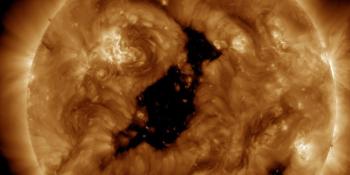
mercoledì, 13 maggio AM
Coronal hole faces Earth

lunedì, 30 marzo PM
X1.5 solar flare

martedì, 17 marzo PM
M2.7 solar flare, CME arrival possible
Ultimi messaggi dal forum
AR4436 169Coronal Hole 53 23Incoming & Unnumbered Active Regions 375Current Farside Activity 484Filaments and prominences 554
Altri argomentiSupporta SpaceWeatherLive.com!
A lot of people come to SpaceWeatherLive to follow the Solar activity or if there is a chance to see the aurora, but with more traffic comes higher costs to keep the servers online. If you like SpaceWeatherLive and want to support the project you can choose a subscription for an ad-free site or consider a donation. With your help we can keep SpaceWeatherLive online!



Notizie sul meteo spaziale
| Ultimo brillamento X | 2026/04/24 | X2.5 |
| Ultimo brillamento M | 2026/05/10 | M5.7 |
| Ultima tempesta geomagnetica | 2026/05/05 | Kp5 (G1) |
| Giorni senza macchie | |
|---|---|
| Ultimi 365 giorni | 3 giorni |
| 2026 | 3 giorni (2%) |
| Ultimo giorno senza macchie | 2026/02/24 |
| Media mensile Numero di Macchie Solari | |
|---|---|
| aprile 2026 | 79.3 -6.6 |
| maggio 2026 | 99.5 +20.2 |
| Ultimi 30 giorni | 96.3 +3.8 |
Questo giorno nella storia*
Aurora on this day in history
No observations submitted for this day in history. If you've observed the aurora and you have some amazing photos to show off, submit your observations now!
Submit your aurora observation