Przeglądasz Archiwum z wtorek, 25 lutego 2014
Codzienne wiadomości na temat aktywności słonecznej i geomagnetycznej z SIDC
Odnotowany: 2014 Feb 25 1240 UTC
Prognoza SIDC
Rozbłyski słoneczne
Active (M-class flares expected, probability >=50%)
Geomagnetyzm
Quiet (A<20 and K<4)
Monitoring przepływu protonów
Proton event expected (10 pfu at >10 MeV)
| strumień 10cm | Ap | |
|---|---|---|
| 25 Feb 2014 | 171 | 007 |
| 26 Feb 2014 | 171 | 017 |
| 27 Feb 2014 | 171 | 007 |
Skrót wiadomości
A X4.9 flare peaked Feb 25 00:49. This event occurred in NOAA AR 1990 close to the Solar East limb. This active region has lived through several solar rotations under the names AR 1967, AR1944 and AR1918. Given its current proximity to the Solar East limb, we cannot estimate well its magnetic configuration and complexity. Continued strong flaring activity would nevertheless not come as a surprise. The X4.9 flare was associated with a gradual SEP event but the (still rising) fluxes did not reach the event thresholds yet. We estimate that the 10 pfu > 10 MeV threshold will eventually be crossed in the coming days, especially if another strong event occurs, and a solar proton event is thus forecasted. The X4.9 flare was also associated with a strong & fast partial halo CME. Given the location of its source on the Solar East limb, we do not expect this CME to become geoeffective but a 'glancing blow' cannot be excluded. Another important region to follow up is the activity complex consisting of NOAA1982-Cat46 and NOAA1981-Cat45. Although this complex is shrinking in size, its magnetic complexity is increasing and major flaring is expected. Also NOAA1986-Cat48 and NOAA1989-Cat50 are capable of isolated M-class flares. Quiet geomagnetic conditions are expected.
Dzisiejsza szacunkowa międzynarodowa liczba plam na Słońcu (ISN): 123, na podstawie 07 stacji.Indeksy solarne na 24 Feb 2014
| Liczba Wolfa z Katanii | 164 |
| Fale radiowe 10,7 cm | 171 |
| AK Chambon La Forêt | 008 |
| AK Wingst | 005 |
| Szacunkowa Ap | 005 |
| Szacowana międzynarodowa liczba plam słonecznych | 117 - Na podstawie stacji 23 |
Podsumowanie wydarzeń godnych uwagi
| Dzień | Początek | Maksymalnie | Koniec | Lokalizacja | Siła | OP | 10cm | Katania/NOAA | Typy impulsów radiowych |
|---|---|---|---|---|---|---|---|---|---|
| 25 | 0039 | 0049 | 0103 | ---- | X4.9 | B | 3700 | 52/1990 | II/1V/2I/3 |
Dostarczone przez Centrum Analizy Danych Wpływów Słonecznych© - SIDC - Przetworzone przez SpaceWeatherLive
Wszystkie czasy w UTC
<< Idź do codziennego przeglądu
Najnowsze wiadomości
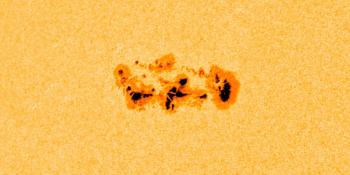
Complex sunspot region 4366

CME impact! S4 solar radiation storm

X1.9 solar flare with earth-directed CME
Najnowsze wiadomości z forum
Wesprzyj SpaceWeatherLive.com!
Wiele ludzi odwiedza stronę SpaceWeatherLive, aby śledzić aktywność słońca lub czy jest szansa na zobaczenie zorzy, ale większy ruch powoduje większe koszty utrzymania serwerów. Jeżeli podoba ci się strona SpaceWeatherLive i chciałbyś/chciałabyś wesprzeć ten projekt to możesz kupić subskrypcje aby uzyskać dostęp do strony bez reklam lub kupić darowiznę. Dzięki waszej pomocy, pomagacie utrzymać serwery SpaceWeatherLive!



Fakty na temat pogody kosmicznej
| Ostatnie rozbłyski klasy X | 2026/02/04 | X4.21 |
| Ostatnie rozbłyski klasy M | 2026/02/25 | M2.4 |
| Ostatnia burza geomagnetyczna | 2026/02/22 | Kp5+ (G1) |
| Dni bez plam słonecznych | |
|---|---|
| Ostatnie 365 dni | 3 Dni |
| 2026 | 3 Dni (5%) |
| Ostatni dzień bez plamy słonecznej | 2026/02/24 |
| Średnia miesięczna liczba plam słonecznych | |
|---|---|
| stycznia 2026 | 112.6 -11.4 |
| Ostatnie 30 dni | 73.8 -44.7 |