Przeglądasz Archiwum z środa, 2 kwietnia 2014
Codzienne wiadomości na temat aktywności słonecznej i geomagnetycznej z SIDC
Odnotowany: 2014 Apr 02 1244 UTC
Prognoza SIDC
Rozbłyski słoneczne
Eruptive (C-class flares expected, probability >=50%)
Geomagnetyzm
Active conditions expected (A>=20 or K=4)
Monitoring przepływu protonów
Quiet
| strumień 10cm | Ap | |
|---|---|---|
| 02 Apr 2014 | 153 | 022 |
| 03 Apr 2014 | 154 | 011 |
| 04 Apr 2014 | 154 | 007 |
Skrót wiadomości
Solar flaring activity was limited to about a dozen of low level C class flares. Most of them originated from NOAA AR 2026, with the strongest one peaking at 06:08 UT, April 2, at C3.5 level. Others originated from NOAA AR 2022, 2027, and 2029. The eruption of a filament located to the south-east of NOAA AR 2021, triggered a faint halo CME which was visible in LASCO COR 2 images from April 1, 16:48 UT onwards. The bulk of the CME was expelled in eastern direction and directed slightly south. CACTus software only detected multiple fragments of the event. The projected speed as estimated from Stereo B COR2 is about 300 km/s. Hence, the arrival of the perturbation can be expected around late April 4 and early April 6, probably only causing merely unsettled to active geomagnetic conditions. This halo CME was immediately followed by a faster partial halo CME, first visible in LASCO C2 images at 19:00 UT, April 1. In STEREO B COR2 the event is first visible at 19:25 UT. CACTus underestimated its angular width, which from manual detection is estimated to be around 160 degrees, with the main component directed in west southwest direction. It does not seem to be related to any front side activity and we therefore do not expect the CME to be geoeffective. However, since the event could neither be clearly related to any activity on the back side, the source of the CME remains yet undetermined. The solar wind speed is steady between 400 and 450 km/s with total field still around 5 nT. There are yet no signs of the expected arrival of the CMEs of March 28, 29, and 30. Unsettled conditions to minor storm levels can still be expected over the next days when/if these CMEs arrive.
Dzisiejsza szacunkowa międzynarodowa liczba plam na Słońcu (ISN): 083, na podstawie 16 stacji.Indeksy solarne na 01 Apr 2014
| Liczba Wolfa z Katanii | 109 |
| Fale radiowe 10,7 cm | 153 |
| AK Chambon La Forêt | 014 |
| AK Wingst | 005 |
| Szacunkowa Ap | 006 |
| Szacowana międzynarodowa liczba plam słonecznych | 074 - Na podstawie stacji 25 |
Podsumowanie wydarzeń godnych uwagi
| Dzień | Początek | Maksymalnie | Koniec | Lokalizacja | Siła | OP | 10cm | Katania/NOAA | Typy impulsów radiowych | |
|---|---|---|---|---|---|---|---|---|---|---|
| Żaden | ||||||||||
Dostarczone przez Centrum Analizy Danych Wpływów Słonecznych© - SIDC - Przetworzone przez SpaceWeatherLive
Wszystkie czasy w UTC
<< Idź do codziennego przeglądu
Najnowsze wiadomości
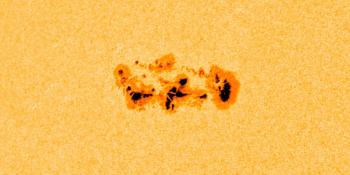
Complex sunspot region 4366

CME impact! S4 solar radiation storm

X1.9 solar flare with earth-directed CME
Najnowsze wiadomości z forum
Wesprzyj SpaceWeatherLive.com!
Wiele ludzi odwiedza stronę SpaceWeatherLive, aby śledzić aktywność słońca lub czy jest szansa na zobaczenie zorzy, ale większy ruch powoduje większe koszty utrzymania serwerów. Jeżeli podoba ci się strona SpaceWeatherLive i chciałbyś/chciałabyś wesprzeć ten projekt to możesz kupić subskrypcje aby uzyskać dostęp do strony bez reklam lub kupić darowiznę. Dzięki waszej pomocy, pomagacie utrzymać serwery SpaceWeatherLive!



Fakty na temat pogody kosmicznej
| Ostatnie rozbłyski klasy X | 2026/02/04 | X4.3 |
| Ostatnie rozbłyski klasy M | 2026/02/09 | M2.8 |
| Ostatnia burza geomagnetyczna | 2026/02/05 | Kp5+ (G1) |
| Dni bez plam słonecznych | |
|---|---|
| Ostatni dzień bez plamy słonecznej | 2022/06/08 |
| Średnia miesięczna liczba plam słonecznych | |
|---|---|
| stycznia 2026 | 112.6 -11.4 |
| lutego 2026 | 135.3 +22.7 |
| Ostatnie 30 dni | 129.4 +28.1 |