Przeglądasz Archiwum z niedziela, 20 kwietnia 2014
Codzienne wiadomości na temat aktywności słonecznej i geomagnetycznej z SIDC
Odnotowany: 2014 Apr 20 1445 UTC
Prognoza SIDC
Rozbłyski słoneczne
Active (M-class flares expected, probability >=50%)
Geomagnetyzm
Minor storm expected (A>=30 or K=5)
Monitoring przepływu protonów
Warning condition (activity levels expected to increase, but no numeric forecast given)
| strumień 10cm | Ap | |
|---|---|---|
| 20 Apr 2014 | 169 | 028 |
| 21 Apr 2014 | 172 | 012 |
| 22 Apr 2014 | 173 | 005 |
Skrót wiadomości
Twelve active regions were reported by NOAA today. Three of them (NOAA ARs 2034, 2035, and 2036) have beta-gamma configuration of the photospheric magnetic field. These three active regions and four others were responsible for numerous C-class flares yesterday and today. None of them was associated with an Earth-directed CME. The strongest flare of the past 24 hours was the C6.4 flare peaking at 08:13 UT today in the NOAA AR 2032 at the west solar limb. We expect further flaring activity on the C-level, with a good chance for an M-class event. After the arrival of the shock produced by the halo CME on April 18 (see below), the proton flux at energies above 10 MeV decreased to values below the threshold of the proton event. The proton flux, however, remains high, and in case of another solar eruption with associated SEPs, the event threshold could be easily crossed. We therefore issue a warning condition for a proton event. An interplanetary shock-like structure was detected this morning. ACE recorded jumps of solar wind speed, temperature, and the interplanetary magnetic filed (IMF) magnitude at 10:23 UT. SOHO/CELIAS detected a jump in density at 10:22 UT, but the jump in speed was detected only 20 to 30 minutes later. Therefore, this discontinuity does not seem to be a typical ICME- driven fast forward shock as ACE did not detect a jump in density at all, and jumps in density and the solar wind speed detected by SOHO/CELIAS were not simultaneous. There is, however, very little doubt that this is a start of an ICME corresponding to the halo CME observed on the Sun on April 18. During the intervals of the strongest IMF magnitude in the post-shock solar wind flow (up to 22 nT), the north-south IMF component Bz was either northward or close to zero. Unsettled geomagnetic conditions (K = 3) were reported by Dourbes and NOAA, and active conditions (K = 4) were reported by IZMIRAN. Currently the IMF magnitude is around 12 nT and the solar wind speed is around 650 km/s, so minor geomagnetic storm conditions (K = 5) are still possible.
Dzisiejsza szacunkowa międzynarodowa liczba plam na Słońcu (ISN): 138, na podstawie 17 stacji.Indeksy solarne na 19 Apr 2014
| Liczba Wolfa z Katanii | /// |
| Fale radiowe 10,7 cm | 169 |
| AK Chambon La Forêt | /// |
| AK Wingst | 014 |
| Szacunkowa Ap | 014 |
| Szacowana międzynarodowa liczba plam słonecznych | 129 - Na podstawie stacji 16 |
Podsumowanie wydarzeń godnych uwagi
| Dzień | Początek | Maksymalnie | Koniec | Lokalizacja | Siła | OP | 10cm | Katania/NOAA | Typy impulsów radiowych | |
|---|---|---|---|---|---|---|---|---|---|---|
| Żaden | ||||||||||
Dostarczone przez Centrum Analizy Danych Wpływów Słonecznych© - SIDC - Przetworzone przez SpaceWeatherLive
Wszystkie czasy w UTC
<< Idź do codziennego przeglądu
Najnowsze wiadomości

Happy New Year! Celebrate with an M7.1 solar flare!
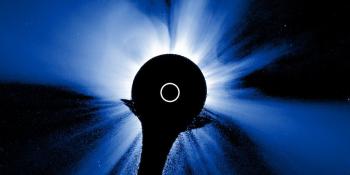
M8.1 solar flare with earth-directed CME
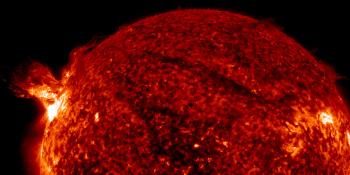
X1.9 solar flare, Coronal hole faces Earth
Najnowsze wiadomości z forum
Wesprzyj SpaceWeatherLive.com!
Wiele ludzi odwiedza stronę SpaceWeatherLive, aby śledzić aktywność słońca lub czy jest szansa na zobaczenie zorzy, ale większy ruch powoduje większe koszty utrzymania serwerów. Jeżeli podoba ci się strona SpaceWeatherLive i chciałbyś/chciałabyś wesprzeć ten projekt to możesz kupić subskrypcje aby uzyskać dostęp do strony bez reklam lub kupić darowiznę. Dzięki waszej pomocy, pomagacie utrzymać serwery SpaceWeatherLive!



Fakty na temat pogody kosmicznej
| Ostatnie rozbłyski klasy X | 2025/12/08 | X1.1 |
| Ostatnie rozbłyski klasy M | 2025/12/31 | M7.11 |
| Ostatnia burza geomagnetyczna | 2026/01/02 | Kp5 (G1) |
| Dni bez plam słonecznych | |
|---|---|
| Ostatni dzień bez plamy słonecznej | 2022/06/08 |
| Średnia miesięczna liczba plam słonecznych | |
|---|---|
| grudnia 2025 | 124 +32.2 |
| stycznia 2026 | 122 -2 |
| Ostatnie 30 dni | 111.1 +8.3 |