Przeglądasz Archiwum z czwartek, 11 września 2014
Wybierz potrzebny element z archiwum
Raporty
Aktywność słoneczna
Aktywność zorzowa
M2.1 and M1.4 solar flares from a sunspot region behind the limb
We are still excited following yesterday's X-class solar flare from sunspot region 2158 but there is another sunspot region that is demanding our attention: a new sunspot region on the eastern limb produced an M2.13 (R1-minor radio blackout) solar flare that peaked at 15:26 UTC and just now an impulsive M1.41 (R1-minor radio blackout) solar flare that peaked at 21:26 UTC. Image: the M2.1 solar flare as seen by NASA SDO.
Middle Latitude Auroral Activity Watch - 12 and 13 September 2014
Yesterday was an exciting day on the Sun. Sunspot region 2158 produced a long duration X1.6 (R3-strong) solar flare while directly facing Earth. Solar imagery suggested at the time that there could be a major Coronal Mass Ejection associated with the event. Now that we have coronagraph imagery from SOHO/LASCO we can conclude that she didn't disappoint.
Najnowsze wiadomości

X1.5 solar flare

M2.7 solar flare, CME arrival possible
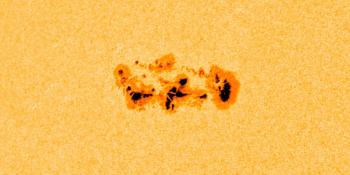
Complex sunspot region 4366
Najnowsze wiadomości z forum
Więcej tematówWesprzyj SpaceWeatherLive.com!
Wiele ludzi odwiedza stronę SpaceWeatherLive, aby śledzić aktywność słońca lub czy jest szansa na zobaczenie zorzy, ale większy ruch powoduje większe koszty utrzymania serwerów. Jeżeli podoba ci się strona SpaceWeatherLive i chciałbyś/chciałabyś wesprzeć ten projekt to możesz kupić subskrypcje aby uzyskać dostęp do strony bez reklam lub kupić darowiznę. Dzięki waszej pomocy, pomagacie utrzymać serwery SpaceWeatherLive!



Fakty na temat pogody kosmicznej
| Ostatnie rozbłyski klasy X | 2026/03/30 | X1.5 |
| Ostatnie rozbłyski klasy M | 2026/04/09 | M1.0 |
| Ostatnia burza geomagnetyczna | 2026/04/18 | Kp6- (G2) |
| Dni bez plam słonecznych | |
|---|---|
| Ostatnie 365 dni | 3 Dni |
| 2026 | 3 Dni (3%) |
| Ostatni dzień bez plamy słonecznej | 2026/02/24 |
| Średnia miesięczna liczba plam słonecznych | |
|---|---|
| marca 2026 | 85.9 +7.7 |
| kwietnia 2026 | 83.6 -2.3 |
| Ostatnie 30 dni | 92.3 +30.4 |