Przeglądasz Archiwum z niedziela, 22 lutego 2015
Codzienne wiadomości na temat aktywności słonecznej i geomagnetycznej z SIDC
Odnotowany: 2015 Feb 22 1243 UTC
Prognoza SIDC
Rozbłyski słoneczne
Eruptive (C-class flares expected, probability >=50%)
Geomagnetyzm
Active conditions expected (A>=20 or K=4)
Monitoring przepływu protonów
Warning condition (activity levels expected to increase, but no numeric forecast given)
| strumień 10cm | Ap | |
|---|---|---|
| 22 Feb 2015 | 115 | 010 |
| 23 Feb 2015 | 115 | 019 |
| 24 Feb 2015 | 115 | 009 |
Skrót wiadomości
Solar flaring activity at the Earth facing side was very low. The sunspot regions remained quite stable. Some minor development in the intermediate spots of NOAA active region 2290 was seen. A full halo CME was detected in SOHO LASCO/C2 (first measurement at 9:24 UT on February 21) and C3 (10:06 UT), which is believed to be associated to a backside event. The CME was followed by a few more narrow CMEs. The CME is asymmetric with the largest component heading to the southwest with a projected speed of 976 km/s (CACTus estimate). STEREO A EUVI images indicate flaring activity and the disappearance of the long filament located in the backside southern hemisphere. PROBA2/SWAP (start at 9:19 UT), SDO/AIA (9:24 UT) and GONG H alpha imagery observed the filament eruption as well. The proton flux (at > 10 MeV) has risen to enhanced levels starting around 12 UT, but did not pass the event threshold and is near 1 pfu. We set a warning condition for the further increase of the proton flux. The arrival of a backsided CME shock is possible. A filament eruption was visible in EUV imagery starting in PROBA2/SWAP at 18:09 UT on February 21, accompanied by a long-duration B7 flare. Flaring activity is expected to remain very low to low. Nominal solar wind conditions were observed, with the magnitude of the interplanetary magnetic field maximally at 7 nT. The solar wind speed decreased from 360 km/s to around 320 km/s. Geomagnetic conditions were quiet to unsettled (K=1 to 3) at the local level (Dourbes) and global level (estimated NOAA Kp), which is expected to continue till the arrival of the anticipated coronal hole high speed stream possibly resulting in active geomagnetic conditions within the next 24 hours (K=4, with a small chance for K=5).
Dzisiejsza szacunkowa międzynarodowa liczba plam na Słońcu (ISN): 030, na podstawie 08 stacji.Indeksy solarne na 21 Feb 2015
| Liczba Wolfa z Katanii | /// |
| Fale radiowe 10,7 cm | 116 |
| AK Chambon La Forêt | 014 |
| AK Wingst | 006 |
| Szacunkowa Ap | 006 |
| Szacowana międzynarodowa liczba plam słonecznych | 045 - Na podstawie stacji 14 |
Podsumowanie wydarzeń godnych uwagi
| Dzień | Początek | Maksymalnie | Koniec | Lokalizacja | Siła | OP | 10cm | Katania/NOAA | Typy impulsów radiowych | |
|---|---|---|---|---|---|---|---|---|---|---|
| Żaden | ||||||||||
Dostarczone przez Centrum Analizy Danych Wpływów Słonecznych© - SIDC - Przetworzone przez SpaceWeatherLive
Wszystkie czasy w UTC
<< Idź do codziennego przeglądu
Najnowsze wiadomości

X1.5 solar flare

M2.7 solar flare, CME arrival possible
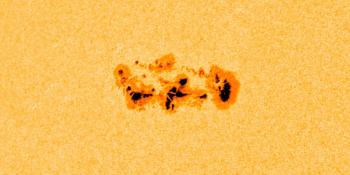
Complex sunspot region 4366
Najnowsze wiadomości z forum
Wesprzyj SpaceWeatherLive.com!
Wiele ludzi odwiedza stronę SpaceWeatherLive, aby śledzić aktywność słońca lub czy jest szansa na zobaczenie zorzy, ale większy ruch powoduje większe koszty utrzymania serwerów. Jeżeli podoba ci się strona SpaceWeatherLive i chciałbyś/chciałabyś wesprzeć ten projekt to możesz kupić subskrypcje aby uzyskać dostęp do strony bez reklam lub kupić darowiznę. Dzięki waszej pomocy, pomagacie utrzymać serwery SpaceWeatherLive!



Fakty na temat pogody kosmicznej
| Ostatnie rozbłyski klasy X | 2026/03/30 | X1.5 |
| Ostatnie rozbłyski klasy M | 2026/04/09 | M1.0 |
| Ostatnia burza geomagnetyczna | 2026/04/19 | Kp6- (G2) |
| Dni bez plam słonecznych | |
|---|---|
| Ostatnie 365 dni | 3 Dni |
| 2026 | 3 Dni (3%) |
| Ostatni dzień bez plamy słonecznej | 2026/02/24 |
| Średnia miesięczna liczba plam słonecznych | |
|---|---|
| marca 2026 | 85.9 +7.7 |
| kwietnia 2026 | 81 -4.9 |
| Ostatnie 30 dni | 94 +31.1 |