Przeglądasz Archiwum z wtorek, 20 kwietnia 2021
Codzienne wiadomości na temat aktywności słonecznej i geomagnetycznej z SIDC
Odnotowany: 2021 Apr 20 1251 UTC
Prognoza SIDC
Rozbłyski słoneczne
Quiet conditions (<50% probability of C-class flares)
Geomagnetyzm
Quiet (A<20 and K<4)
Monitoring przepływu protonów
Quiet
| strumień 10cm | Ap | |
|---|---|---|
| 20 Apr 2021 | 083 | 011 |
| 21 Apr 2021 | 080 | 010 |
| 22 Apr 2021 | 078 | 008 |
Skrót wiadomości
Two, out of several, sunspot groups observed on the visible side of the solar disc have during last 24 hours increased the complexity of their photospheric magnetic field configuration. Catania sunspot groups 87 and 86 (NOAA ARs 2816 and 2817) have presently beta configuration of their photospheric magnetic field. During last 24 hours 17 B-class and one M-class flare were reported, majority of them originating from the Catania sunspot group 86 (NOAA AR 2817). The M1.1 flare observed on April 19 (peaked at 23:42 UT), have originated from the Catania sunspot group 87 (NOAA AR 2816) which is presently still increasing the area and sunspot numbers. During coming hours we can expect B-class flares, and isolated C-class flares. The M-class flares are still possible but not very probable. The M 1.1 flare was associated with the EUV wave, coronal dimming, type II radio burst (indicating presence of a shock wave), and a rather diffuse CME. The CME had angular width of about 100 degrees and projected line of the sight speed of about 500 km/s (as reported by CACTUS software). Although the CME is not very wide, its source region is situated close to the solar disc center and the glancing blow still might be expected at Earth on April 23, although this is not very probable. During last 24 hours the proton flux levels remained at background values.
The greater than 2MeV electron flux still remains above the 1000 pfu threshold, and it is expected to remain above the threshold for long periods throughout April 20. The 24h electron fluence is at moderate levels and is expected to be in the range of moderate to high levels in the next 24 hours.
Earth is still inside the fast solar wind with the speed of about 590 km/s. The interplanetary magnetic field magnitude is 4 nT. Small, negative polarity equatorial coronal hole has reached central meridian this morning. The associated fast solar wind can be expected at Earth on April 23. Due to longer interval of the negative value of the Bz component of the interplanetary magnetic field, active geomagnetic conditions were reported in the evening of April 19 (from about 19 until 23 UT). The local station at Dourbe reported Kp=4 and NOAA reported K=4. Presently the geomagnetic conditions are quiet and we expect them to stay so in the coming hours.
Dzisiejsza szacunkowa międzynarodowa liczba plam na Słońcu (ISN): 055, na podstawie 23 stacji.Indeksy solarne na 19 Apr 2021
| Liczba Wolfa z Katanii | 032 |
| Fale radiowe 10,7 cm | 086 |
| AK Chambon La Forêt | 028 |
| AK Wingst | 018 |
| Szacunkowa Ap | 021 |
| Szacowana międzynarodowa liczba plam słonecznych | 035 - Na podstawie stacji 27 |
Podsumowanie wydarzeń godnych uwagi
| Dzień | Początek | Maksymalnie | Koniec | Lokalizacja | Siła | OP | 10cm | Katania/NOAA | Typy impulsów radiowych |
|---|---|---|---|---|---|---|---|---|---|
| 19 | 2319 | 2342 | 2359 | S24E25 | M1.1 | SN | 87/2816 | II/2III/2IV/1 |
Dostarczone przez Centrum Analizy Danych Wpływów Słonecznych© - SIDC - Przetworzone przez SpaceWeatherLive
Wszystkie czasy w UTC
<< Idź do codziennego przeglądu
Najnowsze wiadomości
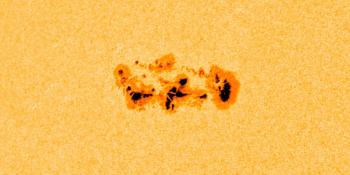
Complex sunspot region 4366

CME impact! S4 solar radiation storm

X1.9 solar flare with earth-directed CME
Najnowsze wiadomości z forum
Wesprzyj SpaceWeatherLive.com!
Wiele ludzi odwiedza stronę SpaceWeatherLive, aby śledzić aktywność słońca lub czy jest szansa na zobaczenie zorzy, ale większy ruch powoduje większe koszty utrzymania serwerów. Jeżeli podoba ci się strona SpaceWeatherLive i chciałbyś/chciałabyś wesprzeć ten projekt to możesz kupić subskrypcje aby uzyskać dostęp do strony bez reklam lub kupić darowiznę. Dzięki waszej pomocy, pomagacie utrzymać serwery SpaceWeatherLive!



Fakty na temat pogody kosmicznej
| Ostatnie rozbłyski klasy X | 2026/02/04 | X4.21 |
| Ostatnie rozbłyski klasy M | 2026/02/16 | M2.4 |
| Ostatnia burza geomagnetyczna | 2026/02/15 | Kp5+ (G1) |
| Dni bez plam słonecznych | |
|---|---|
| Ostatni dzień bez plamy słonecznej | 2022/06/08 |
| Średnia miesięczna liczba plam słonecznych | |
|---|---|
| stycznia 2026 | 112.6 -11.4 |
| lutego 2026 | 109 -3.6 |
| Ostatnie 30 dni | 126.1 +25.9 |