Przeglądasz Archiwum z niedziela, 13 października 2024
Codzienne wiadomości na temat aktywności słonecznej i geomagnetycznej z SIDC
Odnotowany: 2024 Oct 13 1231 UTC
Prognoza SIDC
Rozbłyski słoneczne
M-class flares expected (probability >=50%)
Geomagnetyzm
Quiet (A<20 and K<4)
Monitoring przepływu protonów
Warning condition (activity levels expected to increase, but no numeric forecast given)
| strumień 10cm | Ap | |
|---|---|---|
| 13 Oct 2024 | 214 | 011 |
| 14 Oct 2024 | 212 | 010 |
| 15 Oct 2024 | 210 | 010 |
Aktywne obszary słoneczne i rozbłyski
Solar flaring activity over the last 24 hours has been at low levels, with multiple C-class flares. The strongest flares were two C5.7 flares. The first one (SIDC Flare 2281), peaking at 20:05 UTC on October 12, was produced by SIDC Sunspot Group (SG) 279 (NOAA AR 3850, magnetic type alpha). The second (SIDC Flare 2283), peaking at 06:57 UTC on October 13, was produced by SIDC DG 217 (NOAA AR 3848, magnetic type beta-gamma). There are currently five numbered active regions on the solar disk, with SIDC SG 281 (NOAA AR 3852, magnetic type beta- delta) being the most complex one. SIDC SG 282 (NOAA AR 3853) has decayed into plage. A new, currently unnumbered active region has emerged in the northwest quadrant. The solar flaring activity is expected to be at moderate levels over the next 24 hours, with M-class flares expected and a small chance for X-class flares.
Koronalny wyrzut masy
A coronal mass ejection (CME) was detected in LASCO/C2 data, lifting off the west limb around 11:30 UTC on October 12. It is probably associated with flaring activity near or beyond the west limb. The CME is mostly propagating to the southwest. It is not expected to have an Earth-directed component. A partial halo CME was detected in LASCO/C2 and LASCO/C3 data at 01:21 UTC on October 13. It is probably associated with eruptive activity beyond the west limb. The CME is mostly propagating to the west, and it is not expected to have an Earth-directed component. No other Earth-directed CMEs were observed in the available coronagraph imagery.
Wiatr słoneczny
The solar wind conditions are returning to the slow solar wind regime. Speed values have decreased from around 620 km/s to 500 km/s. The interplanetary magnetic field values were mostly close to 5 nT. The Bz component varied between -3 nT and 4 nT. The interplanetary magnetic field angle was mostly in the negative sector. Mostly slow solar wind conditions are expected over the next 24 hours, with enhancements possible in case of the arrival of a mild, high-speed stream from the southern, positive polarity coronal hole that crossed the central meridian on October 10.
Geomagnetyzm
Geomagnetic conditions globally over the last 24 hours have decreased from unsettled (NOAA Kp 4) to quiet (NOAA Kp 1-2). Geomagnetic conditions locally were initially at minor storm levels (K BEL 5), later decreasing to active and unsettled levels (K BEL 4 to 3) and are currently at quiet levels (K BEL 2). Mostly quiet to unsettled geomagnetic conditions are expected globally and locally in the next 24 hours.
Poziomy przepływu protonów
The greater than 10 MeV proton flux has decreased below the 10 pfu threshold. The greater than 10 MeV proton flux is expected to remain below the threshold for the next 24 hours, pending further eruptive activity.
Strumienie elektronów na orbicie geostacjonarnej
The greater than 2 MeV electron flux as measured by GOES 16 and GOES 18 was enhanced during the last 24 hours, approaching the threshold but remaining below it. It is expected to remain so over the next 24 hours. The 24-hour electron fluence is presently at normal levels and is expected to remain so over the next 24 hours.
Dzisiejsza szacunkowa międzynarodowa liczba plam na Słońcu (ISN): 141, na podstawie 09 stacji.Indeksy solarne na 12 Oct 2024
| Liczba Wolfa z Katanii | /// |
| Fale radiowe 10,7 cm | 214 |
| AK Chambon La Forêt | 020 |
| AK Wingst | 021 |
| Szacunkowa Ap | 019 |
| Szacowana międzynarodowa liczba plam słonecznych | 131 - Na podstawie stacji 15 |
Podsumowanie wydarzeń godnych uwagi
| Dzień | Początek | Maksymalnie | Koniec | Lokalizacja | Siła | OP | 10cm | Katania/NOAA | Typy impulsów radiowych | |
|---|---|---|---|---|---|---|---|---|---|---|
| Żaden | ||||||||||
Dostarczone przez Centrum Analizy Danych Wpływów Słonecznych© - SIDC - Przetworzone przez SpaceWeatherLive
Wszystkie czasy w UTC
<< Idź do codziennego przeglądu
Najnowsze wiadomości
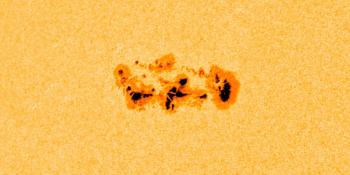
Complex sunspot region 4366

CME impact! S4 solar radiation storm

X1.9 solar flare with earth-directed CME
Najnowsze wiadomości z forum
Wesprzyj SpaceWeatherLive.com!
Wiele ludzi odwiedza stronę SpaceWeatherLive, aby śledzić aktywność słońca lub czy jest szansa na zobaczenie zorzy, ale większy ruch powoduje większe koszty utrzymania serwerów. Jeżeli podoba ci się strona SpaceWeatherLive i chciałbyś/chciałabyś wesprzeć ten projekt to możesz kupić subskrypcje aby uzyskać dostęp do strony bez reklam lub kupić darowiznę. Dzięki waszej pomocy, pomagacie utrzymać serwery SpaceWeatherLive!



Fakty na temat pogody kosmicznej
| Ostatnie rozbłyski klasy X | 2026/02/04 | X4.21 |
| Ostatnie rozbłyski klasy M | 2026/02/25 | M2.4 |
| Ostatnia burza geomagnetyczna | 2026/02/22 | Kp5+ (G1) |
| Dni bez plam słonecznych | |
|---|---|
| Ostatnie 365 dni | 3 Dni |
| 2026 | 3 Dni (5%) |
| Ostatni dzień bez plamy słonecznej | 2026/02/24 |
| Średnia miesięczna liczba plam słonecznych | |
|---|---|
| stycznia 2026 | 112.6 -11.4 |
| Ostatnie 30 dni | 72.7 -45.8 |