Przeglądasz Archiwum z wtorek, 11 listopada 2025
Codzienne wiadomości na temat aktywności słonecznej i geomagnetycznej z SIDC
Odnotowany: 2025 Nov 11 1255 UTC
Prognoza SIDC
Rozbłyski słoneczne
M-class flares expected (probability >=50%)
Geomagnetyzm
Quiet (A<20 and K<4)
Monitoring przepływu protonów
Proton event in progress (>10 MeV)
| strumień 10cm | Ap | |
|---|---|---|
| 11 Nov 2025 | 180 | 022 |
| 12 Nov 2025 | 180 | 051 |
| 13 Nov 2025 | 180 | 007 |
Aktywne obszary słoneczne i rozbłyski
Solar flaring activity was high over the past 24 hours. Eight numbered sunspot groups were on the disk. The largest flare was an X5.1 event that peaked at 10:04 UTC on 11 Nov from SIDC Sunspot Group 687 (NOAA AR 4274) at N23 W23. A Type II radio emission was observed around 10:40 UTC, which is associated with the X5.1 flare. Two M-class flares were also produced by this region: an M1.5 at 19:57 UTC on 10 Nov and an M1.4 at 08:09 UTC on 11 Nov. Solar flaring activity is expected to remain high over the next 24 hours, with M-class flares very likely and a chance for X-class flares.
Koronalny wyrzut masy
A full halo CME was observed on 10 Nov following the X1.2 flare (SIDC CME 559) from SIDC Sunspot Group 687 (NOAA AR 4274). The true radial speed is estimated at about 1300 km/s. The arrival of the associated interplanetary shock at Earth is expected late on 11 Nov to early on 12 Nov. A Type II radio emission alert was observed at 10:40 UTC on 11 Nov. This burst is associated with the X5.1 flare that peaked at 10:04 UTC from SIDC Sunspot Group 687 (NOAA AR 4274). Type II bursts are typically linked to shock-driven eruptions and often indicate an accompanying CME, from this an estimated shock speed of 1350 km/s was given. However, speed estimates from radiospectrography carry methodological uncertainties and should be treated as preliminary. Further analysis is ongoing as additional coronagraph imagery becomes available to refine the true speed and assess any Earth-directed component.
Dziury koronalne
SIDC Coronal Hole 126, an mid-north coronal hole with negative polarity, has returned on the disk and is currently situated on the western side of the Sun.
Wiatr słoneczny
During the last 24 hours the solar wind speed ranged around 410 to 590 km/s. The total interplanetary magnetic field, Bt ,varied between about 0.4 and 8.7 nT, while the southward component, Bz, ranged from roughly -4.6 nT to 6.4 nT. Conditions are expected to become disturbed late on 11 Nov into 12 Nov with the anticipated arrival of interplanetary coronal mass ejection (SIDC CME 559) associated with the X1.2 event (SIDC Flare 6010) that peaked on 10 November at 09:19 UTC, and produced by SIDC Sunspot Group 687 (NOAA Active Region 4274).
Geomagnetyzm
Geomagnetic activity was quiet to unsettled overall with periods of active constions. NOAA Kp reached 4 around 15 to 18 UTC on 10 Nov, otherwise 1 to 3. The Belgian K index similarly peaked near 4 in the late afternoon and briefly again around 23 to 00 UTC, then eased to 1 to 2 through the morning of 11 Nov. Over the next 24 hours, quiet to unsettled conditions are most likely, with isolated active periods possible if Bz turns persistently southward. Additional disturbances remain possible late on 11 to early 12 Nov with the expected CME arrival. The geomagnetic response will depend on the magnetic field orientation within the ejecta and could reach major storm levels (Kp 6 to Kp 7).
Poziomy przepływu protonów
The greater than 10 MeV GOES proton flux crossed the 10 pfu threshold at 11:30 UTC on 10 November following the X1.2 flare from SIDC Sunspot Group 687 and has remained at event levels since then. Around 10:00-10:10 UTC on 11 November, coincident with the X5.1 flare from the same region, the flux increased further. The higher energy channels responded promptly as well, with clear rises at ?50 MeV, ?100 MeV and a noticeable rise at ?500 MeV, indicating a hard-spectrum SEP component. Proton flux is expected to remain elevated over the next 24 hours, with additional enhancements possible if further major flares occur or as CME- driven shocks propagate from SIDC Sunspot Group 687 (NOAA Active Region 4274).
Strumienie elektronów na orbicie geostacjonarnej
The greater than 2 MeV electron flux measured by GOES 18 and GOES 19 was above the 1000 pfu at the start of the reporting period. The greater than 2 MeV electron flux is expected to fluctuate around the 1000 pfu threshold over the next 24 hours. The 24-hour electron fluence was at moderate levels, it is expected to remain at moderate levels over the next 24 hours.
Dzisiejsza szacunkowa międzynarodowa liczba plam na Słońcu (ISN): 150, na podstawie 07 stacji.
Indeksy solarne na 10 Nov 2025
| Liczba Wolfa z Katanii | /// |
| Fale radiowe 10,7 cm | 180 |
| AK Chambon La Forêt | /// |
| AK Wingst | 019 |
| Szacunkowa Ap | 014 |
| Szacowana międzynarodowa liczba plam słonecznych | 157 - Na podstawie stacji 15 |
Podsumowanie wydarzeń godnych uwagi
| Dzień | Początek | Maksymalnie | Koniec | Lokalizacja | Siła | OP | 10cm | Katania/NOAA | Typy impulsów radiowych |
|---|---|---|---|---|---|---|---|---|---|
| 10 | 1946 | 1957 | 2003 | N21W20 | M1.5 | 2N | --/4274 | VI/2 | |
| 11 | 0802 | 0809 | 0813 | N21W31 | M1.4 | SF | --/4274 | ||
| 11 | 0949 | 1004 | 1017 | ---- | X5.1 | --/4274 | II/3VI/3III/2 |
Dostarczone przez Centrum Analizy Danych Wpływów Słonecznych© - SIDC - Przetworzone przez SpaceWeatherLive
Wszystkie czasy w UTC
<< Idź do codziennego przeglądu
Najnowsze wiadomości
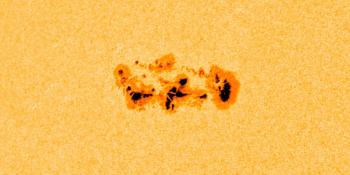
Complex sunspot region 4366

CME impact! S4 solar radiation storm

X1.9 solar flare with earth-directed CME
Najnowsze wiadomości z forum
Wesprzyj SpaceWeatherLive.com!
Wiele ludzi odwiedza stronę SpaceWeatherLive, aby śledzić aktywność słońca lub czy jest szansa na zobaczenie zorzy, ale większy ruch powoduje większe koszty utrzymania serwerów. Jeżeli podoba ci się strona SpaceWeatherLive i chciałbyś/chciałabyś wesprzeć ten projekt to możesz kupić subskrypcje aby uzyskać dostęp do strony bez reklam lub kupić darowiznę. Dzięki waszej pomocy, pomagacie utrzymać serwery SpaceWeatherLive!



Fakty na temat pogody kosmicznej
| Ostatnie rozbłyski klasy X | 2026/02/04 | X4.3 |
| Ostatnie rozbłyski klasy M | 2026/02/05 | M1.1 |
| Ostatnia burza geomagnetyczna | 2026/02/05 | Kp5+ (G1) |
| Dni bez plam słonecznych | |
|---|---|
| Ostatni dzień bez plamy słonecznej | 2022/06/08 |
| Średnia miesięczna liczba plam słonecznych | |
|---|---|
| stycznia 2026 | 112.6 -11.4 |
| lutego 2026 | 139.3 +26.7 |
| Ostatnie 30 dni | 124.9 +18 |