Просмотр архива за суббота, 21 июня 2003
Геофизический отчет
Любая солнечная вспышка, упомянутая в этом расчете, имеет масштабирующий коэффициент, применяемый Центром прогнозирования космической погоды (SWPC). Из-за него солнечные вспышки здесь на 42% слабее, чем в научных данных. Из наших архивов этот коэффициент был удален, чтобы показать реальные величины вспышек.
Обзор солнечной и геофизической активности 2003 Jun 21 0245 UTCПодготовлено NOAA © SWPC и представлено SpaceWeatherLive.com
Совместный обзор солнечной и геофизической активности USAF/NOAA
Количество SGAS 172 на уровне 0245Z 21 Jun 2003 Этот отчет составлен по данным, полученным в SWO, с 20 по JunA. Энергетические события
Начало    Maксимум    Конец    Регион    Место     X-ray     Op    245MHz    10cm     Переменный
1235 1235 1236                       110
B. Протонные события
Нет
C. Геомагнитная активность
The geomagnetic field was at
predominantly unsettled levels today as effects from the western
most recurrent coronal hole wanes. The greater than 2 MeV electron
flux at geosynchronous orbit reached high levels today.
D. Ионизация стратосферы
Нет
E. Ежесуточные индексы: (предварительные/оценочные значения в реальном масштабе времени)
10 cm 117  SSN 121  Afr/Ap 014/012   X-ray Background B2
Ежесуточный протоный поток (значение плотности потока в течение 24 часов)
GT 1 MeV MSG   GT 10 MeV MSG p/(cm2-ster-day)
(GOES - $ 1 синхронная спутниковая орбита от W до 113 градусов)
Ежесуточный электронный поток
GT 2 MeV MSG e/(cm2-ster-day)
(GOES - $ 1 синхронная спутниковая орбита от W до 75 градусов)
K-индексы на каждые 3-часа
Boulder 3 2 3 3 3 4 3 2 Planetary 3 2 3 3 3 3 3 3
F. Комментарии
  Нет
99999
PLAIN
K-Indices:
On 16 June, it was determined that a scaling problem exists with the Boulder magnetometer instrument.  While this problem, and its fix are being investigated the primary instrument for Boulder K-indices has been switched to the Boulder USGS (via Domsat) magnetometer, effective 1500 UTC on 16 June.

GOES Protons:
To ensure continued operational monitoring of important energetic particle data, it is necessary to reassign primary/secondary designations for the GOES Space Environment Monitor (SEM) detectors. GOES 11 (113W) is now the primary satellite for protons. GOES 12 will continue as the primary satellite for magnetometer, X-ray, and electron measurements. GOES 10 (135W) will be the secondary satellite for all SEM sensors - magnetometer, X-ray, and energetic particles.  Because of the degraded state of the proton data on GOES-10, its designation as the secondary source for proton data is a short-term solution.  More permanent solutions have been identified and are being evaluated.  Users will be notified when we define and schedule a permanent fix.  Further details can be found at http://www.sec.noaa.gov/GOES.html.
99999
Все время в UTC
<< Перейти на сегодняшнюю страницу обзора
Последние новости

вторник, 17 марта 2026
M2.7 solar flare, CME arrival possible
воскресенье, 1 февраля 2026
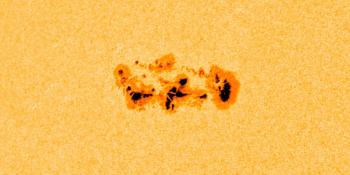
Complex sunspot region 4366

понедельник, 19 января 2026
CME impact! S4 solar radiation storm
Последние сообщения с форума
CMes from ar 4392 (19-21st of march) 163Current Farside Activity 424What, no CH/HSS thread? 57Incoming & Unnumbered Active Regions 228An interesting article about the suns dynamo 2
Больше темПоддержка SpaceWeatherLive.com!
A lot of people come to SpaceWeatherLive to follow the Solar activity or if there is a chance to see the aurora, but with more traffic comes higher costs to keep the servers online. If you like SpaceWeatherLive and want to support the project you can choose a subscription for an ad-free site or consider a donation. With your help we can keep SpaceWeatherLive online!



Факты о космической погоде
| Последняя X-вспышка | 04/02/2026 | X4.21 |
| Последняя M-вспышка | 18/03/2026 | M2.7 |
| Последняя геомагнитная буря | 20/03/2026 | Kp7- (G3) |
| Безупречные дни | |
|---|---|
| Последние 365 дней | 3 дней |
| 2026 | 3 дней (4%) |
| Последний безупречный день | 24/02/2026 |
| Среднемесячное количество солнечных пятен | |
|---|---|
| февраля 2026 | 78.2 -34.3 |
| марта 2026 | 77.5 -0.7 |
| Последние 30 дней | 63.5 -42.2 |