Просмотр архива за суббота, 30 октября 2004
Отчет о солнечной активности
Любая солнечная вспышка, упомянутая в этом расчете, имеет масштабирующий коэффициент, применяемый Центром прогнозирования космической погоды (SWPC). Из-за него солнечные вспышки здесь на 42% слабее, чем в научных данных. Из наших архивов этот коэффициент был удален, чтобы показать реальные величины вспышек.
Отчет о солнечно-геофизической активности 2004 Oct 30 2200 UTCПодготовлено NOAA © SWPC и представлено SpaceWeatherLive.com
Совместный отчет USAF/NOAA о солнечной и геофизической активности
Количество SD 304 на уровне 2200Z 30 Oct 2004IA. Анализ активных солнечных регионов и активности от 29 - 2100Z до 30 - 2100Z Solar activity was high. Region 691 (N14W25) grew
quickly at the end of yesterday, and emerging flux near the leader
spot fueled an instability that resulted in major flares.
Chronologically, Region 691 produced: a C9/Sf with type II sweep at
0049UTC, an M3/Sf with type II at 0333UTC, an M4/Sf TENFLARE with
types II and IV sweep at 0618UTC, an M3/1n with type II at 0928UTC,
an X1/Sf (partially obscured by clouds) TENFLARE with types II and
IV sweep at 1146UTC, and most recently an M5/Sn TENFLARE with type
II sweep at 1633UTC. Numerous large (i.e., 9500 sfu at 245 MHz at
1413UTC) radio bursts occurred throughout the period. A paucity of
LASCO observations made it difficult to discern if associated CMEs
occurred, but there seems to be an indication that at least some CME
activity did occur in conjunction with the latter flares. The region
seems to still retain an amount of potency making additional
significant activity likely. Elsewhere, Region 687 (N12W66) and
Region 693 (S16E34) each had an occasional small C-class flare as
both regions seemed to decay. New Region 695 (S16E68) was numbered.
IB. Прогноз солнечной активности
Solar activity is expected to be
moderate to high. Region 691 is still capable of producing M and X
class flares.
IIA. Обзор геофизической активности от 29 - 2100Z до 30 - 2100Z
The geomagnetic field was quiet to mildly active. Alfven waves in the
solar wind coupled with a slow increase in the radial speed caused
intervals of active conditions. The greater than 10 MeV proton flux
at geosynchronous orbit became enhanced around 0700UTC, in response
to earlier activity in Region 691. The flux has hovered near 1 pfu
for the past 16 hours.
IIB. Прогноз геофизической активности
The geomagnetic field is
expected to be generally unsettled for the next 36 hours. Activity
is expected to increase near midday on 01 November when effects of
shocks and CMEs are due, bringing active to periodic major storming
over the final 36 hours of the period. The greater than 10 MeV
proton flux may exceed event level if Region 691 produces more M and
X level activity. The region is in a well-connected location so this
proton increase would be abrupt should it occur.
III. Вероятность события от 31 - Oct до 02 - Nov
| M-класс | 60% | 60% | 60% |
| X-класс | 30% | 30% | 30% |
| Протон | 50% | 50% | 50% |
| PCAF | yellow | ||
IV. Радиоизлучение λ = 10,7см
  Наблюдаемый       30 Oct 136
  Прогнозируемый   31 Oct-02 Nov  135/135/130
  среднее значение за последние 3 месяца        30 Oct 106
V. Геомагнитные индексы
  Наблюдаемый Afr/Ap 29 Oct  006/007
  По оценкам     Afr/Ap 30 Oct  012/015
  Прогнозируемый    Afr/Ap 31 Oct-02 Nov  010/010-015/025-020/030
VI. Вероятность геомагнитной активности с 31 - Oct до 02 - Nov
| A. Средние широты | |||
|---|---|---|---|
| Активно | 25% | 35% | 40% |
| Слабый шторм | 15% | 20% | 25% |
| Большой шторм | 05% | 05% | 10% |
| B. Высокие широты | |||
|---|---|---|---|
| Активно | 30% | 40% | 45% |
| Слабый шторм | 15% | 25% | 35% |
| Большой шторм | 05% | 05% | 10% |
Все время в UTC
<< Перейти на сегодняшнюю страницу обзора
Последние новости
воскресенье, 1 февраля 2026
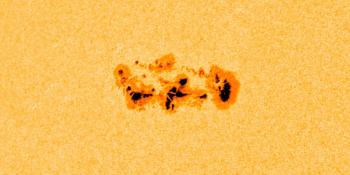
Complex sunspot region 4366

понедельник, 19 января 2026
CME impact! S4 solar radiation storm

воскресенье, 18 января 2026
X1.9 solar flare with earth-directed CME
Последние сообщения с форума
Current Farside Activity 388Solar Transit, Artifacts, or Radiation 82What, no CH/HSS thread? 54Changelog/Featurelog 178AR4374 20
Больше темПоддержка SpaceWeatherLive.com!
A lot of people come to SpaceWeatherLive to follow the Solar activity or if there is a chance to see the aurora, but with more traffic comes higher costs to keep the servers online. If you like SpaceWeatherLive and want to support the project you can choose a subscription for an ad-free site or consider a donation. With your help we can keep SpaceWeatherLive online!



Факты о космической погоде
| Последняя X-вспышка | 04/02/2026 | X4.21 |
| Последняя M-вспышка | 16/02/2026 | M2.4 |
| Последняя геомагнитная буря | 16/02/2026 | Kp6 (G2) |
| Безупречные дни | |
|---|---|
| Последний безупречный день | 08/06/2022 |
| Среднемесячное количество солнечных пятен | |
|---|---|
| января 2026 | 112.6 -11.4 |
| февраля 2026 | 106.5 -6.1 |
| Последние 30 дней | 123.7 +20 |