Просмотр архива за суббота, 15 января 2005
Отчет о солнечной активности
Любая солнечная вспышка, упомянутая в этом расчете, имеет масштабирующий коэффициент, применяемый Центром прогнозирования космической погоды (SWPC). Из-за него солнечные вспышки здесь на 42% слабее, чем в научных данных. Из наших архивов этот коэффициент был удален, чтобы показать реальные величины вспышек.
Отчет о солнечно-геофизической активности 2005 Jan 15 2200 UTCПодготовлено NOAA © SWPC и представлено SpaceWeatherLive.com
Совместный отчет USAF/NOAA о солнечной и геофизической активности
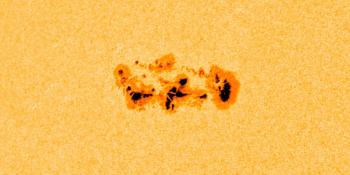
Количество SD 015 на уровне 2200Z 15 Jan 2005IA. Анализ активных солнечных регионов и активности от 14 - 2100Z до 15 - 2100Z Solar activity was at high levels. Large Region 720
(N13W03) produced three major flares this period, beginning with an
X1/1b flare at 15/0043Z. There was no CME associated with this
X-class flare. An impulsive M8 flare was observed at 15/0431Z, and
at 15/0638Z, the region produced the most significant event of the
period, a long duration M8 flare. This event had associated intense
radio emission including a 160,000 sfu burst on 410 MHz and moderate
to strong centimetric bursts including a 3000 sfu Tenflare. Type II
(1300 km/s) and Type IV radio sweeps were also observed, and the
energetic protons (>10 MeV) began to rise soon after the flare
maximum. SOHO/LASCO imagery revealed a fast full halo coronal mass
ejection. Region 720 is a large and magnetically complex sunspot
group with white light area coverage exceeding 1600 millionths.
Strong shear along an extended east-west inversion line in this
region was the focal point for the major flare activity. Region 718
(S07W21) produced an M3 flare at 15/1423Z with an associated 420 sfu
Tenflare and CME off the southwest limb.
IB. Прогноз солнечной активности
Solar activity is expected to continue
at moderate to high levels. Region 720 has potential for M and
X-class flares. An isolated M-class flare is also possible from
Region 718.
IIA. Обзор геофизической активности от 14 - 2100Z до 15 - 2100Z
The geomagnetic field ranged from unsettled to minor storm periods
with isolated major storm levels at high latitudes. A gradual rise
in the solar wind speed began early in the period, rising to a peak
speed near 700 km/s, before gradually declining to near 550 km/s.
The IMF Bz was predominantly southward during the first half of the
period, which accounted for the most disturbed conditions. A greater
than 10 MeV proton enhancement began soon after today's long
duration M8 flare. The protons did not exceed the 10 pfu threshold,
and remain elevated. The greater than 2 MeV electron flux at
geosynchronous orbit was at high levels.
IIB. Прогноз геофизической активности
The geomagnetic field is
expected to range from quiet to severe storm levels. Solar wind
remains elevated at near 500 Km/s which may produce isolated active
periods early on 16 January. A CME associated with today's long
duration M8 flare is expected to impact the geomagnetic field late
on 16 January into 17 January. Major to severe storm periods are
possible during this disturbance. Barring another Earth-directed
CME, the geomagnetic field will likely return to unsettled levels
with isolated active periods on 18 January.
III. Вероятность события от 16 - Jan до 18 - Jan
| M-класс | 85% | 85% | 85% |
| X-класс | 25% | 25% | 25% |
| Протон | 25% | 25% | 25% |
| PCAF | yellow | ||
IV. Радиоизлучение λ = 10,7см
  Наблюдаемый       15 Jan 145
  Прогнозируемый   16 Jan-18 Jan  145/150/150
  среднее значение за последние 3 месяца        15 Jan 106
V. Геомагнитные индексы
  Наблюдаемый Afr/Ap 14 Jan  011/012
  По оценкам     Afr/Ap 15 Jan  015/022
  Прогнозируемый    Afr/Ap 16 Jan-18 Jan  035/040-050/060-010/015
VI. Вероятность геомагнитной активности с 16 - Jan до 18 - Jan
| A. Средние широты | |||
|---|---|---|---|
| Активно | 40% | 50% | 30% |
| Слабый шторм | 25% | 30% | 10% |
| Большой шторм | 15% | 20% | 05% |
| B. Высокие широты | |||
|---|---|---|---|
| Активно | 50% | 40% | 40% |
| Слабый шторм | 30% | 35% | 20% |
| Большой шторм | 20% | 25% | 10% |
Все время в UTC
<< Перейти на сегодняшнюю страницу обзора
Последние новости

вторник, 17 марта 2026
M2.7 solar flare, CME arrival possible
воскресенье, 1 февраля 2026
Complex sunspot region 4366

понедельник, 19 января 2026
CME impact! S4 solar radiation storm
Последние сообщения с форума
Incoming & Unnumbered Active Regions 254AR4401 60Photographing auroras 234SDO Imagery is not updated? 6Current Farside Activity 437
Больше темПоддержка SpaceWeatherLive.com!
A lot of people come to SpaceWeatherLive to follow the Solar activity or if there is a chance to see the aurora, but with more traffic comes higher costs to keep the servers online. If you like SpaceWeatherLive and want to support the project you can choose a subscription for an ad-free site or consider a donation. With your help we can keep SpaceWeatherLive online!



Факты о космической погоде
| Последняя X-вспышка | 04/02/2026 | X4.21 |
| Последняя M-вспышка | 26/03/2026 | M4.0 |
| Последняя геомагнитная буря | 25/03/2026 | Kp5+ (G1) |
| Безупречные дни | |
|---|---|
| Последние 365 дней | 3 дней |
| 2026 | 3 дней (4%) |
| Последний безупречный день | 24/02/2026 |
| Среднемесячное количество солнечных пятен | |
|---|---|
| февраля 2026 | 78.2 -34.3 |
| марта 2026 | 81.4 +3.2 |
| Последние 30 дней | 80 -0.8 |