Просмотр архива за пятница, 20 июня 2014
Daily bulletin on solar and geomagnetic activity from the SIDC
Существующий: 2014 Jun 20 1237 UTC
SIDC Forecast
Солнечные вспышки
Eruptive (C-class flares expected, probability >=50%)
Geomagnetism
Quiet (A<20 and K<4)
Солнечные протоны
Quiet
| 10cm flux | Ap | |
|---|---|---|
| 20 Jun 2014 | 110 | 008 |
| 21 Jun 2014 | 108 | 004 |
| 22 Jun 2014 | 105 | 006 |
Bulletin
Six sunspot groups were reported by Catania today. Only three C-class flares took place during the past 24 hours, and all of them occurred in the Catania sunspot group 89 (that, together with the Catania sunspot group 90, constitutes the NOAA AR 2093). The strongest flare of this time interval was the C5.0 flare peaking today at 11:20 UT. The flare was accompanied by coronal dimmings and a post-eruption arcade indicating the eruption of a CME. However, no coronagraph data are available at the moment to confirm the CME occurrence. We expect further flaring activity on the C-level, mostly from this sunspot group, with an M-class flare being possible but not very likely. A partial halo CME was detected by SOHO/LASCO on June 19, first appearing in the LASCO C2 field of view at 19:24 UT (first frame after a long data gap). The CME had the angular width of around 190 degrees and projected plane-of-the-sky speed of around 400 km/s. The CME was produced by the eruption of a filament to the north of the Catania sunspot groups 89 and 90 (together constituting the NOAA AR 2093), starting around 14:25 UT as seen by SDO/AIA. The eruption was also accompanied by coronal dimmings and a post-erution arcade. It was followed by a perhaps related C4.0 flare peaking at 19:24 UT in the Catania sunspot group 89. This flare was, in turn, accompanied by a narrow CME first appearing in the LASCO C2 field of view at 19:48 UT. This narrow CME is not expected to arrive at the Earth. An interplanetary disturbance associated with the partial halo CME is expected to arrive at the Earth late on June 23 or early on June 24, most probably only with a glancing blow. It may result in active to perhaps minor storm geomagnetic conditions. The Earth is currently inside a slow (around 430 km/s) solar wind flow with slightly elevated (around 6 nT) interplanetary magnetic field magnitude. The geomagnetic conditions are quiet and are expected to remain so.
Today's estimated international sunspot number (ISN): 054, based on 17 stations.Solar indices for 19 Jun 2014
| Wolf number Catania | 114 |
| 10cm solar flux | 111 |
| AK Chambon La Forêt | 016 |
| AK Wingst | 012 |
| Estimated Ap | 013 |
| Estimated international sunspot number | 065 - Based on 24 stations |
Noticeable events summary
| Day | Begin | Max | Конец | Loc | Strength | OP | 10cm | Catania/NOAA | Radio burst types | |
|---|---|---|---|---|---|---|---|---|---|---|
| Нет | ||||||||||
Provided by the Solar Influences Data analysis Center© - SIDC - Processed by SpaceWeatherLive
Все время в UTC
<< Перейти на сегодняшнюю страницу обзора
Последние новости
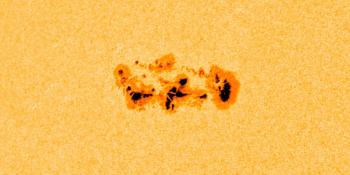
Complex sunspot region 4366

CME impact! S4 solar radiation storm

X1.9 solar flare with earth-directed CME
Последние сообщения с форума
Поддержка SpaceWeatherLive.com!
A lot of people come to SpaceWeatherLive to follow the Solar activity or if there is a chance to see the aurora, but with more traffic comes higher costs to keep the servers online. If you like SpaceWeatherLive and want to support the project you can choose a subscription for an ad-free site or consider a donation. With your help we can keep SpaceWeatherLive online!



Факты о космической погоде
| Последняя X-вспышка | 02/02/2026 | X1.6 |
| Последняя M-вспышка | 02/02/2026 | M2.4 |
| Последняя геомагнитная буря | 28/01/2026 | Kp5+ (G1) |
| Безупречные дни | |
|---|---|
| Последний безупречный день | 08/06/2022 |
| Среднемесячное количество солнечных пятен | |
|---|---|
| декабря 2025 | 124 +32.2 |
| февраля 2026 | 97 -27 |
| Последние 30 дней | 118.3 +3.5 |