Просмотр архива за понедельник, 30 ноября 2020
Daily bulletin on solar and geomagnetic activity from the SIDC
Существующий: 2020 Nov 30 1330 UTC
SIDC Forecast
Солнечные вспышки
C-class flares expected, (probability >=50%)
Geomagnetism
Active conditions expected (A>=20 or K=4)
Солнечные протоны
Quiet
| 10cm flux | Ap | |
|---|---|---|
| 30 Nov 2020 | 120 | 014 |
| 01 Dec 2020 | 122 | 021 |
| 02 Dec 2020 | 122 | 021 |
Bulletin
Solar activity was dominated by an M4 flare peaking at 13:11UT from over the East limb from an unnumbered region that is about to rotate onto the visible disc. Apart from the M flare X-ray flux remained below C level. There are currently 6 regions on disc of which NOAA AR 2786 (Beta-gamma) has the largest flaring potential, although it remained fairly stable over the past 24h. Other regions are less complex and show less flaring potential. The most uncertain factor is the region that is about to rotate onto the disc but which can not be analysed yet. Overall, one needs to factor in a considerable probability (40%) for further M flares with also a very slight possibility of an X-flare.
The M4 flare was associated with a type II radio burst and EUV wave. And in SoHO/LASCO C2 a corresponding CME is visible from around 13:25UT (the true time of emergence in C2 view must be in the data gap between 12:48UT and 13:25UT). The CME is directed well toward the East of the Sun-Earth line with a projected speed of around 1500 km/s. While the bulk is directed off the Sun-Earth line the associated shock wave leaves an asymmetric full halo signature in SoHO/LASCO C2 and C3 imagery. The bulk of the CME is hence not expected to arrive to Earth, and the CME is most probably even directed backward. However, given the uncertainty in its exact direction a glancing blow and arrival of the shock wave can not fully be excluded. If this is the case it should be expected late December 1 or early December 2.
No other Earth directed CMEs have been recorded.
The greater than 10MeV proton flux as measured by GOES rose slowly over the morning to around 3 pfu. It is not expected to rise much further although that can not be excluded. The greater than 2MeV electron flux exceeded the 1000 pfu alert threshold during its diurnal maximum, and this may occur again today. The 24h electron fluence was at moderate levels and is expected to be at normal to moderate levels over the next 24 hours. Overall a decreasing trend was expected although the current Solar wind increase of unknown origin may be changing that forecast if it persists.
Solar wind conditions rose unexpectedly. Especially over the morning, Solar wind speed increased to now around 530 km/s. During the rise, magnetic field reached a peak of 12nT, while Bz remained mostly positive. Total magnetic field has meanwhile declined to low values. The magnetic field phi angle jumped from the positive (away from the Sun) into the negative (towards the Sun) sector. As no clear origin of this increase could be identified we expect a slow return to nominal conditions as the transient passes. Should any shock from the December 29 CME arrive to Earth this could occur late December 1 or early December 2.
Geomagnetic conditions were quiet to unsettled (both local K Dourbes and NOAA Kp 0-3). Geomagnetic conditions are expected to be unsettled with possibly active periods given the current increased solar wind speed, and the possible CME shock arrival tomorrow.
Today's estimated international sunspot number (ISN): 074, based on 11 stations.Solar indices for 29 Nov 2020
| Wolf number Catania | /// |
| 10cm solar flux | 116 |
| AK Chambon La Forêt | 009 |
| AK Wingst | 003 |
| Estimated Ap | 003 |
| Estimated international sunspot number | 083 - Based on 20 stations |
Noticeable events summary
| Day | Begin | Max | Конец | Loc | Strength | OP | 10cm | Catania/NOAA | Radio burst types |
|---|---|---|---|---|---|---|---|---|---|
| 29 | 1234 | 1311 | 1341 | ---- | M4.4 | 240 | --/---- | VI/2II/2III/1 |
Provided by the Solar Influences Data analysis Center© - SIDC - Processed by SpaceWeatherLive
Все время в UTC
<< Перейти на сегодняшнюю страницу обзора
Последние новости
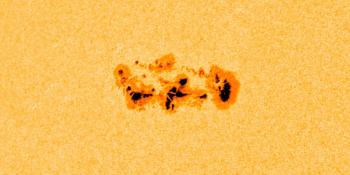
Complex sunspot region 4366

CME impact! S4 solar radiation storm

X1.9 solar flare with earth-directed CME
Последние сообщения с форума
Поддержка SpaceWeatherLive.com!
A lot of people come to SpaceWeatherLive to follow the Solar activity or if there is a chance to see the aurora, but with more traffic comes higher costs to keep the servers online. If you like SpaceWeatherLive and want to support the project you can choose a subscription for an ad-free site or consider a donation. With your help we can keep SpaceWeatherLive online!



Факты о космической погоде
| Последняя X-вспышка | 03/02/2026 | X1.5 |
| Последняя M-вспышка | 03/02/2026 | M3.4 |
| Последняя геомагнитная буря | 28/01/2026 | Kp5+ (G1) |
| Безупречные дни | |
|---|---|
| Последний безупречный день | 08/06/2022 |
| Среднемесячное количество солнечных пятен | |
|---|---|
| декабря 2025 | 124 +32.2 |
| февраля 2026 | 133 +9 |
| Последние 30 дней | 120.6 +10.9 |