Просмотр архива за среда, 21 февраля 2024
Daily bulletin on solar and geomagnetic activity from the SIDC
Существующий: 2024 Feb 21 1231 UTC
SIDC Forecast
Солнечные вспышки
Quiet conditions (<50% probability of C-class flares)
Geomagnetism
Quiet (A<20 and K<4)
Солнечные протоны
Quiet
| 10cm flux | Ap | |
|---|---|---|
| 21 Feb 2024 | 150 | 008 |
| 22 Feb 2024 | 148 | 010 |
| 23 Feb 2024 | 146 | 010 |
Solar Active Regions and flaring
Solar flaring activity over the past 24 hours was at low levels. The largest flare was a C4.4-flare, with peak time 02:17 UTC on February 21, associated with a yet unnumbered active region behind the east-limb on the southern hemisphere of the Sun. There are currently 3 numbered active regions on the visible disk. NOAA AR 3590 (beta-gamma) is the largest and most magnetically complex region but has only produced minor C-class flares in the last 24 hours. NOAA AR 3586 (beta) has been stable and inactive. NOAA AR 3584 has decreased in size and is rotating over the west limb. The solar flaring activity is likely to be at low levels over the coming days with C-class flares expected and M-class flares possible.
Выбросы корональной массы
No Earth directed Coronal Mass Ejections (CME)s, have been observed in the last 24 hours. Further analysis of the CME seen in LASCO C2 data one at 23:24 UTC on February 19, shows it is not expected to impact the Earth.
Солнечный ветер
Slow solar wind conditions were recorded over the past 24 hours. The solar wind speed as measured by ACE, gently declined from around 460 km/s to around 270 km/s. The interplanetary magnetic field fluctuated between 2 nT and 9 nT, with the Bz reaching a minimum value of -6 nT. The phi-angle was in the positive sector (directed away the Sun) with periods on the negative sector. In the next 24-hours slow solar wind conditions are expected.
Geomagnetism
Geomagnetic conditions were globally and locally quiet (Kp 3 and K Bel 3) with some unsettled periods over the past 24 hours.
Proton flux levels
Over the past 24 hours the greater than 10 MeV GOES proton flux continued to decrease and, although still slightly elevated, remained below the 10 pfu threshold. The proton flux is expected to continue to decrease over the next 24 hours.
Electron fluxes at geostationary orbit
The greater than 2 MeV GOES 16 electron flux was below the 1000 pfu threshold and is expected to remain so in the upcoming days. The 24h electron fluence was at nominal level and is expected to remain so in the next days.
Today's estimated international sunspot number (ISN): 050, based on 11 stations.Solar indices for 20 Feb 2024
| Wolf number Catania | /// |
| 10cm solar flux | 153 |
| AK Chambon La Forêt | 012 |
| AK Wingst | 007 |
| Estimated Ap | 006 |
| Estimated international sunspot number | 049 - Based on 24 stations |
Noticeable events summary
| Day | Begin | Max | Конец | Loc | Strength | OP | 10cm | Catania/NOAA | Radio burst types | |
|---|---|---|---|---|---|---|---|---|---|---|
| Нет | ||||||||||
Provided by the Solar Influences Data analysis Center© - SIDC - Processed by SpaceWeatherLive
Все время в UTC
<< Перейти на сегодняшнюю страницу обзора
Последние новости

M2.7 solar flare, CME arrival possible
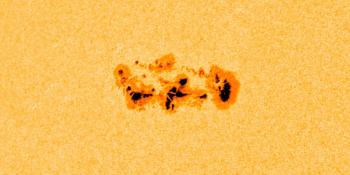
Complex sunspot region 4366

CME impact! S4 solar radiation storm
Последние сообщения с форума
Больше темПоддержка SpaceWeatherLive.com!
A lot of people come to SpaceWeatherLive to follow the Solar activity or if there is a chance to see the aurora, but with more traffic comes higher costs to keep the servers online. If you like SpaceWeatherLive and want to support the project you can choose a subscription for an ad-free site or consider a donation. With your help we can keep SpaceWeatherLive online!



Факты о космической погоде
| Последняя X-вспышка | 04/02/2026 | X4.21 |
| Последняя M-вспышка | 28/03/2026 | M1.3 |
| Последняя геомагнитная буря | 25/03/2026 | Kp5+ (G1) |
| Безупречные дни | |
|---|---|
| Последние 365 дней | 3 дней |
| 2026 | 3 дней (3%) |
| Последний безупречный день | 24/02/2026 |
| Среднемесячное количество солнечных пятен | |
|---|---|
| февраля 2026 | 78.2 -34.3 |
| марта 2026 | 85.2 +7 |
| Последние 30 дней | 85.2 +9.8 |