Просмотр архива за суббота, 25 октября 2025
Daily bulletin on solar and geomagnetic activity from the SIDC
Существующий: 2025 Oct 25 1231 UTC
SIDC Forecast
Солнечные вспышки
C-class flares expected, (probability >=50%)
Geomagnetism
Quiet (A<20 and K<4)
Солнечные протоны
Quiet
| 10cm flux | Ap | |
|---|---|---|
| 25 Oct 2025 | 133 | 017 |
| 26 Oct 2025 | 135 | 017 |
| 27 Oct 2025 | 137 | 043 |
Solar Active Regions and flaring
Solar flaring activity was low over the past 24 hours, with several C-class flares recorded. The largest flare was a C1.6 flare (SIDC Flare 5872), peaking at 10:23 UTC on October 25, associated with SIDC Sunspot Group 653 (NOAA Active Region 4267; magnetic type alpha). There are currently seven numbered active regions on the visible solar disc. SIDC Sunspot Group 653 (NOAA Active Region 4267) was the main driver of the flaring activity observed over the past 24 hours, together with SIDC Sunspot Group 672 (NOAA Active Region 4256). SIDC Sunspot Group 607 (NOAA Active Region 4254; magnetic type alpha) is approaching the west limb. A new region emerged and was numbered SIDC Sunspot Group 683 (magnetic type beta) near S12E51, but remained quiet. The remaining active regions are relatively simple (magnetic type alpha or beta) and did not produce any significant flaring activity. Solar flaring activity is expected to be low over the next 24 hours, with C-class flares very likely and a small chance for M-class flares.
Выбросы корональной массы
The faint coronal mass ejection (SIDC CME 586) was observed in SOHO/LASCO-C2 imagery, starting at 14:36 UTC on October 23 and first reported yesterday. While the bulk of the ejecta is expected to miss Earth, a mild glancing blow could be possible on October 27. No other Earth-directed CMEs were detected in the available coronagraph imagery over the past 24 hours.
Корональные отверстия
A large recurrent positive polarity coronal hole (SIDC Coronal Hole 134) reached the central meridian at around 12:00 UTC today. An associated high-speed stream may affect the solar wind environment near Earth from late October 27.
Солнечный ветер
Over the past 24 hours, solar wind parameters (ACE and DSCOVR) reflected the waning influence of a high-speed stream (HSS). The solar wind speed decreased from 580 to 430 km/s. The interplanetary magnetic field remained weak, below 6 nT, and its southward component fluctuated between -6 nT and 6 nT. A gradual transition to slow solar wind conditions is expected over the next few days, with a chance of a weak enhancement from October 27 due to the possible glancing blow from SIDC CME 586 and the arrival of a high-speed stream from a large positive polarity coronal hole (SIDC Coronal Hole 134).
Geomagnetism
Geomagnetic conditions reached active levels globally (NOAA Kp = 4) between 03:00 and 06:00 UTC on October 25 and locally over Belgium (K-Bel = 4) at around 18:00 UTC on October 24, due to mild HSS influence. Mostly unsettled geomagnetic conditions are expected over the next 24 hours. On October 27-28, geomagnetic conditions are expected to reach active and minor storm levels, with a chance of isolated moderate storm periods due to the expected HSS and a possible glancing blow from SIDC CME 586.
Proton flux levels
The greater than 10 MeV GOES proton flux was below the 10 pfu threshold level over the past 24 hours and is expected to remain so for the next 24 hours.
Electron fluxes at geostationary orbit
The greater than 2 MeV electron flux measured by GOES 18 and GOES 19 was below the 1000 pfu threshold. The greater than 2 MeV electron flux is expected to remain below the 1000 pfu threshold over the next 24 hours. The 24-hour electron fluence was at normal levels and is expected to be at normal levels over the next 24 hours.
Today's estimated international sunspot number (ISN): 099, based on 07 stations.
Solar indices for 24 Oct 2025
| Wolf number Catania | 105 |
| 10cm solar flux | 134 |
| AK Chambon La Forêt | 020 |
| AK Wingst | 012 |
| Estimated Ap | 012 |
| Estimated international sunspot number | 098 - Based on 26 stations |
Noticeable events summary
| Day | Begin | Max | Конец | Loc | Strength | OP | 10cm | Catania/NOAA | Radio burst types | |
|---|---|---|---|---|---|---|---|---|---|---|
| Нет | ||||||||||
Provided by the Solar Influences Data analysis Center© - SIDC - Processed by SpaceWeatherLive
Все время в UTC
<< Перейти на сегодняшнюю страницу обзора
Последние новости
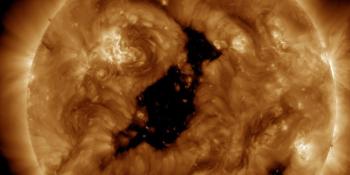
Coronal hole faces Earth

X1.5 solar flare

M2.7 solar flare, CME arrival possible
Последние сообщения с форума
Поддержка SpaceWeatherLive.com!
A lot of people come to SpaceWeatherLive to follow the Solar activity or if there is a chance to see the aurora, but with more traffic comes higher costs to keep the servers online. If you like SpaceWeatherLive and want to support the project you can choose a subscription for an ad-free site or consider a donation. With your help we can keep SpaceWeatherLive online!



Факты о космической погоде
| Последняя X-вспышка | 24/04/2026 | X2.5 |
| Последняя M-вспышка | 02/06/2026 | M1.2 |
| Последняя геомагнитная буря | 16/05/2026 | Kp6- (G2) |
| Безупречные дни | |
|---|---|
| Последние 365 дней | 3 дней |
| 2026 | 3 дней (2%) |
| Последний безупречный день | 24/02/2026 |
| Среднемесячное количество солнечных пятен | |
|---|---|
| апреля 2026 | 79.3 -6.6 |
| июня 2026 | 146 +66.7 |
| Последние 30 дней | 97.9 +6 |