Просмотр архива за четверг, 13 ноября 2025
Daily bulletin on solar and geomagnetic activity from the SIDC
Существующий: 2025 Nov 13 1245 UTC
SIDC Forecast
Солнечные вспышки
C-class flares expected, (probability >=50%)
Geomagnetism
Active conditions expected (A>=20 or K=4)
Солнечные протоны
Quiet
| 10cm flux | Ap | |
|---|---|---|
| 13 Nov 2025 | 161 | 017 |
| 14 Nov 2025 | 155 | 019 |
| 15 Nov 2025 | 150 | 021 |
Solar Active Regions and flaring
Solar flaring activity was low over the past 24 hours, with only C-class flares identified. SIDC Sunspot Group (SG) 687 (NOAA Active Region [AR] 4274, Beta-Gamma-Delta magnetic configuration) produced most of the flaring activity. Among its activity was the brightest flare of the past 24 hours (SIDC flare 6035), a C6 that peaked on 13 Nov at 03:34 UTC. The only other flare-emitting region was SIDC SG 689 (NOAA AR 4276, Beta-Gamma magnetic configuration). It emitted two flares including the second and highest peak of the double-peaked SIDC flare 6055 on 13 Nov at 06:40 UTC. In the next 24 hours more C-class flaring activity is expected with a chance of an M-class flare from SIDC SG 687.
Выбросы корональной массы
SIDC Sunspot Group 687 (NOAA Active Region 4274) produced two Coronal Mass Ejections on 13 Nov at 00:24 UTC and at 03:48 UTC. As the later is significantly faster than the former, they are expected to merge and deliver a glancing blow at Earth's environment on 15 Nov at the first half.
Солнечный ветер
Solar Wind (SW) conditions were in the process of subsiding when another Coronal Mass Ejection (SIDC CME 600) arrived at Earth on 12 Nov at 18:50 UTC, as predicted. The SW speed had dropped to 600 km/s before the latest arrival but after the event increased to 1000 km/s and now registers values at around 850 km/s. The interplanetary magnetic field (B) peaked at 40 nT at the arrival of the CME but rapidly decreased and is now at the 10 nT. The B's North-South component (Bz) fluctuated between -17 and 28 nT between 12 Nov 18:50 UTC and 13 Nov 04:00 UTC but has since rapidly converged to close to zero values. The effects of the new CME arrival appear to be short-lived hence the magnetic field is expected to be weak in the next 24 hours. However, the SW speed is expected to decline very slowly and remain well above the 700 km/s level.
Geomagnetism
The global geomagnetic conditions were at storm levels almost throughout the past 24 hours. More specifically they reached major storm levels (NOAA Kp 7+ and 7-) on 13 Nov between 00:00 UTC and 06:00 UTC. Moderate storm conditions (NOAA Kp 6) were registered on 12 Nov at 18:00-21:00 UTC and on 13 Nov at 06:00-09:00 UTC. Minor storm conditions (NOAA Kp 5+ and 5-) prevailed for the remaining of the past 24 hours, with the exception of the active levels observed on 13 Nov at 09:00-12:00 UTC. The local geomagnetic conditions were significantly milder with minor storm conditions (K BEL 5) only recorded on 13 Nov at 00:00-03:00 UTC. Unsettled to active conditions (K BEL 3-4) were registered during the rest of the past 24 hours. The global geomagnetic conditions are expected to significantly relax in the next 24 hours and range between minor storm and active levels. The local geomagnetic conditions are expected to continue to be milder and reach up to active levels.
Proton flux levels
During the past 24 hours the greater than 10 MeV proton flux, as measured by the GOES-19 satellite, dropped very significantly and is now above but close to the 10 pfu threshold. The greater than 100 MeV proton flux has also decreased significantly and now is well below the 10 pfu threshold. The greater than 500 MeV has reached background noise levels during the past 24 hours. For the next 24 hours the greater than 10 MeV proton flux is expected to drop below the 10 pfu level and the greater than 100 MeV proton flux is expected to reach background noise levels.
Electron fluxes at geostationary orbit
The greater than 2 MeV electron flux as measured by GOES 19 was below the 1000 pfu alert threshold during the past 24 hours. It is expected to remain below the alert level in the next 24 hours. The 24-hour electron fluence was at moderate levels, it is expected to remain at moderate levels over the next 24 hours.
Today's estimated international sunspot number (ISN): 134, based on 11 stations.Solar indices for 12 Nov 2025
| Wolf number Catania | /// |
| 10cm solar flux | 163 |
| AK Chambon La Forêt | 094 |
| AK Wingst | 130 |
| Estimated Ap | 149 |
| Estimated international sunspot number | 141 - Based on 18 stations |
Noticeable events summary
| Day | Begin | Max | Конец | Loc | Strength | OP | 10cm | Catania/NOAA | Radio burst types | |
|---|---|---|---|---|---|---|---|---|---|---|
| Нет | ||||||||||
Provided by the Solar Influences Data analysis Center© - SIDC - Processed by SpaceWeatherLive
Все время в UTC
<< Перейти на сегодняшнюю страницу обзора
Последние новости
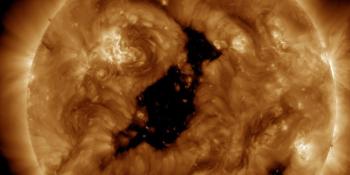
Coronal hole faces Earth

X1.5 solar flare

M2.7 solar flare, CME arrival possible
Последние сообщения с форума
Больше темПоддержка SpaceWeatherLive.com!
A lot of people come to SpaceWeatherLive to follow the Solar activity or if there is a chance to see the aurora, but with more traffic comes higher costs to keep the servers online. If you like SpaceWeatherLive and want to support the project you can choose a subscription for an ad-free site or consider a donation. With your help we can keep SpaceWeatherLive online!



Факты о космической погоде
| Последняя X-вспышка | 03/06/2026 | X1.0 |
| Последняя M-вспышка | 03/06/2026 | M7.9 |
| Последняя геомагнитная буря | 16/05/2026 | Kp6- (G2) |
| Безупречные дни | |
|---|---|
| Последние 365 дней | 3 дней |
| 2026 | 3 дней (2%) |
| Последний безупречный день | 24/02/2026 |
| Среднемесячное количество солнечных пятен | |
|---|---|
| апреля 2026 | 79.3 -6.6 |
| июня 2026 | 139.5 +60.2 |
| Последние 30 дней | 96.2 +2.6 |